

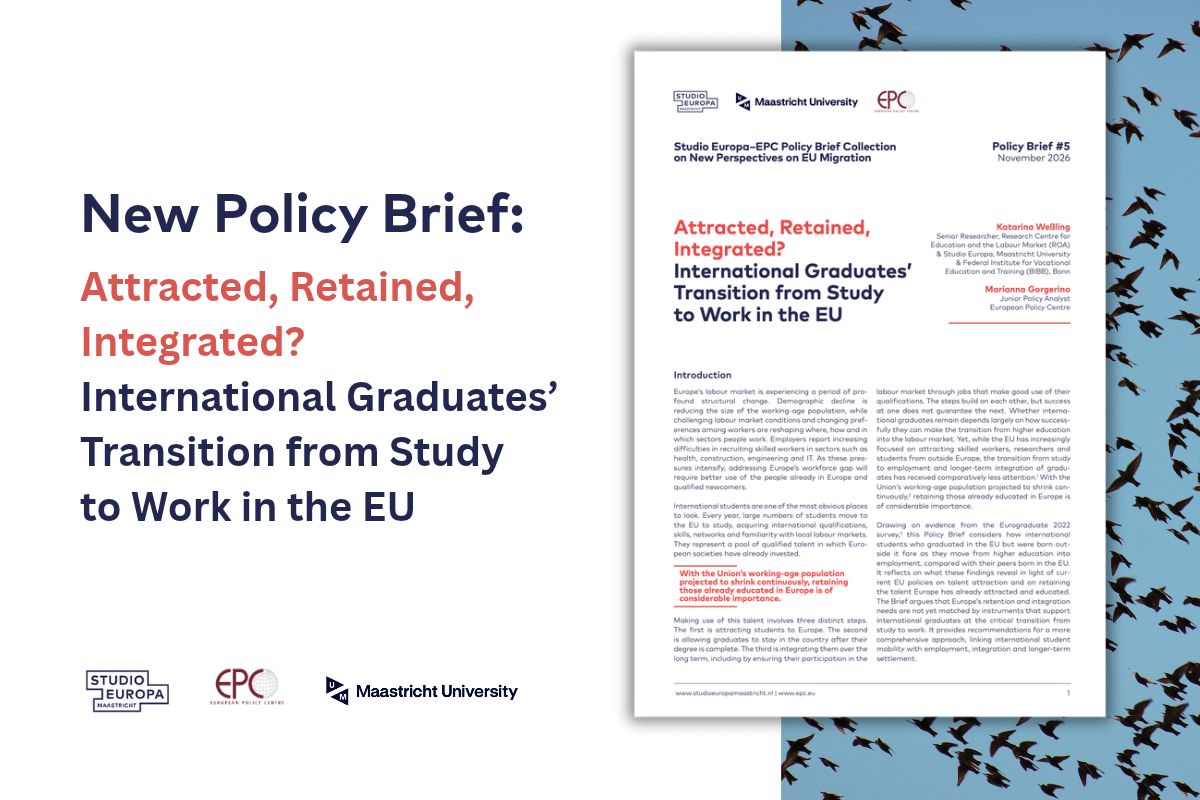
Attracted, Retained, Integrated? International Graduates’ Transition from Study to Work in the EU


With the EU’s working-age population projected to shrink continuously in the coming decades, Europe’s future competitiveness will depend, in part, on its ability to make the most of its talent and skills.
A new EPC and Studio Europa Maastricht Policy Brief examines how EU graduates move from higher education into employment, drawing on evidence from the Eurograduate survey. It finds that graduates born outside the EU face a markedly more difficult transition into the labour market than their peers. They are more likely to experience unemployment, work in jobs below their qualification level and report lower job satisfaction.
Main conclusions:
- Existing EU frameworks on talent attraction, integration and youth employment do not adequately address the specific challenges that migrant graduates face such as limited residence security, weaker professional networks, language barriers and discriminatory hiring practices.
- The successor to the 2021–2027 Action Plan on Integration and Inclusion should target EU-educated migrant graduates with professional language training, mentoring, career guidance and access to networks.
- The EU should address residence-related barriers to long-term integration. Counting time spent in the EU as a student or trainee fully towards long-term resident status would shorten the path to secure status, while encouraging graduates to build their futures in the host country and employers to invest in their skills.
- Employer-facing initiatives such as job-placement support, mentoring and apprenticeships should be extended to EU-educated migrant graduates and paired with concrete anti-discrimination measures.
Policies should focus on creating conditions in which migrant graduates are able to enter employment on equal terms and make full use of the skills they acquired in Europe.
The support the European Policy Centre receives for its ongoing operations, or specifically for its publications, does not constitute an endorsement of their contents, which reflect the views of the authors only. Supporters and partners cannot be held responsible for any use that may be made of the information contained therein.