


EU Talent Partnerships: From humanitarian dependence to refugee self-reliance?
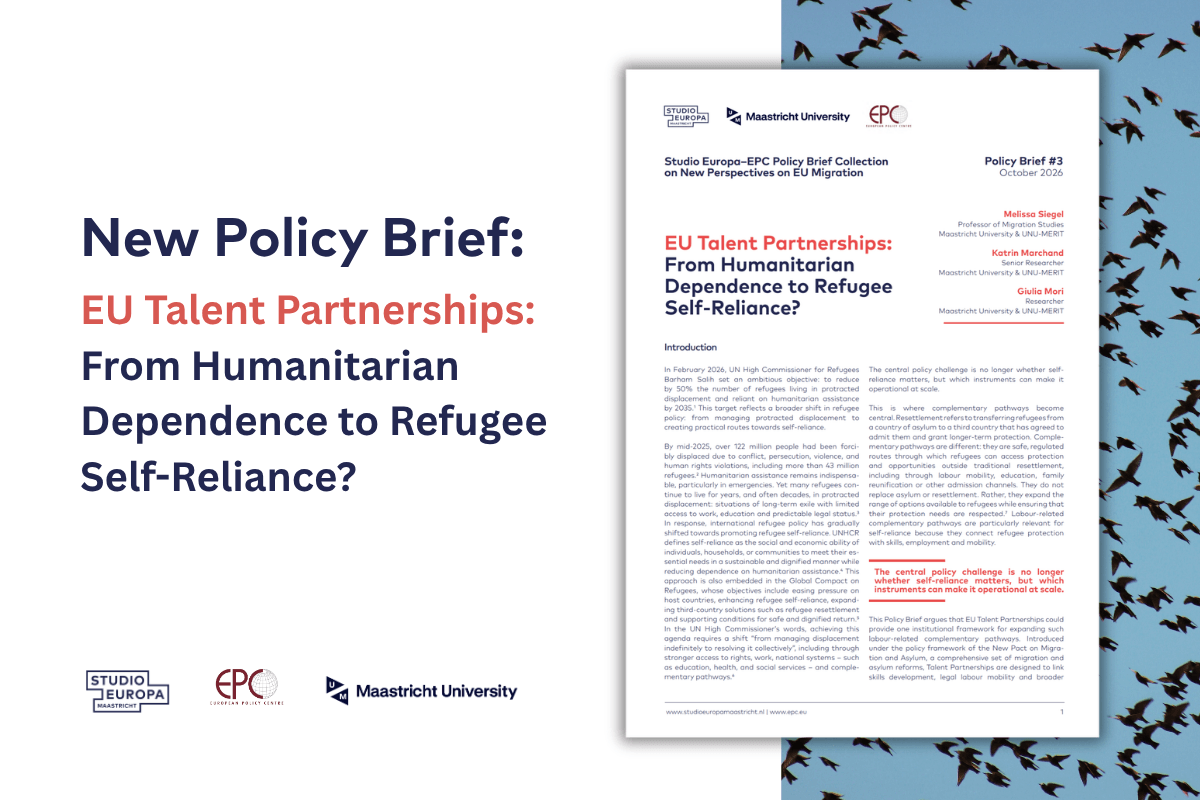
In February 2026, UN High Commissioner for Refugees Barham Salih set an ambitious objective: to reduce by 50% the number of refugees living in protracted displacement and reliant on humanitarian assistance by 2035. This target reflects a broader shift in refugee policy: from managing protracted displacement to creating practical routes towards self-reliance.
In the UN High Commissioner’s words, achieving this agenda requires a shift “from managing displacement indefinitely to resolving it collectively”, including through stronger access to rights, work, national systems – such as education, health, and social services – and complementary pathways.
The central policy challenge is no longer whether self-reliance matters, but which instruments can make it operational at scale.
This is where complementary pathways become central. They do not replace asylum or resettlement. Rather, they expand the range of options available to refugees while ensuring that their protection needs are respected. Labour-related complementary pathways are particularly relevant for self-reliance because they connect refugee protection with skills, employment and mobility.
This Policy Brief argues that EU Talent Partnerships could provide one institutional framework for expanding such labour-related complementary pathways. Introduced under the policy framework of the New Pact on Migration and Asylum, a comprehensive set of migration and asylum reforms, Talent Partnerships are designed to link skills development, legal labour mobility and broader migration cooperation with partner countries. At the policy level, the European Commission has recognised that Talent Partnerships may also benefit displaced persons. In practice, however, mobility opportunities have largely focused on nationals of partner countries. Refugees residing in those same countries have remained marginal to the framework, even where partner countries are also major refugee hosts.
Read the full Policy Brief here.
The support the European Policy Centre receives for its ongoing operations, or specifically for its publications, does not constitute an endorsement of their contents, which reflect the views of the authors only. Supporters and partners cannot be held responsible for any use that may be made of the information contained therein.

