



The forces threatening liberal democracy are not simply an extreme version of the political right. Their ideologies are contradictory, their populism often fraudulent and their ambitions fundamentally destructive. They sit outside the traditional political spectrum.
The term ‘far right’ is misleading. It suggests a coherent ideology at one end of the political spectrum. But today’s anti-democratic movements can accommodate fascists, nationalists, religious fundamentalists, social conservatives, misogynists, racists, extreme individualists and many other groups. Their beliefs frequently contradict each other.
This is not about the political right, including strongly conservative views, as a whole. It is a different phenomenon, transcending the left–right divide.
What unites these forces is not ideology but purpose. They oppose social progress, pluralism, equality and democratic constraints on power. They are defined less by what they want to build than by what they seek to destroy.
For many, ideology is a disguise. Behind proclaimed populism and traditional values lie personal ambition, unchecked power and corruption. Contradictions do not matter when beliefs are instruments rather than principles.
Even describing these forces as illiberal or undemocratic does not go far enough. Their worldview is Hobbesian: a brutal struggle in which force determines outcomes, the strong dominate the weak, and they expect to emerge on top. Social Darwinism without collective progress.
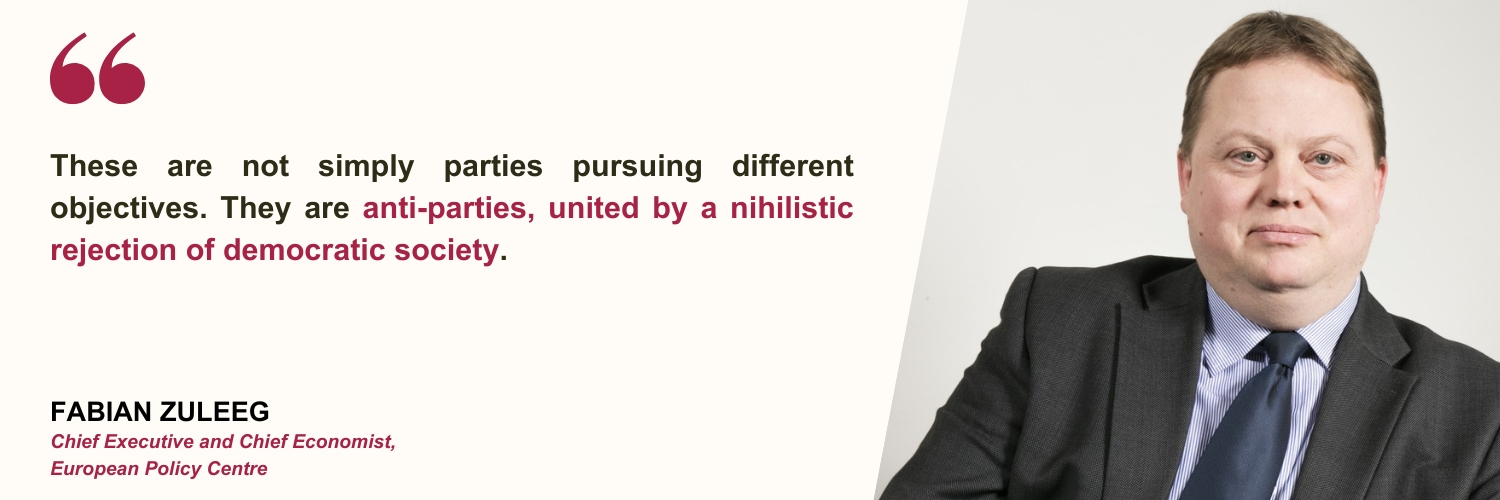
These are not simply parties pursuing different objectives. They are anti-parties, united by a nihilistic rejection of democratic society. Their politics is misanthropic, treating solidarity, cooperation and human progress as weaknesses.
Calling them the far right normalises them as another political tendency. The threat is not merely to liberal democracy, but to the very possibility of a society built on mutual respect, shared rules and human progress.
Fabian Zuleeg is Chief Executive and Chief Economist at the European Policy Centre.
The support the European Policy Centre receives for its ongoing operations, or specifically for its publications, does not constitute an endorsement of their contents, which reflect the views of the authors only. Supporters and partners cannot be held responsible for any use that may be made of the information contained therein.