


EU–Morocco partnership at 30: adaptation under geopolitical strain
The 15th EU–Morocco Association Council, held on 29 January 2026, reaffirmed the durability of a decades-old partnership while exposing the geopolitical pressures shaping relations. Beyond celebratory statements, the Council revealed a reactive logic, in which strategic and security considerations are mobilised to manage immediate challenges rather than to articulate a long-term vision.
Meeting on the eve of the 30th anniversary of the EU-Morocco Association Agreement, European and Moroccan leaders stressed continuity, mutual trust and the strategic nature of their cooperation. At the same time, discussions pointed to an expanded agenda: over three decades, relations have moved beyond trade to encompass security, migration, climate action and regional diplomacy, with Brussels long framing Morocco as a key partner in its Southern Neighbourhood.
This framing was reinforced by Morocco's Minister of Foreign Affairs, Nasser Bourita, who situated the partnership within what he described as a “world of uncertainty and conflict”. Against this backdrop, the Council placed increasing emphasis on improving the operational effectiveness of cooperation across a wide range of policy areas, reflecting a pragmatic, security-first orientation.
Nowhere was this shift more evident than in migration and security cooperation, which remain central pillars of the relationship. Launched in Barcelona last November, the EU’s new Pact for the Mediterranean forms part of a broader effort to recalibrate Euro–Mediterranean relations around shared responsibility. This aligns with the EU's Global Gateway Initiative, an infrastructure project presented as an alternative to the Belt and Road Initiative which focuses on connectivity, investment and human development while supporting continued cooperation on shared priorities, including migration.
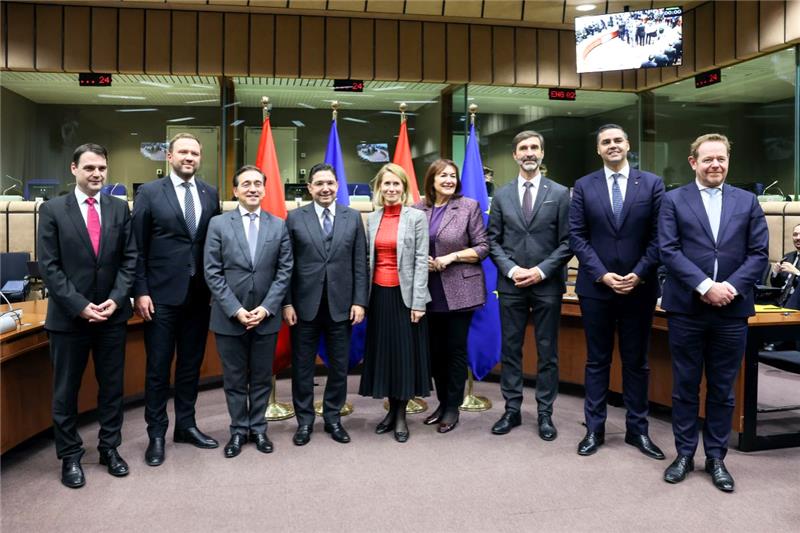 Consilium, EU-Morocco Association Council 29 January 2026.
However, cooperation rests on asymmetric foundations: the EU's influence stems less from formal mechanisms than from its economic weight and normative agenda as Morocco's largest trading partner and a key source of grants and investment. Morocco's strategic value for the EU, by contrast, lies in its geographical position and role in migration control, counterterrorism and regional stability.
These dynamics explain the emphasis placed on security cooperation beyond existing frameworks. In this context, the Council called for closer coordination to combat terrorism and promote security and prosperity in the Sahel, further anchoring migration within a wider security-driven agenda.
Geopolitics was visible in discussions on Gaza and Ukraine, albeit largely on the level of political declarations. On the Middle East, the EU and Morocco reiterated their support for a two-state solution and acknowledged Morocco's role through the Al Quds Committee, chaired by King Mohammed VI, reflecting established diplomatic language. On Ukraine, both sides reaffirmed their commitment to the principles of sovereignty and territorial integrity. EU High Representative Kaja Kallas noted that response to Russia’s aggression is not territorially limited, as shadow fleet operations and mercenary activity take place across the Mediterranean and Africa – even if this logic has yet to translate into concrete EU–Morocco coordination.
However, the issue of the Western Sahara continues to limit meaningful political convergence. The Western Sahara, a region claimed by Morocco since 1975, is a former Spanish colony whose status remains unresolved under international law. Although the EU referenced Morocco's autonomy proposal in line with recent UN Security Council resolutions, it continues to support UN-led negotiations, with any decision based on referendum. The issue will likely persist, casting a shadow over relations and resurfacing through past controversies, including allegations of attempts to influence European Parliament positions on Western Sahara.
As EU–Morocco relations enter their fourth decade, the challenge will be to ensure that continuity does not slide into complacency. For Brussels, maintaining credibility as a global partner requires preventing migration and security cooperation from eclipsing broader political and socio-economic engagement. Rabat, meanwhile, seeks recognition not merely as a neighbour, but as an ally in shaping a clear and durable vision for the partnership.
Imane Bouali is an Event and Communication Assistant at the European Policy Centre.
The support the European Policy Centre receives for its ongoing operations, or specifically for its publications, does not constitute an endorsement of their contents, which reflect the views of the authors only. Supporters and partners cannot be held responsible for any use that may be made of the information contained therein.

