


The EU’s response to Ceuta: the first stress test after the Pact reforms?


The entry of an estimated 60,000 people – mainly of Moroccan origin - into the Spanish exclaves of Ceuta and Melilla has triggered a major political drama. The sheer scale overwhelmed the Spanish authorities, while speculation about the causes has dominated early reporting and political debate. At the same time, the incident has been seized to justify further changes before current rules on solidarity and border pressures have been stress-tested.
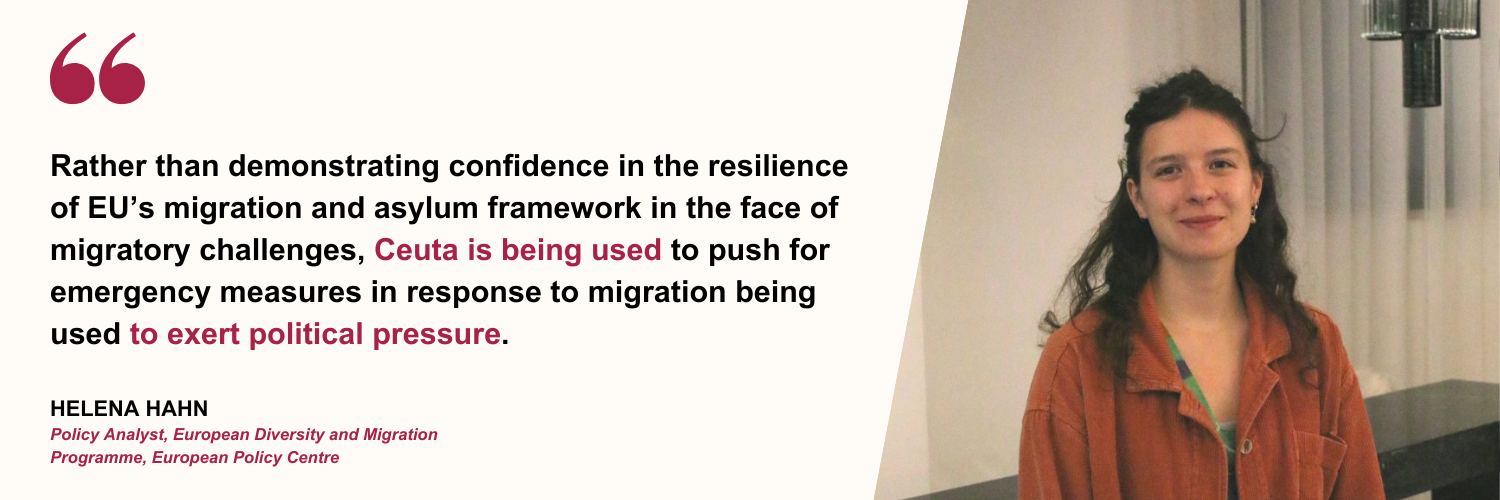
Following vigorous debate and accusations via letters and public statements, EU interior ministers met informally to discuss the situation in Ceuta, converging on intensified counter-smuggling efforts and stronger third-country cooperation, and reinforced returns. Prior to the meeting, Spain demanded greater solidarity, calling for an EU-wide response. In contrast, Italy, Germany, Greece and others signalled a willingness to treat Ceuta as previous crises by reverting to restrictive Schengen measures and measures to suspend access to asylum. Rather than demonstrating confidence in the resilience of EU’s migration and asylum framework in the face of migratory challenges, Ceuta is being used to push for emergency measures in response to migration being used to exert political pressure.
Proponents of externalisation will use Ceuta as an example of why further deterrence measures, notably ‘return hubs’, are needed. Yet, five days into the incident, there are no signs of a prolonged crisis even as several thousand remain on Spanish territory. Instead, the events risk becoming a useful distraction from Pact implementation, diverting attention from the challenges that lie ahead.
After the 12 June deadline for Pact implementation, official communication and early reporting have exposed uneven levels of preparedness among member states in key elements of the reforms. Under the new rules of the Common European Asylum System (CEAS), member states must ensure the ability to swiftly deal with processing at the border and channel people into the appropriate procedures, including return. Moreover, the first full cycle of solidarity will commence with the Commission’s assessment of migratory pressures and solidarity needs in October, which has already proven a delicate and difficult endeavour. Although the scale of the incident in Ceuta far exceeded previous pressure situations faced by Spain, the Pact is precisely designed for member states like Spain to be better equipped to deal with similar situations.
The Ceuta incident not only underscores that the EU cannot afford internal divisions and tensions over migration. As a first stress test following the Pact reforms, it highlights the need for further investments into implementation and doubling down on achieving greater CEAS resilience.
Helena Hahn is a Policy Analyst within the European Diversity and Migration programme.
The support the European Policy Centre receives for its ongoing operations, or specifically for its publications, does not constitute an endorsement of their contents, which reflect the views of the authors only. Supporters and partners cannot be held responsible for any use that may be made of the information contained therein.