

From feed to food: Financing farmers’ protein diversification

Europe’s agrifood system faces growing pressures from climate change, biodiversity loss and import dependencies. Agriculture accounts for around 13% of the EU’s total greenhouse gas (GHG) emissions, with the livestock sector responsible for 84% of Europe’s food-related GHG emissions and receiving over 80% of the EU’s Common Agricultural Policy (CAP) support. Around 80% of the land needed to feed EU citizens is devoted to raising animals and growing their feed, yet 75% of EU farm animals are kept in intensive systems that depend heavily on imported protein crops. This exposes farmers directly to price volatility driven by supply chain disruptions, especially in the age of climate shocks and intense geopolitical rivalries, such as the Russian invasion of Ukraine and the recent war in Iran.
Scaling plant-based protein production for human consumption, supplying feedstock for plant-based foods and precision fermentation, and adopting agroecological systems that combine protein crops with lower livestock densities can reduce emissions, cut import dependence, strengthen farmer resilience and open new revenue streams. Yet many European agricultural producers face significant barriers, including high upfront investment costs, infrastructure locked into intensive livestock systems, skills gaps, insufficient storage and processing capacity, and uncertain markets. In 2022, the unmet demand for financing among EU farmers reached €62 billion, disproportionately affecting small farms and young farmers.
Several current policy processes present a timely opportunity to build a coherent financial framework to support farmers in diversifying protein production. These include negotiations on the post-2027 CAP and Multiannual Financial Framework (MFF), the Commission’s expected EU Protein Plan and Livestock Strategy, the ongoing revision of the Public Procurement Directive and the defence-oriented Readiness 2030 programme. Meanwhile, the EU-Mercosur Partnership Agreement, signed in January 2026,9 adds urgency to the debate over the competitiveness of EU livestock production and reinforces the case for investing in protein diversification.
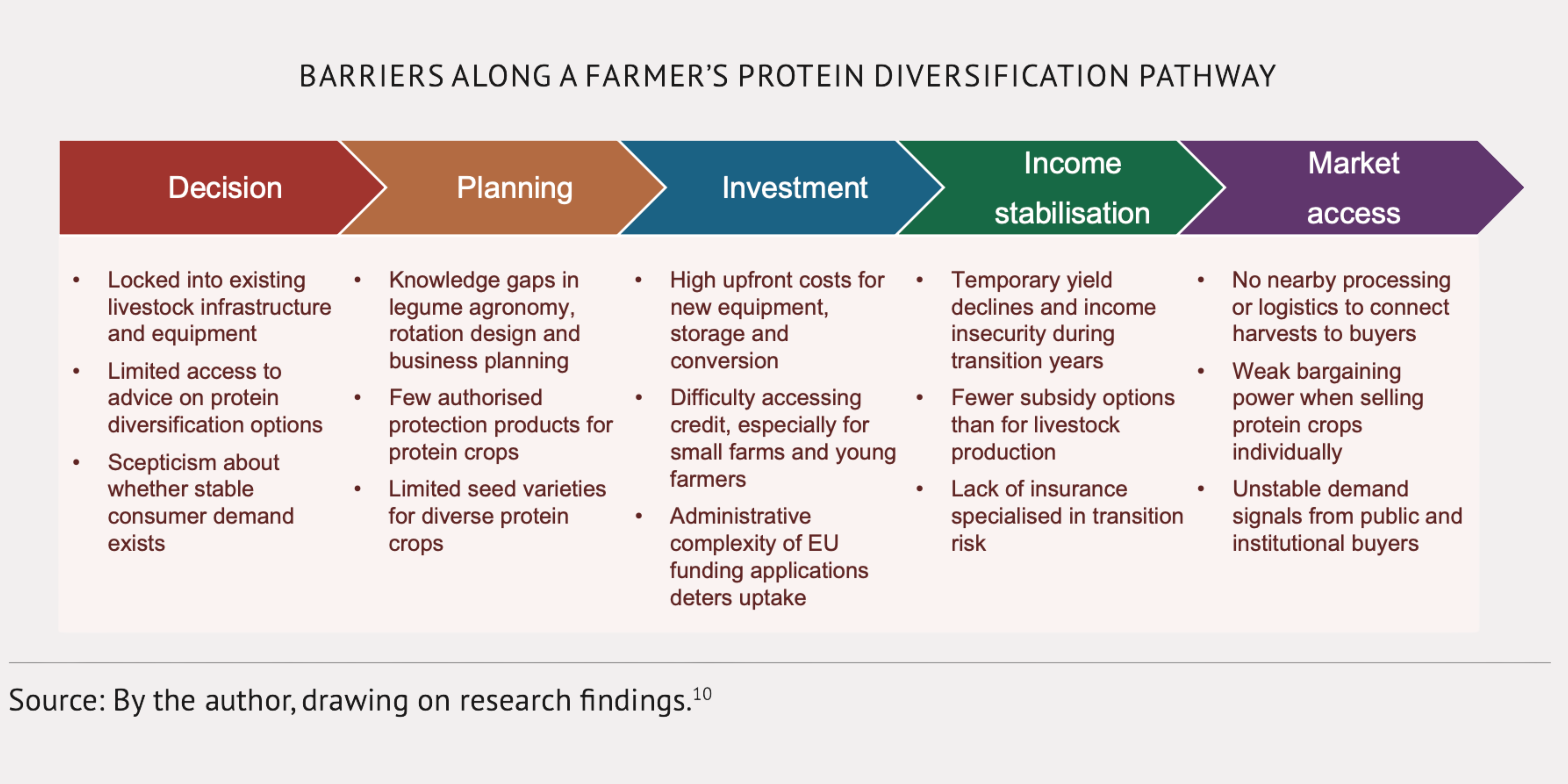
This Policy Brief examines how EU financial instruments and incentives can empower farmers to diversify protein production towards crops for direct consumption, plant-based food and precision fermentation, or agroecological systems with lower livestock densities. It draws on literature reviews, expert interviews and a December 2025 EPC roundtable with policymakers, farmer representatives, civil society, academics and financial actors.
Read the full Policy Brief here.
Laura Picot is a Visiting Policy Fellow within the Sustainable Prosperity for Europe programme, where her work focuses on agrifood, climate and nature.
The support the European Policy Centre receives for its ongoing operations, or specifically for its publications, does not constitute an endorsement of their contents, which reflect the views of the authors only. Supporters and partners cannot be held responsible for any use that may be made of the information contained therein.
This Policy Brief builds on the findings of independent research which was carried out in 2025-2026 with the support of The School for Moral Ambition. Artificial intelligence was used in data synthesis and drafting of this publication.