

The EU is missing the mark on One Health targets

Each November, World Antimicrobial Resistance (AMR) Awareness Week presents an opportunity to consider the threat resistant bacteria pose to EU health security. Yet member states are making poor progress on turning awareness into action. The European Commission should prioritise setting binding targets for member states through an EU-wide One Health strategy that acknowledges crucial interplays between environmental, animal and human health.
In recent summers, a foul-smelling sludge has clogged Europe’s lakes and shorelines, raising alarm from the Mediterranean to the Baltic Sea. These toxic blooms of algae and cyanobacteria are fuelled by intensive livestock farming, which contaminates nearby soil and waterways with nutrient and bacterial runoff. They are dangerous for humans and animals alike: the toxins they release can cause severe illness or even death. But behind these acute health threats lurks a quieter danger: research shows that the runoff that causes the blooms may also be giving rise to AMR hotspots where resistant bacteria can accumulate and spread.
AMR kills around 35,000 people a year in the EU/EEA, costing an estimated €11.7 billion annually in medical costs and lost productivity as treatment options dwindle. But as the toxic blooms demonstrate, resistance does not stay in silos: rather, it ricochets between humans, animals and the environment. European authorities endorse a One Health approach that reflects these linkages, but the EU has yet to adopt binding regulations that fight AMR on all three fronts.
A hard stance on soft laws is needed
The latest AMR surveillance data, released today, 18 November, by the ECDC, reveals some concerning trends: the EU remains far from reaching key targets, and deadly infections resistant to ‘last-resort’ antibiotics are on the rise.
Over the last decade, the EU has released a series of non-binding targets, guided by the 2017 European One Health Action Plan against AMR, a 2023 Council Recommendation and a joint framework from five EU agencies. But without concrete requirements for member states, progress towards meeting these targets seems destined to remain off-track and uneven throughout the bloc.
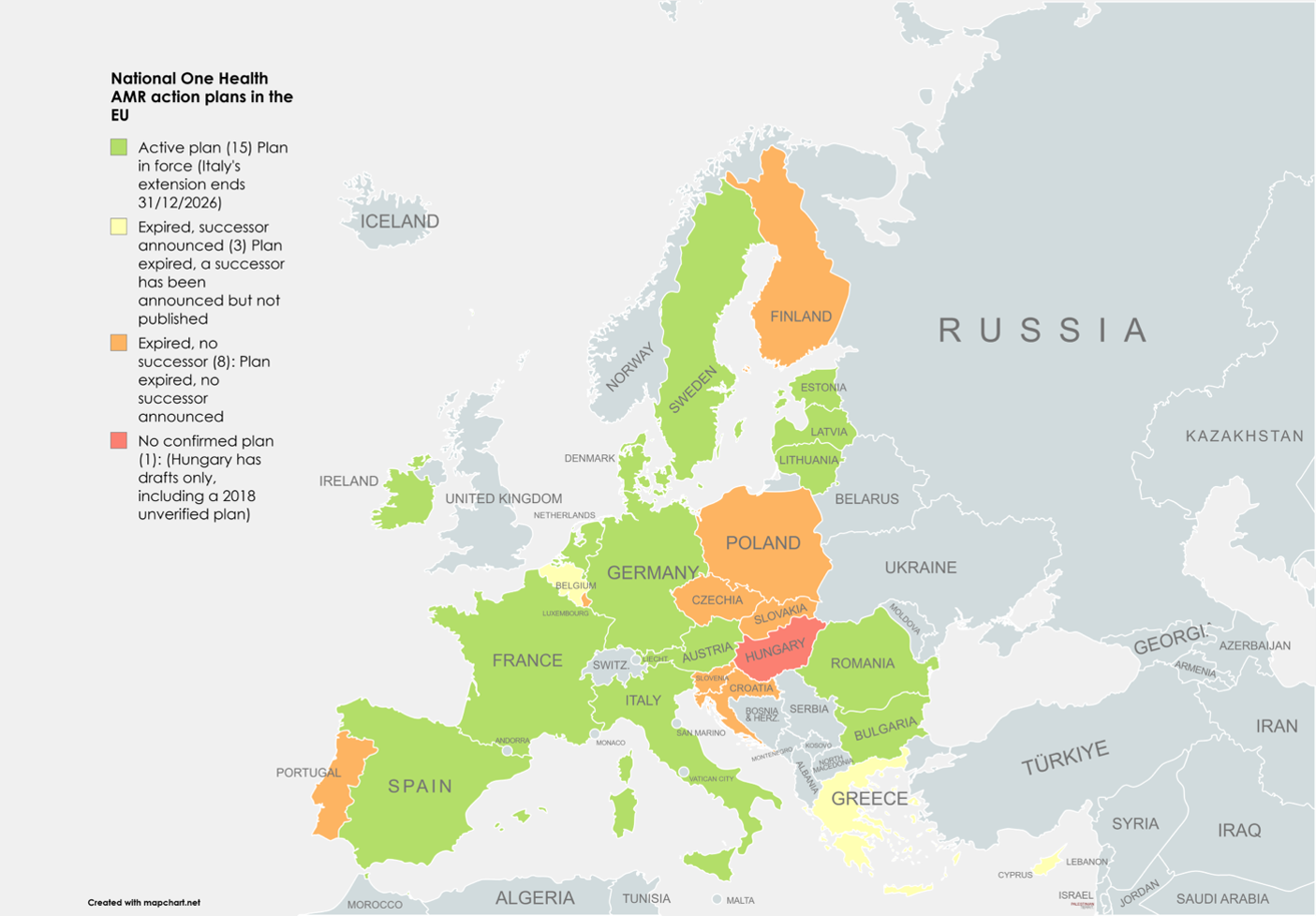
A closer review of the 27 member states in November 2026 shows that at least 11 had no confirmed current One Health plan. Eight had expired plans with no successor, and three have announced successors but not published them (see map below).
Greece, for example, ranks first in the EU for antibiotic consumption and has seen a troubling rise in resistant bloodstream infections, yet its One Health action plan expired in 2023. Hungary’s plan has been in draft form for years. And Poland, which has consistently performed poorly on antibiotic use and resistance metrics, has never had a One Health plan.
Europe should treat AMR as a critical health security matter, replacing this patchwork approach with consistent regulation and binding EU-wide targets.
Factory farming: An inconvenient truth
Existing One Health plans tend to advocate for better veterinary medicine, recommending prudent prescribing and improved care for sick animals. But they fail to acknowledge the industrial farming practices that foment disease in the first place: animals are kept in close quarters, in poor conditions that spread infection and necessitate widespread antibiotic use.
The EU has successfully curbed antimicrobial use in animals, with a 24.3% drop in veterinary antimicrobial sales for farmed animals between 2018 and 2024 – an achievement to be applauded. But with billions of animals housed and slaughtered on European farms each year, even these significant reductions are dwarfed by the sizes of the herds.
Farmed animals account for 98% of veterinary antimicrobial sales, yet there are no enforced caps on antimicrobial use in livestock. Researchers have proposed a limit of 50 mg per kg of livestock a year, but five member states exceeded it in 2024, with Cyprus (112.9 mg/kg) and Spain (93.1 mg/kg) topping the charts.
EU policy should treat industrial farming as an AMR driver in its own right. Lawmakers should aim to decrease herd sizes through supply-side actions that reduce reliance on animal proteins, either through cultivation of plant-based proteins or research and development of alternative proteins.
Fill in the monitoring gaps
Up to 90% of antibiotics administered to livestock may be excreted in a biologically active form, landing in our soil and water supply. This antibiotic runoff from factory farms has been linked to higher environmental resistance gene levels, but these connections remain understudied and largely unregulated.
Tetracyclines, the antibiotics most used in livestock, joined the EU surface water watchlist only in 2025. Meanwhile, the veterinary sulphonamides commonly found under farms are not currently on any watchlist, nor is there consensus on or set thresholds for AMR indicators in groundwater.
The path of infection from farm to human is likewise poorly traced. Studies have found that farmers and their family members are much more likely to carry resistant strains of E. coli and Staphylococcus aureus than the general population. But outside targeted studies, testing farm workers is not standard practice – and even asymptomatic carriers risk developing severe infections down the line or spreading resistant bacteria to others.
To keep citizens healthy and prevent the spread of AMR, the EU must address these gaps in monitoring and surveillance. Member states should regularly measure antibiotic runoff and resistance gene levels in groundwater near intensive livestock areas, as well as implement standard practices for the surveillance of resistant infections in farm workers.
A chance to make One Health deliver on its promises
Taken together, these recommendations can help address key weaknesses in Europe’s approach to One Health. With the agencies’ joint One Health framework expiring at the end of this year, the Commission has a rare opening to draft a holistic One Health plan with binding targets that hold every member state accountable and establish metrics against which to measure true progress.
Elyse Franko-Filipasic is a Health and Societal Resilience Fellow at the European Policy Centre. She is placed with EPC through the EU Food Transition Fellowship Programme at the School for Moral Ambition.
The support the European Policy Centre receives for its ongoing operations, or specifically for its publications, does not constitute an endorsement of their contents, which reflect the views of the authors only. Supporters and partners cannot be held responsible for any use that may be made of the information contained therein.