

Türkiye and the EU have “everything to gain” from closer cooperation, says Turkish Foreign Minister
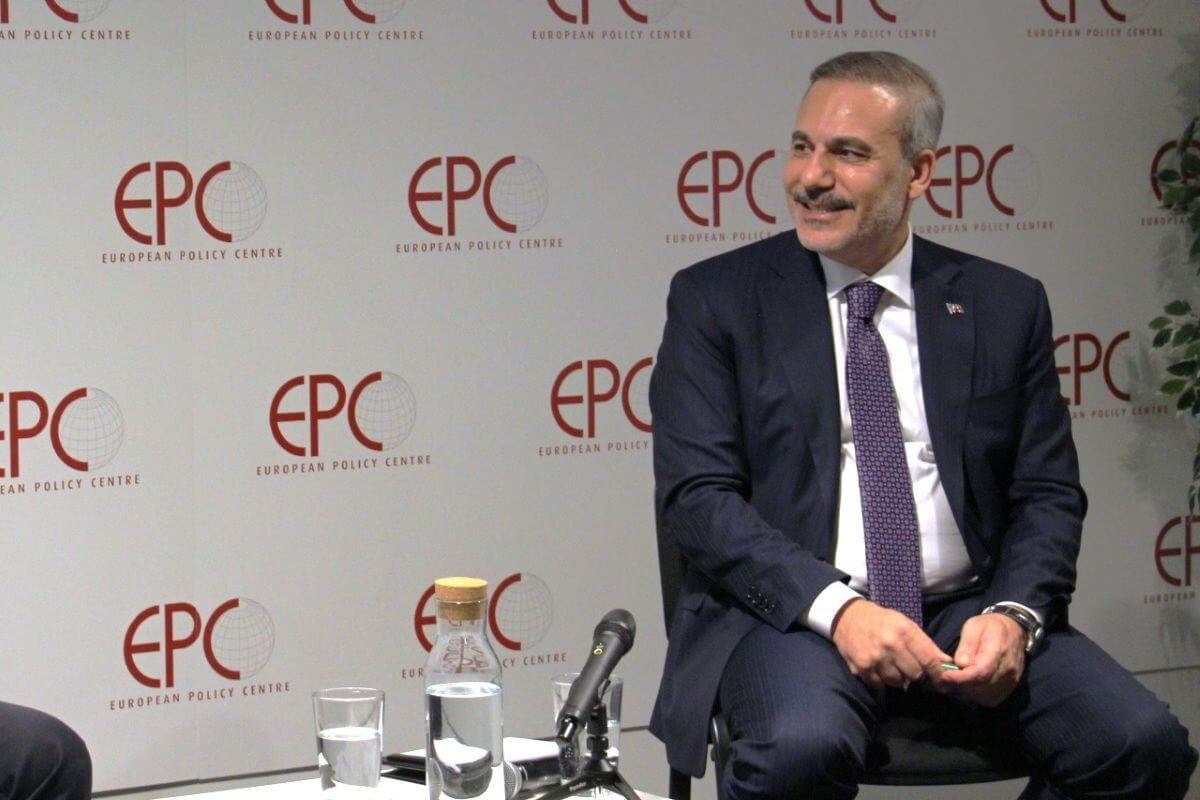
“Rather than mourning the loss of old relationships, Europe must reinforce existing ones.”
Speaking at the European Policy Centre, Turkish Foreign Minister Hakan Fidan argued that Europe must assume greater responsibility for its own security, while developing stronger cooperation with countries that can contribute to a more resilient defense architecture. He described Türkiye as an essential partner, highlighting its strategic location, defence-industrial base and position as “NATO’s second-largest army“ and strategic access to the Mediterranean and Black Seas.
“The peace dividend is over”, Fidan said. “This new reality comes with both challenges and opportunities” and Europe must seize these opportunities.
Fidan argued that two major shifts are transforming Europe’s strategic environment: the gradual reduction of the United States’ traditional security role in Europe and the rapid rise of artificial intelligence and emerging technologies.
Europe cannot afford to approach security, technological transformation and economic competitiveness without Türkiye as a key partner.
The Minister also warned that Europe risks falling behind in the global technological race, with “technological capacity expanding faster than governance frameworks”.
“AI turns economic and technological dependence into a sovereignty question”, and Europe needs to build a competitive technological ecosystem and should do so together with all partners, including Türkiye. “Türkiye and the EU are natural partners in every aspect, with nothing to lose and everything to gain from working together”, he said.
Talking about the EU-Türkiye Customs Union, Fidan stressed the mutually beneficial nature of the economic relationship, expressing concerns about Europe’s inability to start negotiations to modernise the custom union “because of the narrow interests of some of its members”.
Modernisation, he argued, would promote investment and build more reliable supply and value chains, on both sides, warning that excluding Türkiye would “risk fragmenting supply chains that businesses on both sides already depend on”.
Fidan came back on the topic of security, warning that a more autonomous EUropean defence architecture cannot succeed if key partners are excluded. While welcoming the introduction of several programmes, including SAFE, the Minister felt that Türkiye had not been adequately approached or consulted.
Audience questions turned to developments in Syria, where Fidan welcomed cooperation between Türkiye, European countries, regional actors and the United States following the fall of the Assad regime.
Fidan argued that the European Union had played a constructive role in rehabilitating the political environment and political conditions surrounding the new Syrian government, but “There is a lot to be done. We are just at the beginning now”.
Fidan also warned that the country remains fragile and identified the risk of renewed conflict as the greatest threat to recent progress. A further deterioration in security, he argued, could trigger another major refugee crisis affecting both Türkiye and Europe. He called on international partners to continue supporting Syrian stabilisation efforts and to avoid actions that could undermine the country’s transition.
The discussion also touched on long-standing tensions between Türkiye and Greece. Fidan argued that President Erdogan “has been trying to work with every elected Greek prime minister on the same issue again and again.” An issue that for Fidan seems solvable, as “the political will in Turkey exists”.
Concluding his remarks, Fidan returned to the broader strategic picture. As Europe faces growing competition, shifting alliances and accelerating technological change, he argued that the EU needs to think more broadly about its place in the world and the partnerships required to secure its future. “Europe extends well beyond the EU”, he said, calling for a more inclusive and strategic approach to cooperation across the continent.
The support the European Policy Centre receives for its ongoing operations, or specifically for its publications, does not constitute an endorsement of their contents, which reflect the views of the authors only. Supporters and partners cannot be held responsible for any use that may be made of the information contained therein.