

What's left of Franco-German defence cooperation?

For a decade, the Main Ground Combat System (MGCS) and the Future Combat Air System (FCAS) were flagships of Franco-German defence integration: Germany leading the tank, France the fighter jet. Each was meant to replace a Cold War-era platform by around 2040.
Now both are gone. A high-profile Franco-German defence industrial programme backed by significant public investment is no longer.
Last month, Dassault Aviation and Airbus abandoned their joint development of the New Generation Fighter, FCAS's core, after years of acrimony. Only the drones and "combat cloud", anchored by Airbus, Thales and Indra, will continue. Then Germany's defence minister confirmed MGCS would also not produce a common tank platform.
Both projects failed for the same reason: governance arrangements agreed at launch could not survive later shifts in industrial rivalries. They also fell victim to German political resistance, especially in the Bundestag, to funding the French defence industry.
FCAS started as a bilateral programme led by France. But Spain's 2019 accession, channeled through Airbus Defence and Space, altered the balance within the consortium. Airbus pushed for greater control over the fighter's flight controls, cockpit and stealth systems, and for freer IP-sharing among partners, fuelling tension between French and German counterparts.
Wary of ceding know-how to a company with no track record of building a combat aircraft from scratch, Dassault resisted though the deeper problem was a leadership structure no longer aligned with actual capability.
MGCS followed a similar arc. Germany was to lead through KNDS, the leading pan-European defence company, but Rheinmetall's entry in 2019 upset that balance. The inclusion of the German company prompted France to bring in Thales in 2024 - to reset the Franco-German balance. Finally, the compromises meant to salvage the partnerships ended up undoing them. In both cases.
The fallout is costly: a decade and considerable funding have been spent. Two cooperation projects failed to show that pooled European defence industry works. These pan-European failures come just as the continent can least afford to waste money. Quite the opposite: in light of Russia’s war of aggression, Europe absolutely needs to.
Paris and Berlin are now both pursuing national stopgaps. In June 2026, Paris unveiled a tank project, CAPINT (Capacité Intermédiaire). The new tank pairs a German-made Leopard 2A8 chassis with a French ASCALON turret. Although a pragmatic solution, it is a French “concession” to a German component. Berlin, on the other hand, is weighing upgrades to its Leopard 2A7/A8 fleet, or a hybrid "Leopard 3".
Dassault will develop France's next fighter alone, using the nuclear-certified and carrier-capable Rafale F5 as its baseline. Germany and Spain have meanwhile formed "Team Gen 6" to pursue a rival sixth-generation aircraft via Airbus.
The fates of FCAS and MGCS were intertwined: the failure of FCAS contributed to the collapse of the MGCS. Their breakdowns demonstrate how national industrial interests can outweigh shared European defence objectives. The Franco-German « defeat » is eroding trust and potential future European defence collaboration.
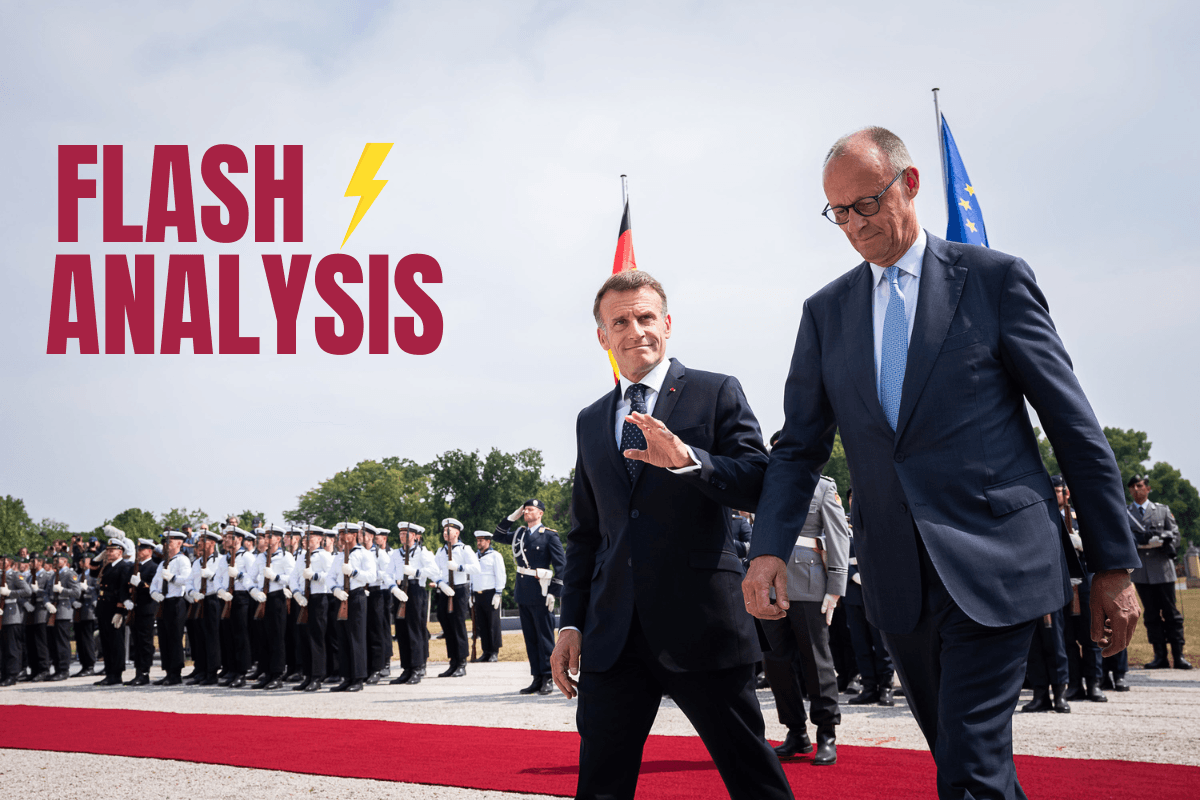
Paris and Berlin are trying to contain the damage. At a joint cabinet meeting last week, President Macron and Chancellor Merz sought to shift the focus to a broader agenda of European defence cooperation, announcing closer collaboration on missile defence, long-range strike capabilities, space and nuclear deterrence. Among the announcements was Germany's first-ever participation in a French nuclear exercise, scheduled for later this year — signalling that Franco-German defence cooperation, though badly bruised, is not yet dead.
Clarisse Maiorano is a Programme Assistant in the Europe in the World Programme at the European Policy Centre.
Paul Taylor is a Senior Visiting Fellow in the Europe in the World Programme at the European Policy Centre.
The support the European Policy Centre receives for its ongoing operations, or specifically for its publications, does not constitute an endorsement of their contents, which reflect the views of the author only. Supporters and partners cannot be held responsible for any use that may be made of the information contained therein.