

At the far right, far from normalisation: Where Marine Le Pen’s party stands in the EU
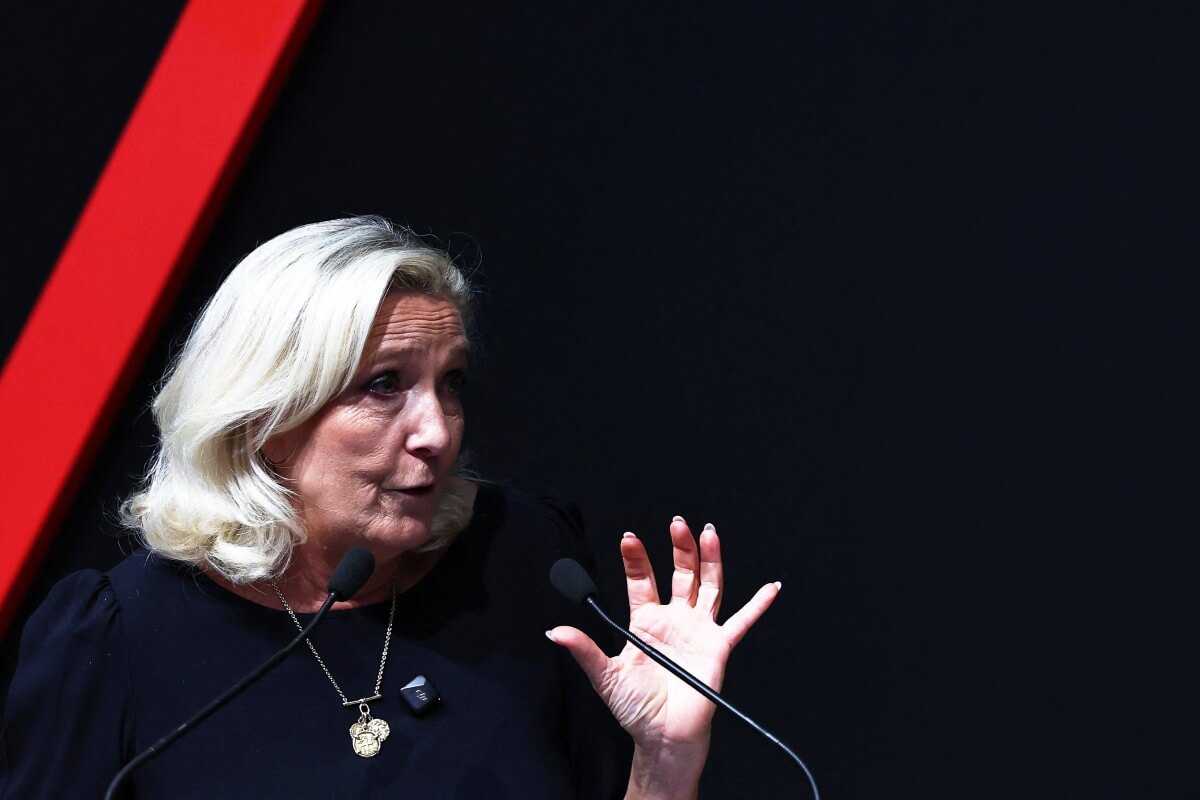


Marine Le Pen, leader of the far-right Rassemblement National (RN), is the frontrunner in next year’s French presidential election. Although she has made her party more acceptable to voters at home, its voting record in the European Parliament suggests that EU policymakers should not expect moderation.
French far-right leader Marine Le Pen will launch her presidential campaign at a party congress on 25 October. With six months to go before the two-round election, on 18 April and 2 May 2027, she is the current favourite to become the next French leader. She is polling well ahead of all other candidates from the left, right and centre, and she is even considered the most competent among them.
This is in part due to the de-demonisation strategy followed by Le Pen’s party, the National Rally (RN), for more than a decade to appear more moderate and respectable to attract voters from traditional right-wing parties.
In recent years, the RN has abandoned some of its most radical propositions, such as a Eurozone exit or a fully-fledged Frexit, and it is now promising to respect EU rules on deficits. But in its manifesto for the 2024 EU elections, it proposed a “new institutional organisation” to create an alliance of nations. Ahead of the 2027 election, Le Pen has already pledged a referendum to reject the primacy of EU law over migration policy and a €11bn annual reduction of France’s contribution to the EU, while at the same time promising to be “constructive”.
The RN has sought to balance its mainstreaming strategy with its continued Euroscepticism. To assess the party’s longer-term political positioning, the EPC and Eulytix analysed its voting record in the European Parliament since 2019, using roll-call votes on amendments and final texts. The findings show that the RN remains rooted in the far right. Increased alignment with the European Conservatives and Reformists (ECR) has not been accompanied by convergence with the European People’s Party (EPP), the group at the centre of EU decision-making.
Figure 1: The distribution political groups’ alignment with the RN (measured by percentage of votes similar to those of RN)
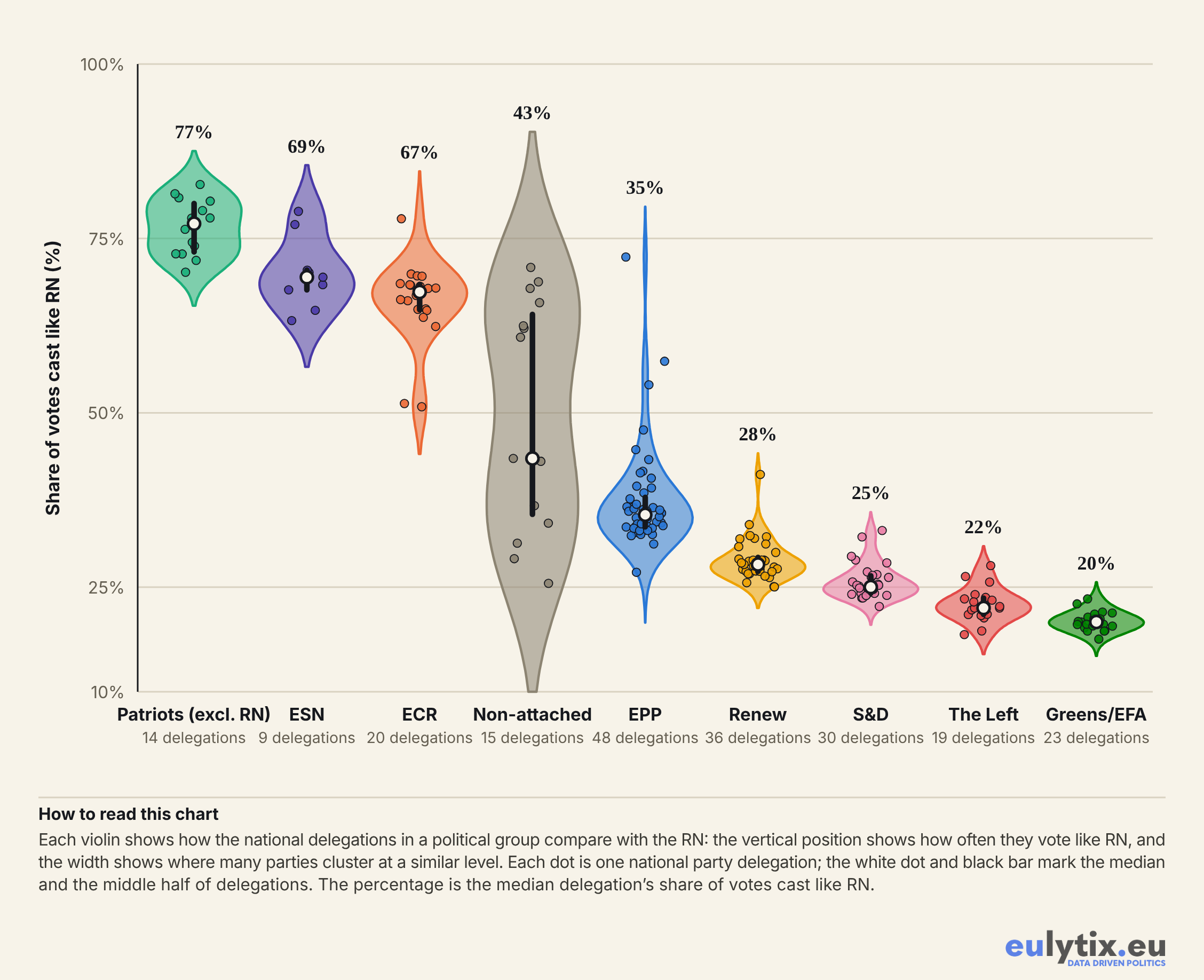
The RN’s voting record over the 2019–2026 period shows that it is firmly anchored in the far right, first in the Identity and Democracy (ID) group between 2019 and 2024, and since 2024 in the Patriots for Europe (PfE) group.
Le Pen’s party has aligned with other PfE delegations in 81% of votes during the current term. Within the group, it is closest to the opposition parties on the radical right: Portugal’s Chega and Belgium’s Vlaams Belang (78% each), followed by Poland’s Konfederacja (76%). Alignment is also high with Italy’s Lega (75%) and Spain’s Vox (74%), both of which have participated in regional or national governments. By contrast, the RN is less aligned with Czechia’s ANO (69%) and Hungary’s Fidesz (66%). Both these have held seats in the European Council and the Council of Ministers, giving them stronger incentives to support negotiated compromises.
Outside PfE, the RN is most closely aligned with Europe of Sovereign Nations (ESN) and the ECR, matching each group in 69% of votes. ESN was created in 2024 as a splinter group led by Alternative for Germany (AfD) after the RN refused to remain allied with it, deeming it too radical.
The convergence between the RN and ECR is recent, and of limited extent. In the previous term, between 2019–2024, Le Pen’s party voted like ECR in 56% of cases. However, the 13-point increase since 2024 remains below the 18-point average among the five other delegations that belonged to both ID and PfE. Of the six ID/PfE delegations, the RN ranks only fifth in alignment with ECR. Le Pen’s party is not a leader in a convergence with ECR; it is following other delegations amid the current European Parliament’s broader ideological shift to the right.
Figure 2: RN alignment with ECR, ESN and EPP by policy issues (measured by the percentage of similar votes).
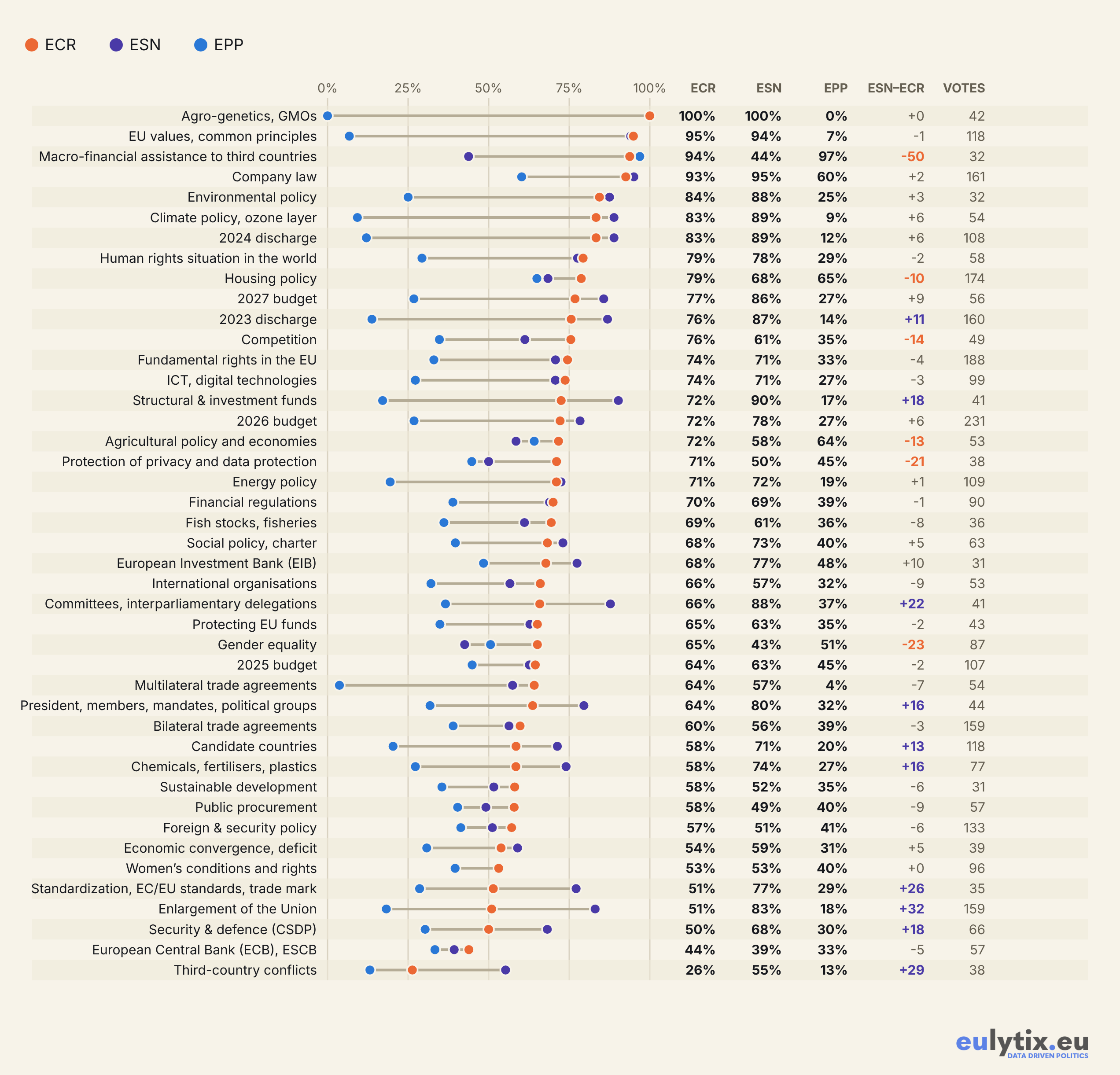
The analysis of policy-area data shows that while the RN is converging with the ECR, it remains ideologically close to the ESN. When the ECR and ESN agree, the RN votes with them 82% of the time. This is especially the case on EU values, where they cast similar votes on the annual Rule of Law Report. When the two groups diverge, the RN sides slightly more often with the ESN (44%) than with ECR (40%), while taking neither position in the remaining 16% of votes. It will vote with the ESN on issues such as enlargement, third-country conflicts (mainly the war in Ukraine), and security and defence, and will be closer to the ECR on other issues such as gender equality, privacy and data protection, as well as competition law.
Mirroring the pattern within PfE, the RN is more closely aligned with ECR parties that are in opposition, such as Poland’s Law and Justice (PiS; 69%), than with current governing parties, such as Prime Minister Giorgia Meloni’s Brothers of Italy (FdI; 66%) and the New Flemish Alliance of Belgian Prime Minister Bart De Wever (51%).
In the meantime, the RN has been moving further from the centre right. Alignment with the EPP, which was already low at 41% in the previous term, has fallen to just under 34% since 2024. The gap is the widest on issues like EU values (7% alignment), climate (9%), multilateral trade agreements (4%), third-country conflicts (13%), enlargement (18%) or energy policy (19%). Although the RN has moved somewhat closer to the ECR – which is often seen as a gatekeeper of potential far-right normalisation – it clearly stands far away from the European political mainstream.
Figure 3: Quarterly evolution of RN alignment with the ECR and EPP, 2019–2026 (measured by percentage of similar votes)
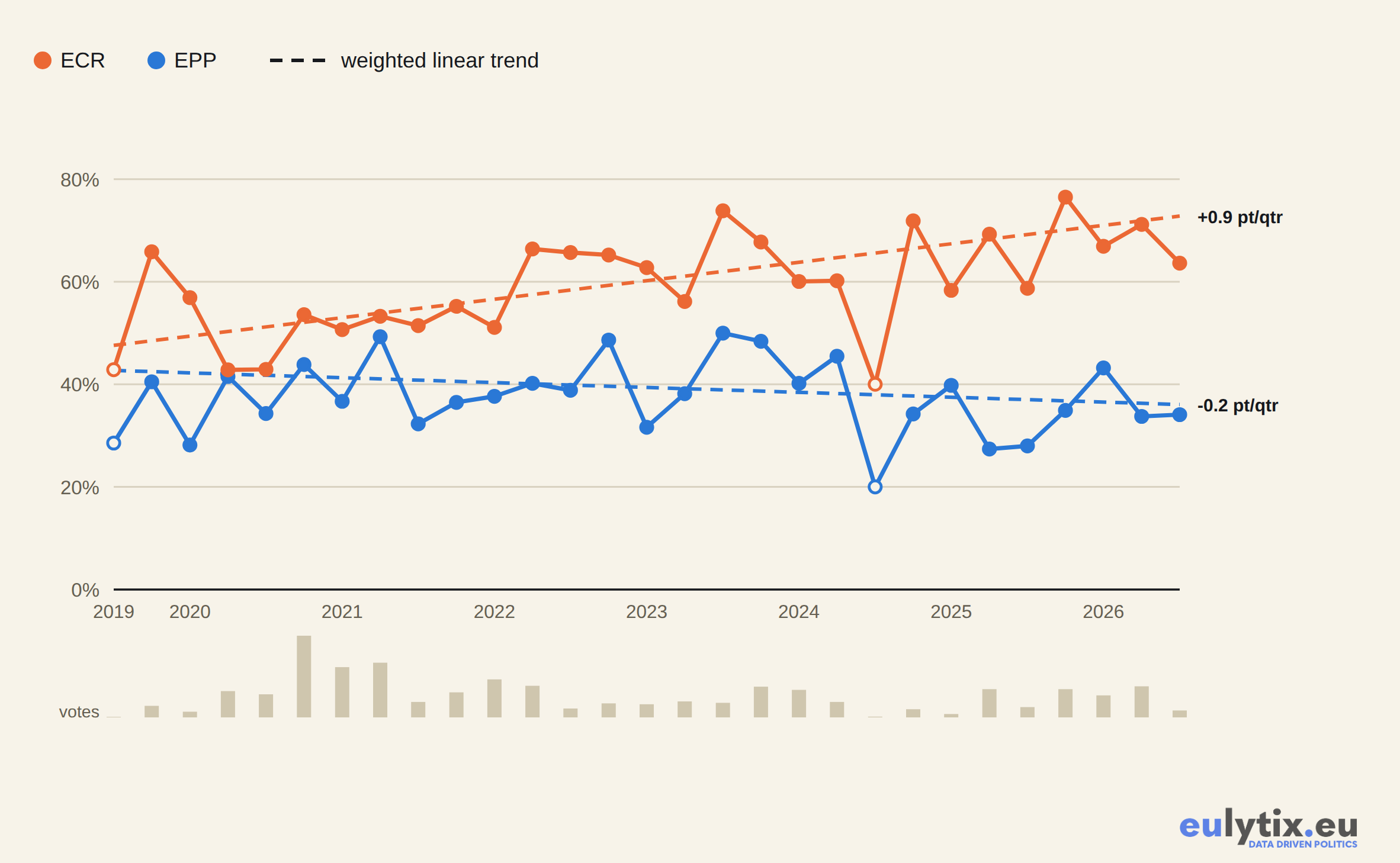
Overall, although the RN has sought to present itself domestically as a credible party of government, its voting record in the European Parliament shows that this normalisation has not extended to the EU level. Its growing alignment with the ECR has coincided with a further decline in alignment with the EPP. Combined with its proposals to challenge the primacy of EU law on migration and reshape the Union’s institutional architecture, this record gives EU policymakers little reason to expect domestic mainstreaming to translate into accommodation at the European level.
Figure 4: FdI alignment with ECR and EPP when in opposition in Italy (2019–2022), compared with RN alignment with ECR and EPP, 2024–2026 (by policy issues, measured by percentage of similar votes)
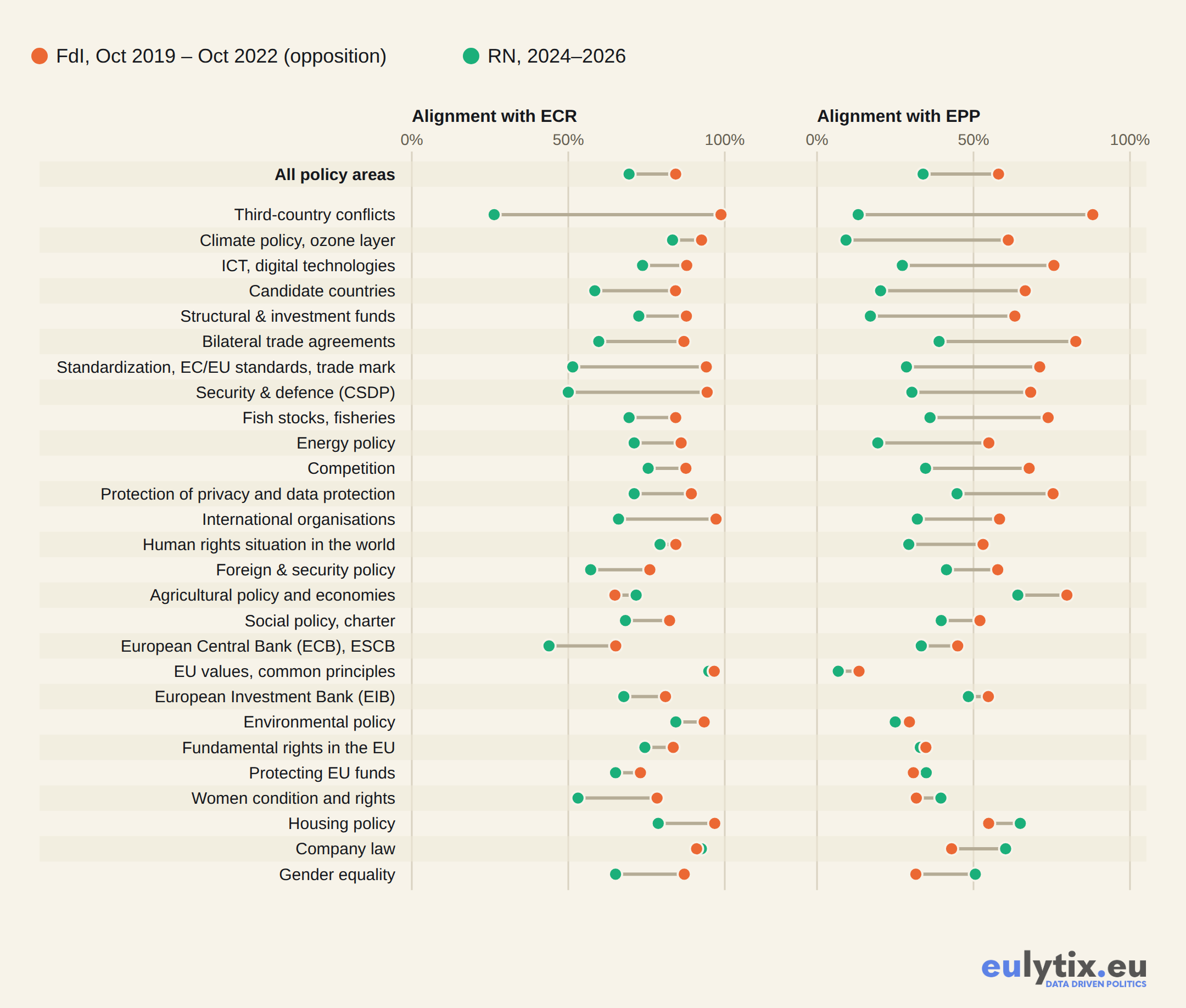
Our analysis provides little support for expectations that, if elected French president, Marine Le Pen would follow Giorgia Meloni’s path: a far-right female leader who, once in power, moves towards the EU mainstream and comes to be regarded as a loyal partner. The RN’s record in the European Parliament points in the opposite direction. This is particularly clear when comparing with the voting behaviour of Meloni’s party, FdI, in the years preceding its accession to power in Italy in 2022.
Between 2019, when it entered the European Parliament, and 2022, FdI aligned with the EPP in 58% of votes – 24 percentage points more than the RN does today. Although FdI’s distance from the mainstream right remained significant, it was therefore easier for FdI and Meloni to bridge than it would be for the RN and Le Pen following a victory in France in 2027. Moreover, FdI voted with the Parliament’s majority in 49.8% of cases, compared with 35.1% for the RN today.
Marine Le Pen has announced that she would engage in a trial of strength over the EU budget and institutional architecture. Were she to join the European Council in 2027, however, she would likely struggle to build support for her preferred EU settlement, but she would still be able to make collective agreement harder.
The party’s record suggests persistent opposition to the compromises that sustain the European mainstream. Any engagement with a Le Pen presidency would need to distinguish tactical pragmatism from genuine normalisation—and prepare for a France more willing to contest the Union from within.
Eric Maurice is a Policy Analyst in the European Politics and Institutions Programme at the European Policy Centre.
Attila Kovács is the CEO of Eulytix.
The support the European Policy Centre receives for its ongoing operations, or specifically for its publications, does not constitute an endorsement of their contents, which reflect the views of the authors only. Supporters and partners cannot be held responsible for any use that may be made of the information contained therein.