

Bosnian elections 2026: How Dodik won without running
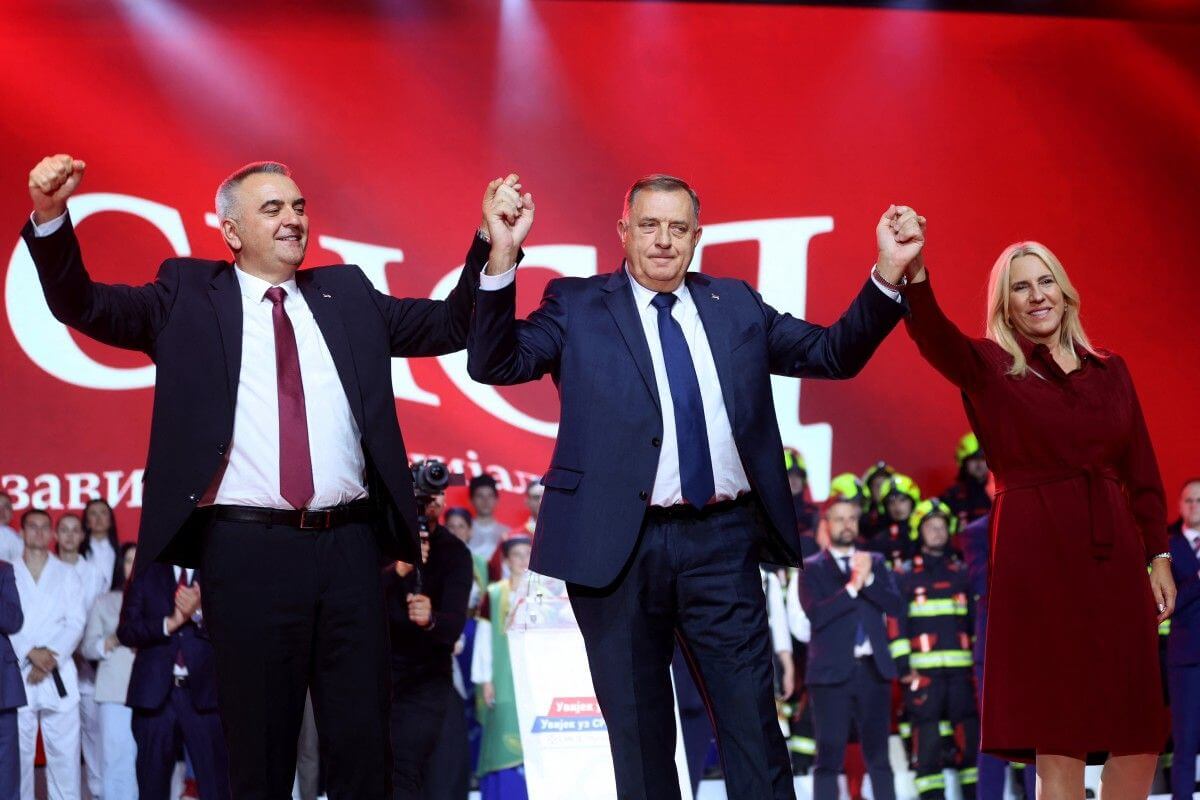

The biggest winner of the 4 October general election in Bosnia and Herzegovina is someone who did not run. In Republika Srpska, the vote was framed as a test of Milorad Dodik's political future. The former president of the entity was ousted from office last year following his conviction for defying the decisions of the High Representative.
Dodik’s political continuity depended on the success of his party, the Alliance of Independent Social Democrats (SNSD), and their good results have secured his political influence. SNSD and its coalition partners retained the majority at the entity parliament (the regional legislative assembly), while their results at the state Parliamentary Assembly offer them a privileged position in the negotiations for the Council of Ministers. Their candidates at entity and state-level presidencies won with absolute majorities and by greater margins than in 2022.
Despite not being allowed to run, Dodik was the main character during the campaign. He participated in rallies, SNSD lists were named after him and he continued acting as the de facto leader abroad, meeting with Israeli Prime Minister Benjamin Netanyahu and Russian President Vladimir Putin.
Željka Cvijanović and Denis Bećirović were re-elected as the Serb and Bosniak members of the Presidency. On the Croat side, a candidate from the Croatian Democratic Union of Bosnia and Herzegovina (HDZ BiH), Darijana Filipović, was elected after Željko Komšić’s two consecutive terms. During these terms, HDZ BiH has insisted that Komšić was not a “legitimate representative”, a position supported by the Croatian HDZ.
Hurdles on the EU path
Dodik’s strengthened grip on power worsens Bosnia’s already fragile EU membership prospects. Over the past years, SNSD has obstructed the adoption of EU-related reforms and delayed the adoption of the Reform Agenda for the Growth Plan. Dodik’s close ties with Russia conflict with EU foreign policy alignment, an important requisite for membership. More fundamentally, his threats to Bosnia’s territorial integrity run counter to the country’s EU aspirations.
His secessionist agenda is nothing new. What has changed is the geopolitical landscape. Since Donald Trump’s return to the White House, US priorities towards the Western Balkans have shifted from state-building to economic transactionalism. In October 2025, the US lifted sanctions against Dodik and Cvijanović and only a few months later members of the Trump administration hosted the two leaders in Washington.
Meanwhile, the EU has taken little concrete action. The EU never joined the US and the UK in imposing sanctions on Dodik, and only after his conviction did some EU member states take bilateral restrictive measures, while Hungary and Croatia blocked EU-wide sanctions. EEAS, the EU Delegation and the Commission often condemned the destabilising actions and regretted the blockages to the EU path but avoided explicitly naming those responsible for the obstruction.
In the past, Dodik has defined himself as pro-EU, and has committed to the reforms that membership entails, at least rhetorically. However, over the past months he has been increasingly confrontational with the EU, making it clear that he has no intention to adhere to the EU requirements.
Restoring the leverage
After the election, EU High Representative on foreign policy Kaja Kallas and Enlargement Commissioner Marta Kos stressed Bosnia’s EU perspective “as a single, united and sovereign country”. However, the membership prospect has lost credibility. Discussions on how to advance the country’s EU bid remained absent from the campaign, and membership is perceived as an increasingly distant goal.
Stronger after the election and capable of blocking decisions and reforms, Dodik might use this position to extract concessions from the EU. Shortly after the election, he already lashed out at the EU, declaring that “[Bosnian Serbs are] bored listening to worn-out phrases about reforms” and warning that returning to “the letter of Dayton” was a condition for engagement.
The EU should not give in to this blackmail. Instead, it needs to take stronger action against those seeking to undermine the country’s integrity and block EU integration. The obstructors should be named explicitly in EU documents and communications, as the US used to do. Without Viktor Orbán in the picture, EU members cannot hide behind Hungary’s veto to justify inaction. Croatia opposed sanctions arguing that they would have a negative effect on the country’s stability and EU path. However, Dodik’s ties with Russia, the dismissal of court rulings and vilification of the EU should make Zagreb reconsider its position. The election of an HDZ BiH presidency member should give Croatia fewer reasons to continue shielding Dodik.
The EU must make a clear distinction between obstructing leaders and citizens, like Marta Kos did after Ratko Mladić’s funeral, addressing citizens directly and explicitly recognising that leaders’ disruptive actions do not represent an entire society. The EU should strengthen direct engagement with citizens, including through local authorities and civil society. Where reforms are blocked, the EU should consider halting assistance to the obstructing authorities and redirecting it to municipalities and civil society, as it did in Georgia.
The Union’s leverage in Bosnia has weakened. It cannot be restored overnight. Delivering on EU promises when candidate countries deliver on theirs, while confronting those who obstruct, is an indispensable first step.
Berta López Domènech is a Policy Analyst in the European Politics and Institutions Programme at the European Policy Centre.
The support the European Policy Centre receives for its ongoing operations, or specifically for its publications, does not constitute an endorsement of their contents, which reflect the views of the authors only. Supporters and partners cannot be held responsible for any use that may be made of the information contained therein.