

Clashing trilemmas in the United States and China will shape the global order
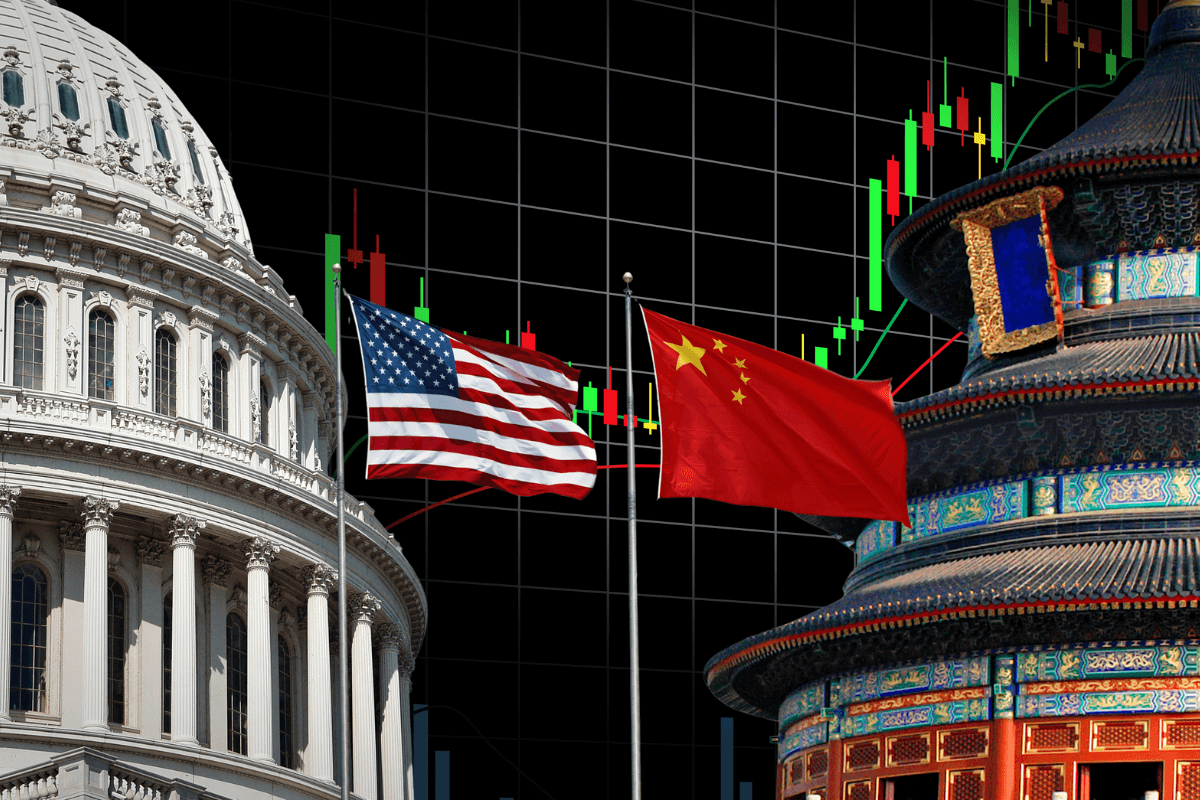


The United States and China are both pursuing technological dominance through excess investment. In both cases, vast industrial and financial resources are being mobilised at a rising cost to other domestic priorities, with growing spillover effects for trading partners. A different outcome is economically possible but, politically, it is likely to emerge only once the underlying macroeconomic contradictions in both superpowers come to the fore. Against this backdrop, the European Union should lay the ground for a more stable long-term global equilibrium.
It is in Europe’s paramount interest to foster a more stable long-term global equilibrium. In an international environment dominated by two rapacious superpowers, the European Union cannot rely on persuasion alone; its strategy must be grounded in action. Three orientations could guide this effort:
1. First, to avoid contributing to the global investment glut and widening global imbalances, the EU should ensure that its higher investment is matched by stronger domestic consumption.
2. Second, it should implement measures to retain savings within the Union, preventing them from fueling the US investment boom, while protecting itself against an influx of Chinese products to make overinvestment costly for China.
3. Third, building on the Mercosur agreement and other free trade agreements in the pipeline (notably, the one with India), the EU should strive to rally countries beyond the G2 in support of a rules-based multipolar world.
Two predatory superpowers
In 2025, the United States and China confirmed their status as the world’s uncontested political and economic superpowers – often at the expense of the rest of the world. Their predatory nature has been increasingly laid bare.
Under President Trump, the United States has moved away from the role of an ‘indispensable nation’ towards that of an ‘extractive superpower’. Rather than underwriting a stable rule-based international economic order, Washington increasingly uses tariffs, sanctions, regulatory pressure and security leverage to pull investment, technology and rents towards itself – from adversaries and allies alike.
China is a superpower of a different nature. Beijing has adopted the strategy of making its economic partners increasingly dependent on the Chinese economy. Its role as a ‘dependency superpower’ rests on massive exports, control over key segments of global supply chains and critical materials and the provision of credit and foreign direct investment. In parallel, on the domestic front, China has made strong efforts to reduce its own dependencies (the “dual circulation” theory) and to develop “new quality productive forces” to compete with the United States in high-tech sectors.
Last year, growth remained strong in both countries despite growing disruption and turbulence generated by the erosion of the rule-based international economic order, to which both Trump’s America and Xi’s China have contributed significantly. Still, underlying economic weaknesses persist. In the United States, strong headline figures mask a K-shaped recovery that is translating into an affordability crisis. The US fiscal position continues to deteriorate. Tariffs and strong-arm immigration policies are slowing the return of inflation to target.
In China, high growth was largely driven by a net export boom, and in 2025 its trade surplus surpassed $1 trillion for the first time. The strong performance of Xi’s “new quality productive forces” was counterbalanced by worrying developments in the real estate sector. Falling housing prices, high youth unemployment and weak wage dynamics have kept consumption subdued. In 2025, the goal of rebalancing China’s economic model was missed again.
Clashing macroeconomic trilemmas
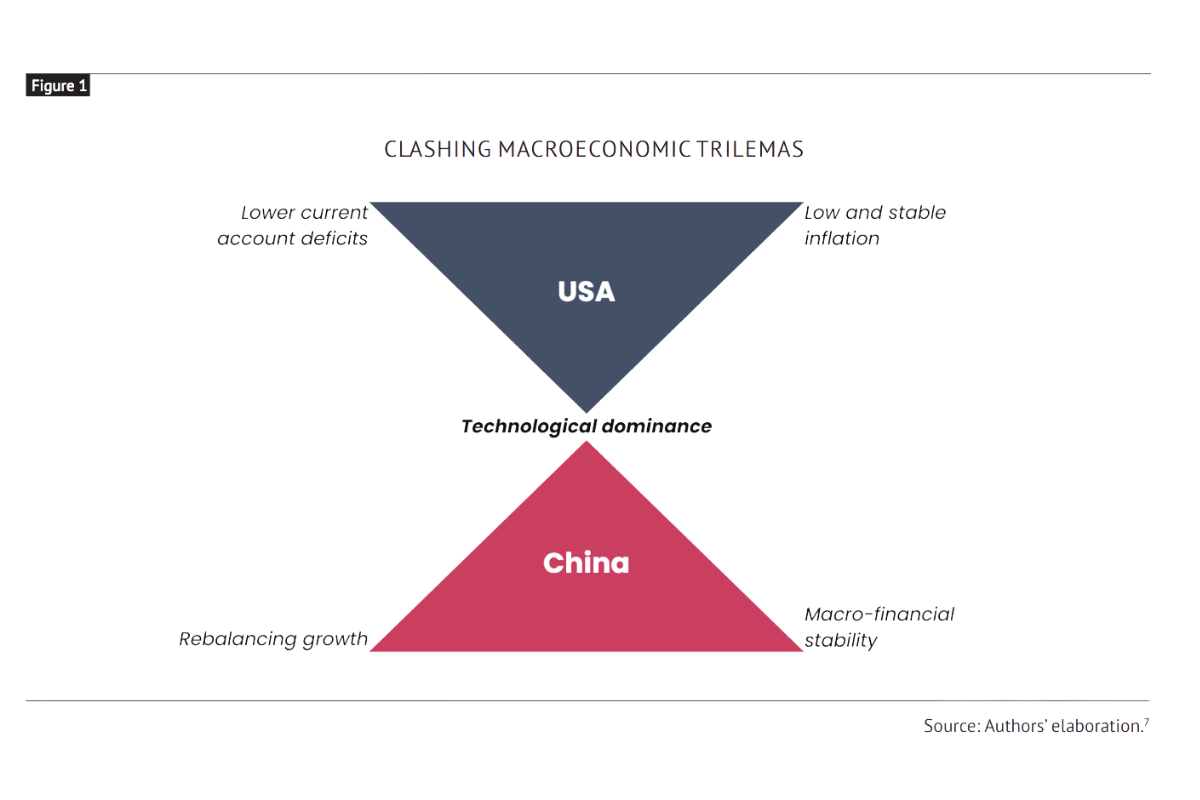
Looking ahead, both the United States and China face clashing macroeconomic trilemmas: that is, sets of three policy objectives that cannot be achieved simultaneously.
As shown in the figure below, technological superiority through high levels of investment is a common objective in both economies, although the policy tools used to pursue it differ. Technological dominance underpins the predatory character of the two superpowers. Precisely because this goal is shared, it has become a major source of bilateral tension and generates significant negative spillovers for their trading partners.
Read the full Discussion Paper here.
Moreno Bertoldi is Senior Associate Research Fellow at the Italian Institute for International Political Studies (ISPI).
Marco Buti is Tommaso Padoa-Schioppa Chair at the European University Institute’s Robert Schuman Center and former Director General for Economic and Financial Affairs at the European Commission.
The support the European Policy Centre receives for its ongoing operations, or specifically for its publications, does not constitute an endorsement of their contents, which reflect the views of the author only. Supporters and partners cannot be held responsible for any use that may be made of the information contained therein.