

Dead on arrival: Why von der Leyen’s deal must be undone


Nothing is agreed until everything is agreed. The EU should now steel itself and reject the terms imposed by Donald Trump
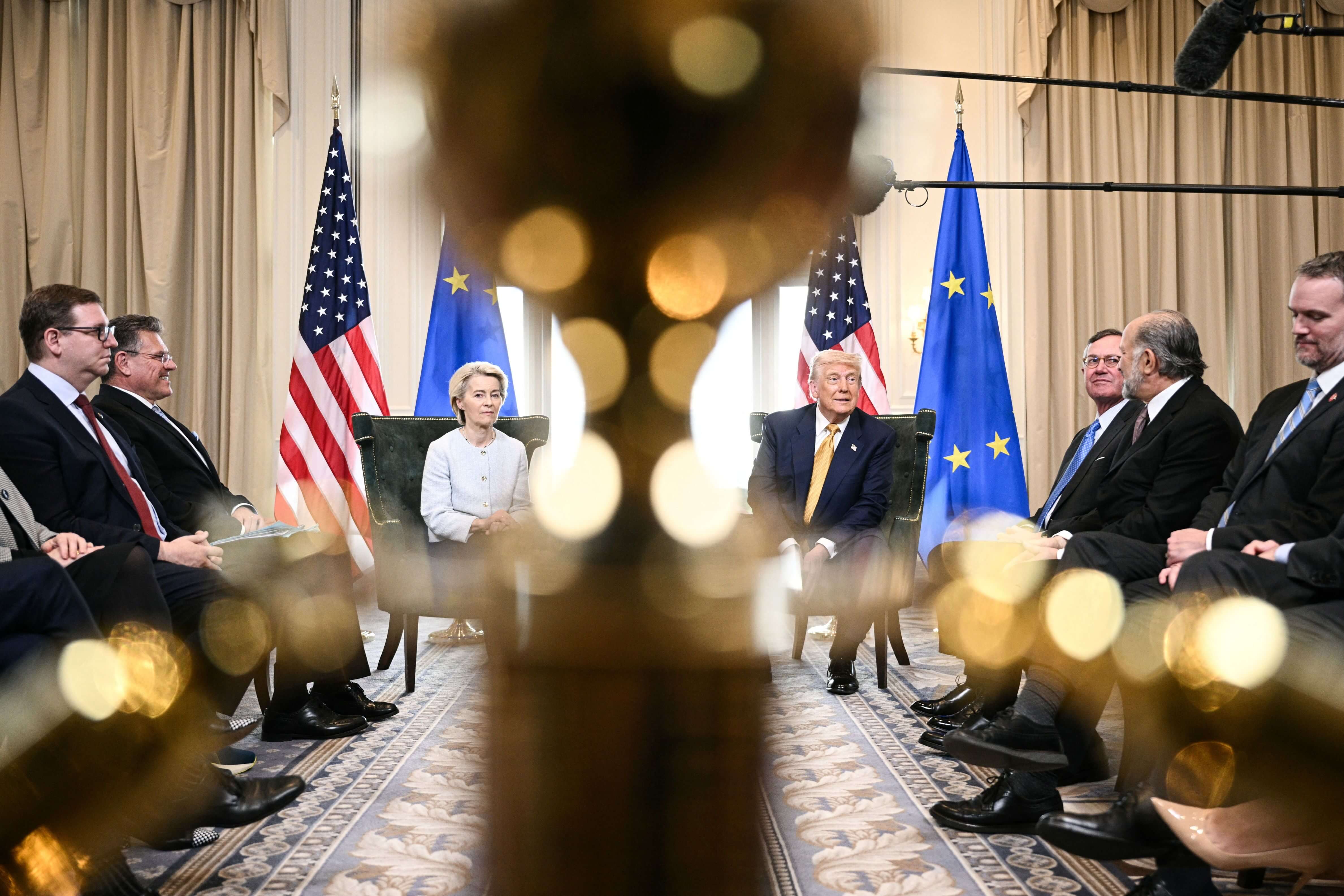
Ursula von der Leyen’s Turnberry golf course deal has been rightly dismissed as a capitulation and a humiliation for Europe. Assuming such an accord will put an end to Donald Trump’s coercion and bullying is either naive or the result of a miserable delusion. The EU should now steel itself and reject the terms imposed by Trump.
Is this deal really as bad as it sounds? Unfortunately, it is, for at least three reasons.
The optics and signalling were terrible as von der Leyen became a supplicant to a triumphant Trump. The blow to Europe’s international credibility is incalculable, in a world that expects the EU to stand up for reciprocity and rules-based trade, to resist Washington’s coercion like Canada, China and Brazil have, rather than condoning it.
Economically, it’s a damaging one-way street: EU exporters lose market access while the bloc is hit by more favoured US competition. Core European industrial sectors, like pharma and steel and aluminium, are left in the dark or by the wayside. The balance also tilts in the US’ favour in important sectors such as consumer goods, food and drinks, and agriculture. Tariffs tend to stick, so this is long term damage. The EU is even giving up its right to respond to future US pressure through duties on digital services or network fees.
To top it off, von der Leyen’s defence and investment pledges (for which she had no mandate) go against Europe’s interest. The EU’s competitiveness predicament is precisely one of net investment outflows. As international capital now reallocates under the pressures of Trumponomics and a weakening dollar, the case for Europe to become a strategic investment power was strengthening. Von der Leyen’s promise of $600bn in EU investment in the US is therefore disastrous messaging.
How could this happen? All EU member states wanted to avoid Trump’s 30% tariff threat and a trade war, but in the end, none perhaps as much as Germany and Ireland, supported by German carmakers and US big tech firms. Yet Irish sweetheart digital tax deals, as well as BMW and Mercedes’ plans to move production hubs to the US (also to serve the EU market), cannot be Europe’s future.
EU governments were distinctly unhelpful in building the EU’s negotiation position. But, in the end, it was von der Leyen who blinked; she bears responsibility. Her close team took control in the closing weeks and went into the final meeting manifestly prepared only to say yes, which made Trump’s steamrolling inevitable.
Let’s think of the counterfactual: if von der Leyen had stepped into the room and rejected these terms, Trump’s wrath and some market turmoil might have ensued. But ultimately it would very likely have come to a postponement, a new negotiation, and at some point, a different deal that would not be so lopsided or unilaterally trade away deep and long-term European interests and principles.
The situation is reminiscent of the final rounds of the Brexit negotiations five years ago when von der Leyen similarly was giving in to unacceptable demands from Boris Johnson, only to ultimately U-turn under pressure from a steelier EU chief negotiator and a quartet of member states.
Today, von der Leyen runs Brussels with a strong presidential hand and has largely done away with internal checks and balances inside the Commission. That is her prerogative and her style, but the upshot should not be weak, ineffective, and unprincipled dealings on Europe’s major geopolitical challenges, from Trump to Gaza.
The “deal” in Scotland is, in reality, an unstable interim accord. Nothing is yet inked and signed; Washington and Brussels are already locking horns on its interpretation and negotiations on the finer (and broader) points are ongoing. The 27 EU governments will inevitably get involved as the final deal needs to be translated into an international agreement and EU law. Some big ones – Germany and Italy – seemingly are on board, reluctant or not. However, internal political dynamics may change calculations. Opposition parties and right-wing contenders, a real political threat to leaders in Germany and France, are already lambasting the deal.
Unless von der Leyen strikes a dirty bargain with the member states, the European Parliament will also have a say. The long time chair of the trade committee, Bernd Lange, has set the tone for how the deal would be viewed there, calling it "asymmetry set in stone" and even “a misery”. As details seep out on what von der Leyen has really agreed to and what the US expect from the EU, and all the consequences become clear, an already unpalatable deal may become even more so.
Weakening US economic data and returning stock market jitters show that Trump’s negotiation footing is fragile. His new tariff threats come with new extensions, up to 90 days in the case of Mexico, as his position is overstretched. For Europe, the lesson from the Brexit negotiations is that nothing is agreed until everything is agreed. There is now an opportunity for EU governments and the European Parliament to course correct and salvage something from this global train wreck.
A version of this op-ed was published by The Guardian.
Georg Riekeles is Associate Director and Head of Europe's Political Economy programme at the European Policy Centre.
Varg Lukas Folkman is a Policy Analyst in Europe’s Political Economy programme.
The support the European Policy Center receives for its ongoing operations, or specifically for its publications, does not constitute an endorsement of their contents, which reflect the views of the authors only. Supporters and partners cannot be held responsible for any use that may be made of the information contained therein.