

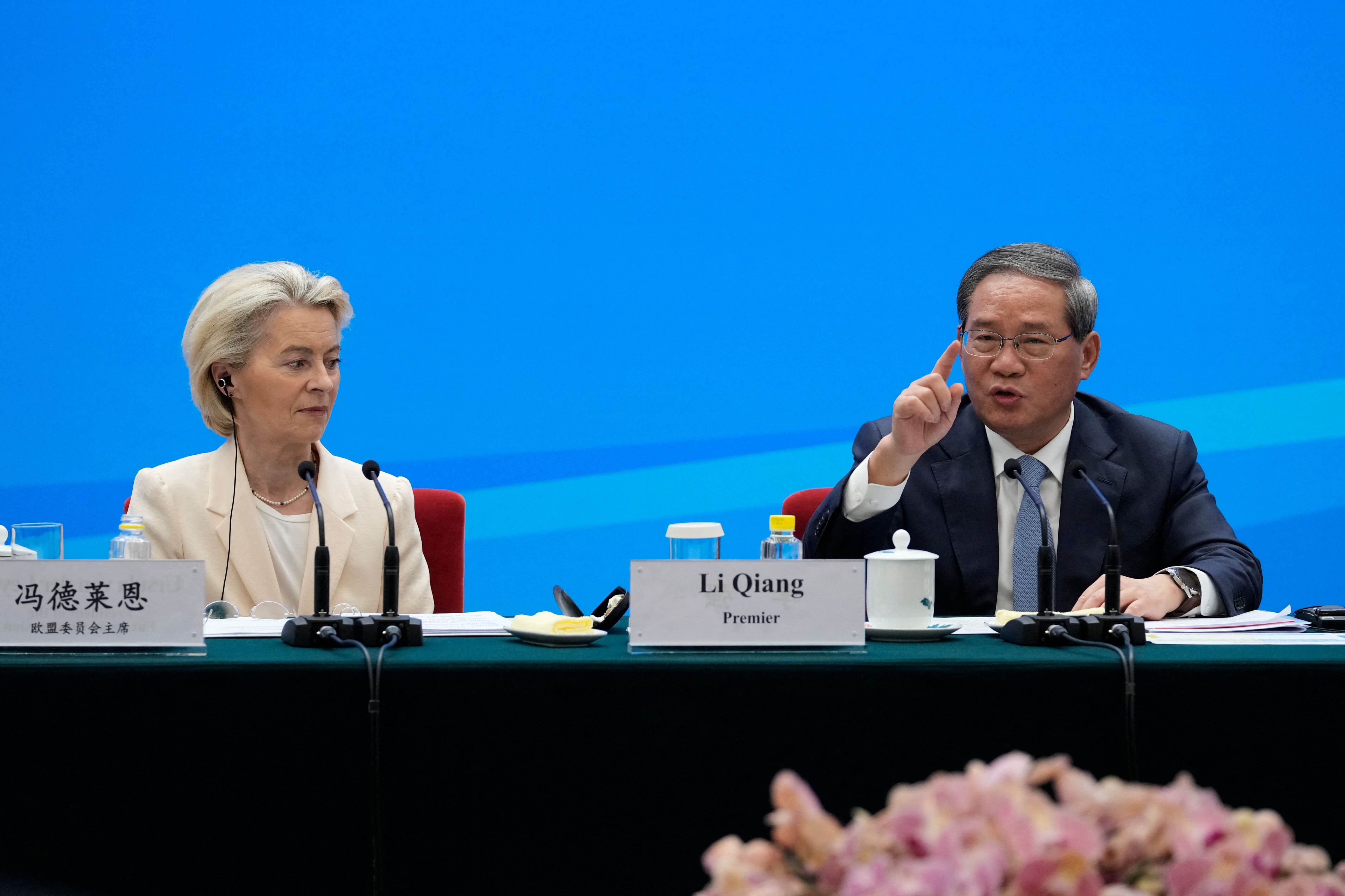

Relations between the European Union and China have seen better days. Not even Donald Trump's return to the White House helped bring Brussels and Beijing closer together. António Costa and Ursula von der Leyen travelled to China for the traditional bilateral Summit on 24 July, marking 50 years of formal diplomatic ties between the Asian giant and the EU. But it was no occasion for fireworks. If the political and diplomatic ties between the two sides have been gradually deteriorating in recent years, economic and trade relations, although still strong, also show no signs of improving.
A negative trend
Relations between the EU and China have been on a downward slope for a few years, and this negative trend is likely to continue. In March 2019 the EU adopted a new strategy that classified China as a 'partner', an 'economic competitor', and a 'systemic rival'. Beijing rejected this approach from the get-go, especially the notion of rivalry, but the growing problems in the relationship seemed to confirm that ties were changing for the worse.
The COVID-19 pandemic, declared in March 2020, accelerated the distancing; it hardened the views of Europeans on China, both at public opinion and leadership levels. The openly critical stance of many 'Wolf Warrior' Chinese diplomats towards European governments, politicians or even analysts—on issues ranging from the management of the public health crisis, to Xinjiang, Hong Kong and Taiwan—widened the political divide.
In 2021, tensions between the EU and China reached an even lower level with the imposition of sanctions on China for human rights violations in Xinjiang. Beijing responded with a disproportionately heavy hand, imposing countersanctions on members of the European Parliament, the EU's Political and Security Committee, and European think tanks and analysts, subsequently leading to the freezing of the EU-China Comprehensive Agreement on Investment (CAI) that had been concluded in December 2020.
To make matters worse, China's ambivalent stance on Russia's war against Ukraine, and Beijing's failure to openly condemn Moscow's illegal military aggression turned the April 2022 EU-China Summit into a "dialogue of the deaf," in the undiplomatic words of former EU foreign policy chief, Josep Borrell.
All eggs in one basket?
The lesson learned by the president of the European Commission, from the evolution of Sino-European relations and Russian aggression, was clear: Brussels and the EU’s 27 member states could not repeat with Beijing the mistake they had made with Moscow in terms of strategic vulnerabilities. If with Russia the European addiction was its chronic dependence on fossil fuels, with China the strong economic (inter)dependence between both sides would make the problem much greater in the event of a diplomatic break.
In 2023, Commission President Ursula von der Leyen, in a landmark foreign policy speech organised by the European Policy Centre and MERICS, enunciated the idea of "de-risking" the relationship between Europe and China. Not wanting a 'divorce', which most EU countries reject, the Commission wanted some economic distancing and diversification.
Once again, Chinese officials did not like to be associated with the idea of "risk," and even less so after the Biden administration adopted the same policy.
De-risking, little by little...
Despite a slight slowdown in trade between 2023 and 2024, economic relations between the EU and China remained strong, albeit difficult as a result of growing political pains.
In 2024, China remained the main source of European imports of goods and the third export market for Europe, behind the US and the UK. If the Netherlands is the largest importer of Chinese products in the EU, Germany is, of the 27, the one that exports the most to China. Last year, the European trade deficit in goods with China was €305.8 billion, but trade in services had a surplus of €21.7 billion in favour of the EU.
However, the high trade figures should not mask the difficulties that European businesses continue to experience in China—from IP theft and technology transfer to difficult access to the Chinese market and the lack of a level playing field. In a recent survey of 503 European companies published by the EU Chamber of Commerce in China, 73% say that it has become more difficult to do business in China—the fourth consecutive year of decline. Many look to the future with pessimism, citing the economic slowdown in the country and trade disputes between Washington and Beijing.
Paradoxically, despite the negative developments reported, many European companies continue increasingly buying components from China for price and economic competitiveness reasons. De-risking, ma non troppo.
Contradictory signals
In recent months, in this context of deteriorating bilateral political ties, reinforced by a general growing trend of ‘transactionalism’ in major powers’ foreign policy, there have been mixed signals from both China and the EU on the direction of travel of the relationship. Just three instances illustrate the point.
First, Beijing launched a 'charm offensive' in Brussels since the end of 2023 and, especially, after the re-election of Donald Trump, which recently culminated in the lifting of sanctions on European parliamentarians as a form of political de-escalation between the two sides before the 50th anniversary confab. Yet, China decided to appoint, as Special Representative for European Affairs, a prominent 'wolf warrior' ambassador who was based in Paris during the pandemic.
Having shown an initial openness to deepen ties with China in Davos at the beginning of this year, by the time of the G7 Summit in Canada in June, von der Leyen once again pointed batteries at Beijing, speaking of a new “Chinese Shock” and criticizing the restrictions China was imposing on the export of critical minerals. Beijing did not like the accusations, as it had not liked the countervailing duties imposed by the EU on the imports of electric cars subsidized by the Chinese state just a few months earlier.
Finally, if China in 2022 had an apparently 'ambivalent' position regarding the Russian aggression against Ukraine, in 2025 it became clear that Beijing is firmly on Moscow's side. On his visit to Brussels earlier this month, China’s chief diplomat, Wang Yi, reportedly admitted that his country could not accept a Russian defeat in the conflict that would allow the US to refocus on Asia. While not surprising, this open support for the country that is currently Europe's biggest security threat sent chills throughout Brussels.
Fireworks: neither before nor after the ‘party’
As the Summit closed, there was no call for celebrations nor fireworks in Beijing. The most important deliverable of the meeting was that it took place without major hiccups.
After Xi Jinping’s refusal to come to Europe, Costa and von der Leyen travelled to China and got some facetime with the Chinese president, following speculation that he might not show up. Yet none of the substantive, big-ticket issues that needed to be resolved—from trade imbalances and overcapacity to Russia’s aggression on Ukraine—seem to have improved much as Europeans and the Chinese grow gradually apart. Like with the US, the EU-China relationship now has a basket of ‘irritants’ that will worsen if left unaddressed pragmatically.
While the joint statement on climate may be the ‘lifesaver’ that allows both sides to show that they can still partner constructively, it may be too little, too late to lower the political temperature.
Ricardo Borges de Castro is a Senior Adviser at the European Policy Centre.
The support the European Policy Centre receives for its ongoing operations, or specifically for its publications, does not constitute an endorsement of their contents, which reflect the views of the authors only. Supporters and partners cannot be held responsible for any use that may be made of the information contained therein.