

Europe’s place in the global permacrisis
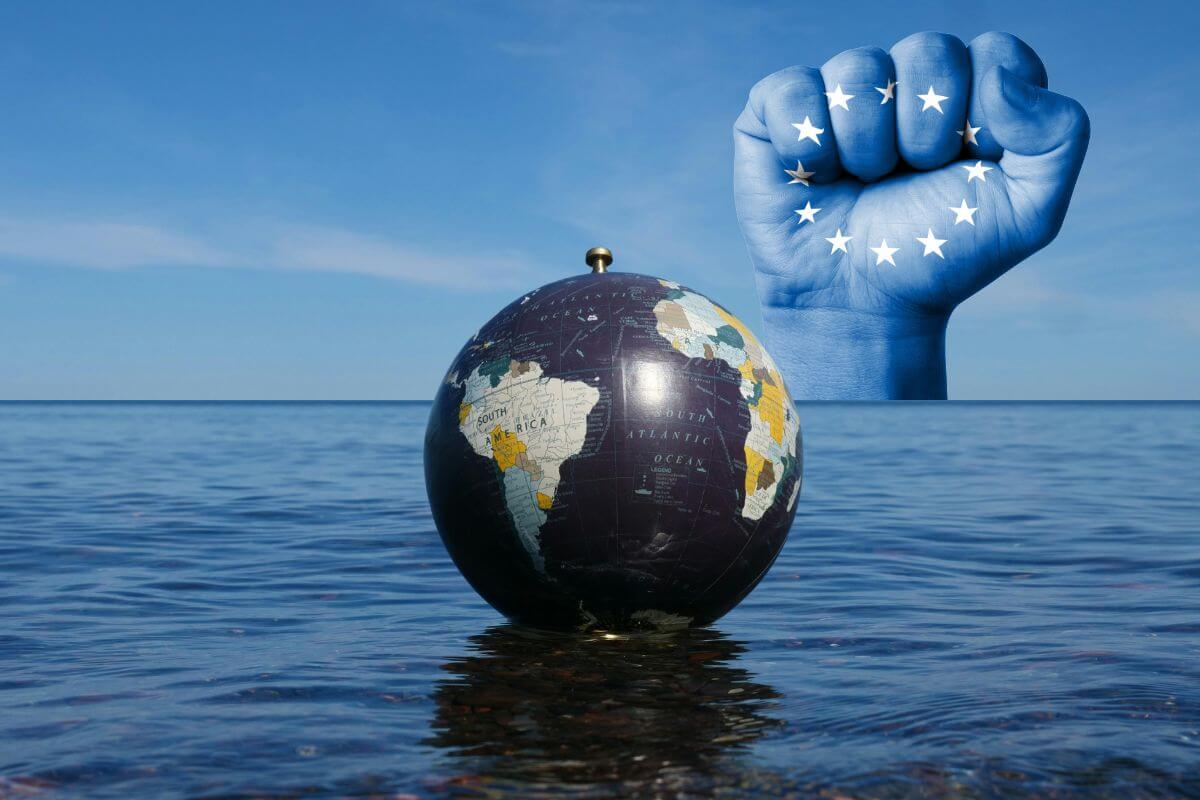
The phenomenon of permacrisis is now observable internationally, having been manifest in Europe for almost two decades. Europe’s prolonged exposure to it offers a series of warnings and a vantage point for understanding how sustained instability reshapes political and economic systems. This perspective is increasingly relevant beyond the continent, as the global permacrisis culminated in and is accelerated by the second Trump administration’s destructive whirlwind of attacks aimed at changing global interactions and norms. Europeans have, by and large, realised the catastrophic nature of Trumpian ideology and actions, given his ambivalent stance on Russia’s aggression against Ukraine and European security, aggressive moves on Greenland and assault on global stability – as well as his views on multilateralism and multilateral Europe as an irrelevance or even an enemy. But the rest of the world should be under no illusion. The US and Israeli war with Iran has further demonstrated that today’s crises are interconnected: conflict around a regional power can threaten the Strait of Hormuz, disrupt global oil and gas flows, fuel inflation, weaken growth and intensify insecurity far beyond the immediate battlefield.
Trump’s threats to weaken or abandon NATO only add to this volatility, calling into question one of the core institutional foundations of international security at precisely the moment it is most needed. The chaos now being deliberately generated is a negative-sum game for everybody, reducing global prosperity, sustainability and security, making the world a much more dangerous place for the next generations. There is a need to build a new global architecture before it is too late. Europe can play a decisive role, working with willing partners around the world, if it gets its own house in order.
Living in a contested landscape
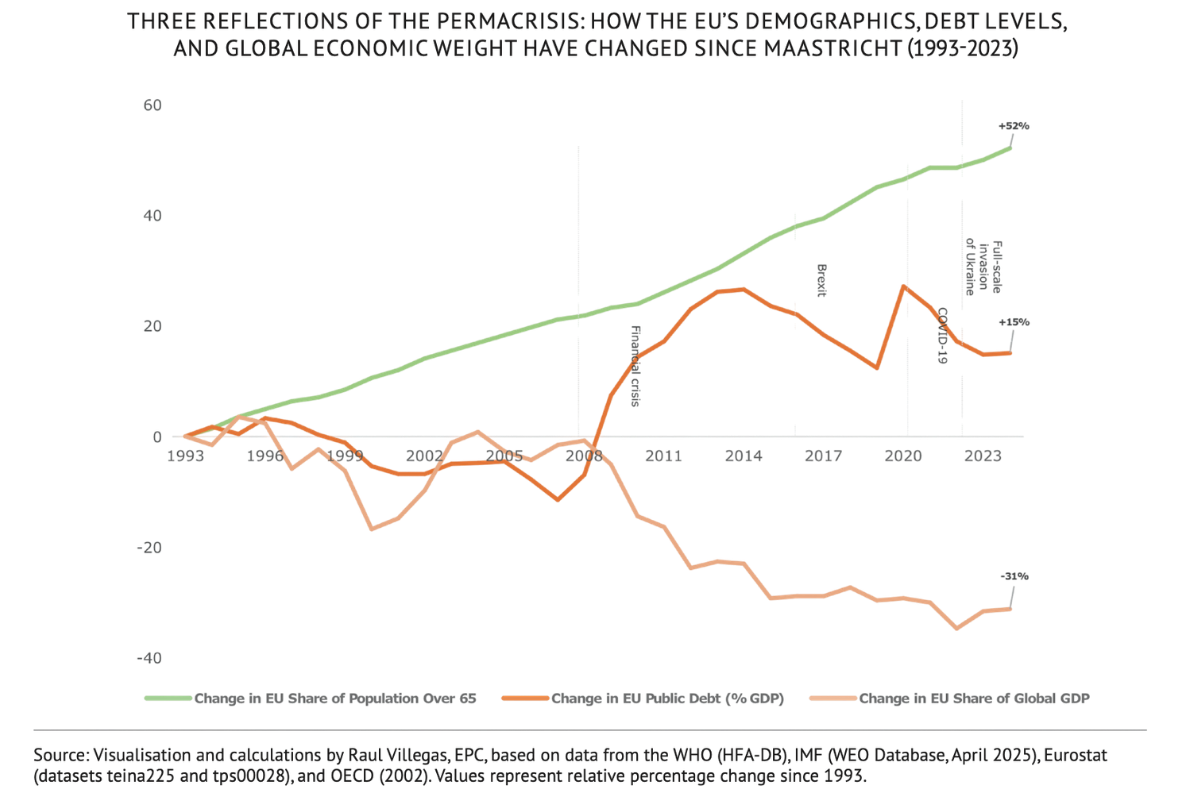
Almost five years ago, we noted that Europe, the old continent, has been in permacrisis ever since the onset of the global economic and financial crisis in 2007/2008. The period since then has been characterised by interconnected and constant crisis-level challenges, including the financial and economic crisis, the sovereign debt and Euro crises, migration, Brexit, terrorism, COVID-19, the first Trump administration, war and instability in the Middle East, as well as Russia’s ongoing aggressions, including the full-scale invasion of Ukraine.
All of this has been happening alongside a constant background challenge of fundamental structural changes, necessitated by climate change, population ageing and the global technological revolution (poly-transition). This has highlighted and accelerated political fragmentation and polarisation within Europe, as seen in the case of Brexit, and the rise of far-right populism, illiberal governments and political leaders.
At the same time, geopolitics and geoeconomics have become significantly more challenging, including the rise of China, and the challenge to liberal democracy from within the ‘West’ following the (re-)election of Donald Trump, as well as the ongoing military aggression of Putin’s Russia, which is not only aimed at Ukraine but at European security as a whole. This perfect storm is threatening to sweep away the political, economic and security architecture which has underpinned (Western) European progress since the Second World War. More broadly, it is undermining a multilateral project which, albeit imperfect, offers the best available basis to pursue prosperity collectively and to coordinate action around goals – such as the green transition – that would otherwise be unattainable.
The signs of this changing world were already on the horizon, for instance, with repeated Russian aggression in 2008, 2014 and 2022. But many did not want to see what was coming. It took the radically changed stance of the United States (US) towards its European allies to shake Europe out of the illusion that, even in an increasingly contested landscape, its foundations were secure. The warning voices should have been heeded in the past – Europe would now be in a much better place if that had been the case. It is important to listen to these voices again today, not only to their warnings but to their recommendations – to make sure that Europe does what is necessary, so that, sometime in the future, this can be seen as the inflection point when Europe started to take back control over its own future.
But this is no longer only a European problem. The fundamental challenge to Europe’s architecture is now replicated at the global level. The world is now in a global permacrisis, triggered by the re-election of Trump as US President and his subsequent actions. His approach, reinforced by his administration and the ideologues in the background, is challenging the global architecture and norms of international behaviour created after the Second World War. It is true that many parts of the world did not share the prosperity and stability of Western Europe over the last eight decades. Even within Europe, much of the East spent more than half of the period since the Second World War under communist dictatorship, and there has also been war in Europe during that period. Globally, there have been many conflicts, and many parts of the world have not shared in the increasing prosperity. But ever since the ‘end of history’ following the fall of the Soviet empire, there has been the hope that the end of the Cold War would also usher in a new period of global, mutually beneficial cooperation and progress, including a reform of the international architecture based on fair representation of emerging, small, and middle powers. Trump has shattered this illusion. Instead of an ordered multipolar world, we are now facing an international environment where ‘might is right’, without order and rules – in short, a global permacrisis.
The challenge for Europe will be to convince others that this is indeed a global permacrisis – and not “merely” from a European perspective – a hostile environment. Many are still under the illusion that Trump shaking up the global order will be in their interest, providing them with a way of escaping from American hegemony.
Even among those who are now realising the negative impact Trump is having, for instance in relation to global trade or with respect to stability – in the Middle East with first Gaza and then Iran, or Latin America with his actions in Venezuela – they still do not see the pervasive long-term danger and the distinct possibility that the US disengagement from multilateral institutions may long outlive Trump. The war involving Iran has shown how rapidly regional conflict can spill over into global economic instability, with the closure of the Strait of Hormuz putting oil and gas flows at risk. Trump’s threats to weaken or even withdraw from NATO further compound this uncertainty, undermining confidence in the wider security architecture. Rather than ‘wait Trump out’, those who believe in a non-Trumpian global future will have to show what long-term damage and destruction he will cause, while also constructively offering a way forward.
Read the full Discussion Paper here.
Fabian Zuleeg is Chief Executive and Chief Economist at the European Policy Centre.
The author would like to thank Raul Villegas, former Policy Analyst at the Executive Office of the European Policy Centre, for his contributions in the development of this paper. He is also grateful to Almut Möller, Director for European and Global Affairs and Head of the Europe in the World programme at the European Policy Centre, and to Janis A. Emmanouilidis, Deputy Chief Executive and Director of Studies, for their valuable comments in the development of this paper.
The support the European Policy Centre receives for its ongoing operations, or specifically for its publications, does not constitute an endorsement of their contents, which reflect the views of the author only. Supporters and partners cannot be held responsible for any use that may be made of the information contained therein.