

Leaders’ retreat: EU needs escape velocity to close tech gap with US, China

As EU leaders prepare for next week’s retreat on competitiveness, one question should be at the top of their minds: how can Europe do all it takes to close the technology gap with the United States and China? Ultimately, this is a question about the boldness and scale of action required to transform Europe from a mid-tech economy into a high-tech powerhouse.
In a recent paper on the AI revolution, the White House Council of Economic Advisors took a swipe at what it called the “decline of Europe”, speculating that AI could trigger a new “Great Divergence”, with the United States pulling further ahead while Europe and others fall behind.
Much of the Council’s argument focused on the stark gap in cumulative private investment in AI, which exceeded $470 billion in the United States between 2013 and 2024, compared to roughly $50 billion across all EU countries combined. Matching the US dollar for dollar will be difficult, if not impossible – and may not be the best use of resources either. But there should be no illusions: a massive increase in investment is essential, even existential, not only for AI, but for clean technology and defence. It must come from all available sources, particularly Europe’s underutilised household savings and pension capital, in addition to government spending.
The moment to create the right framework conditions could not be more opportune. Last year saw dramatically heightened interest in European stocks, building on a growing investor appetite for diversification. To consolidate this refreshingly positive trend, the EU must offset its weaker spending power by strengthening the foundations of its innovation ecosystem and enabling firms to scale more rapidly.
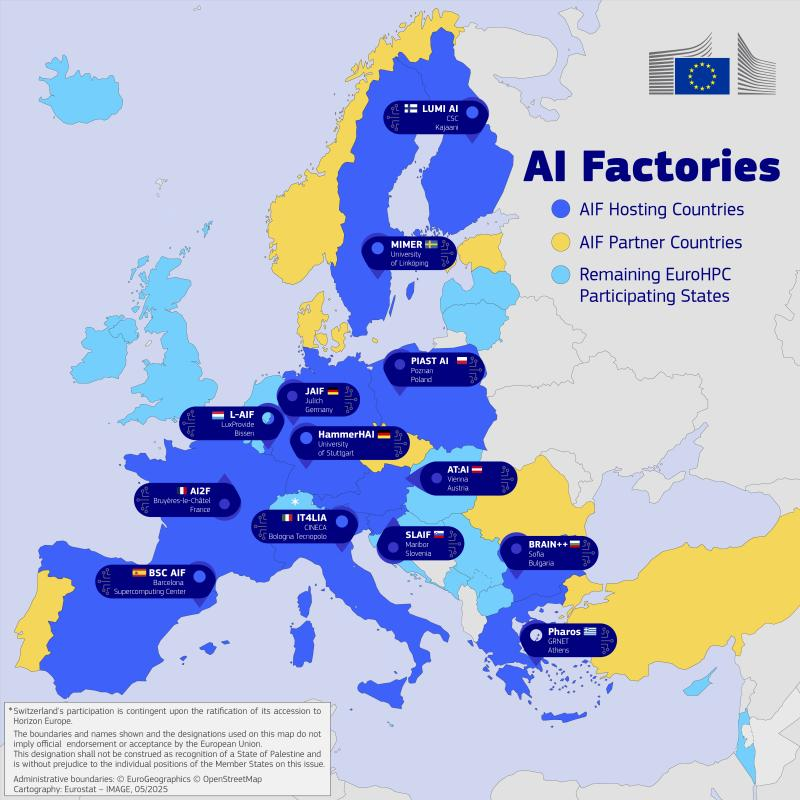 AI Factories. Image by: European Commission
The priority should be to unclog Europe’s financial system and direct funding towards the technological frontier. Here, patient capital essential. Deep-tech and industrial innovation have long development cycles. Europe therefore needs longer funding timelines – ideally 15 to 20 years – and a broader shift away from short-termism in its savings and investment model. Europe’s banks, which remain the principal source of external financing for companies, poorly suited to meeting this need, as they face hard balance-sheet constraints. The good news is that banks are beginning to partner with private credit funds, which can more easily hold long-term, illiquid credit risk, increasing overall financing capacity. Life insurers and pension funds must also step in and boost Europe’s securitisation market, a crucial funding vehicle for data centres and technology firms. To do so, however, they must be freed from some of the most stringent aspects of the Solvency II rules, which treat securitisations as structurally risky assets even when they are highly rated.
The European Commission has proposed the creation of the Scaleup Europe Fund, for which a private and independent manager is now being sought. Once established, the fund must support longer holding periods and larger funding rounds, enabling companies to build full product portfolios rather than betting everything on a single breakthrough. At the same time, governments must play a stronger role as early customers for emerging technologies. Establishing a dedicated European procurement framework for deep-tech – including advance market commitments similar to those used for vaccines during the Covid-19 pandemic – would create predictable demand and help innovative firms reach scale more quickly.
 Server room in CERN (Switzerland). Image by: Florian Hirzinger via Wikimedia Commons
The growing momentum should also allow Europe to tackle its perennial problem: national fragmentation that invites regulatory arbitrage. Divergent tax regimes, pension systems and supervisory practices cause European savings either to remain trapped in national markets or to flow outside of the EU in search of better returns. There is no shortcut to fixing this problem other than a step change in Europe’s capital-markets architecture, beginning with transforming the European Securities and Markets Authority into a strong and genuinely European supervisor. This would reduce distortions and allow savings to flow more freely across borders within the EU. What often seems impossible has been achieved before, as demonstrated by the creation of the European Banking Authority in banking supervision.
Finally, real substance must be given to the EU-INC concept – a pan-European legal framework for incorporating and operating a company seamlessly across the Single Market – and to provide a much-needed boost to Europe’s founders and entrepreneurs. To be effective, the initiative must be ambitious: it should establish a single, central, fully digital and API-enabled EU-level company registry with standardised investment documents, allowing Europe to stand out for ease of incorporation and governance. Crucially, the EU-INC option must be open to all, rather than restricted to a narrow or pre-defined category of ‘innovative’ firms. Otherwise, arbitrary limits would be introduced, undermining the usefulness of the initiative. By offering a lean, standardised framework for incorporation, governance and early fundraising, EU-INC would give European start-ups a vital lift, removing many of the hurdles they face in early stages. If European leaders are serious about enabling innovative firms to scale, they should endorse it now.
Across all these areas, the EU has a chance to overcome its intrinsic limitations and finally harness the benefits of scale. But incremental improvement will not suffice. Europe needs what might be called an ‘escape velocity’ – the point at which reforms are sufficiently bold and coordinated to break free from structural fragmentation, chronic underinvestment and slow decision-making. Below that threshold, progress risks being absorbed by inertia.
Paweł Świeboda is a Senior Visiting Fellow and Co-Director of the Brussels Economic Security Forum, the EPC's flagship project on economic security.
The support the European Policy Centre receives for its ongoing operations, or specifically for its publications, does not constitute an endorsement of their contents, which reflect the views of the authors only. Supporters and partners cannot be held responsible for any use that may be made of the information contained therein.