

Strengthening the Implementation of the New Pact on Migration and Asylum through Soft Enforcement
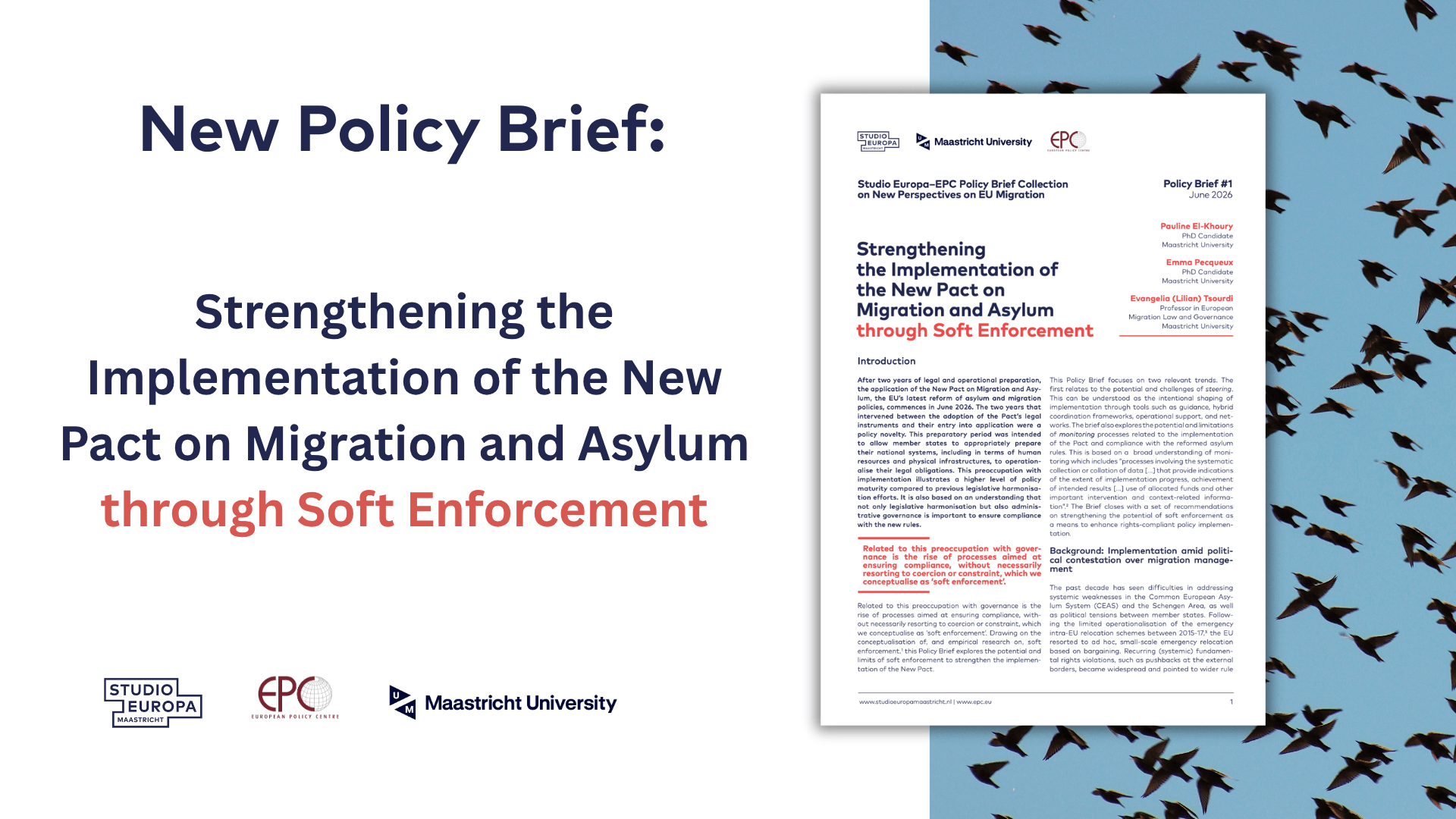


As the EU’s New Pact on Migration and Asylum entered into application on 12 June, a new EPC–Studio Europa Maastricht Policy Brief asks a critical question: how can implementation and compliance be ensured in practice?
The brief highlights the growing role of “soft enforcement” – through steering and monitoring – in holding member states to their obligations.
It finds that these tools can improve coordination and consistency, but also warns of opacity, overlapping structures and monitoring overload that risk weakening accountability.
The authors call for greater transparency, clearer roles, stronger coherence and resourcing of soft enforcement processes to ensure implementation remains effective and rights‑compliant.
Main conclusions:
- Soft enforcement will be a key feature of the newly reformed CEAS, given the limited margin for sanctioning non-compliance.
- It can strengthen consistency and trust, and reduce divergent practices across member states, but only if properly designed and resourced.
- Without greater transparency, clarity and reduced overlap, current complexity risks undermining effectiveness and accountability.
Read the full Policy Brief here.
Pauline El-Khoury is a PhD Candidate at Maastricht University.
Emma Pecqueux is a PhD Candidate at Maastricht University.
Evangelia (Lilian) Tsourdi is a Professor in European Migration Law and Governance at Maastricht University.
This publication is part of a collaborative project between Studio Europa Maastricht (SEM) and the European Policy Centre (EPC). The policy brief collection has been jointly developed, reviewed, and endorsed by both partners.
The support SEM and EPC receive for their operations, or specifically for this publication, does not constitute an endorsement of its contents, which reflect the views of the author(s) alone. Neither supporters nor partners can be held responsible for any use that may be made of the information contained herein.