

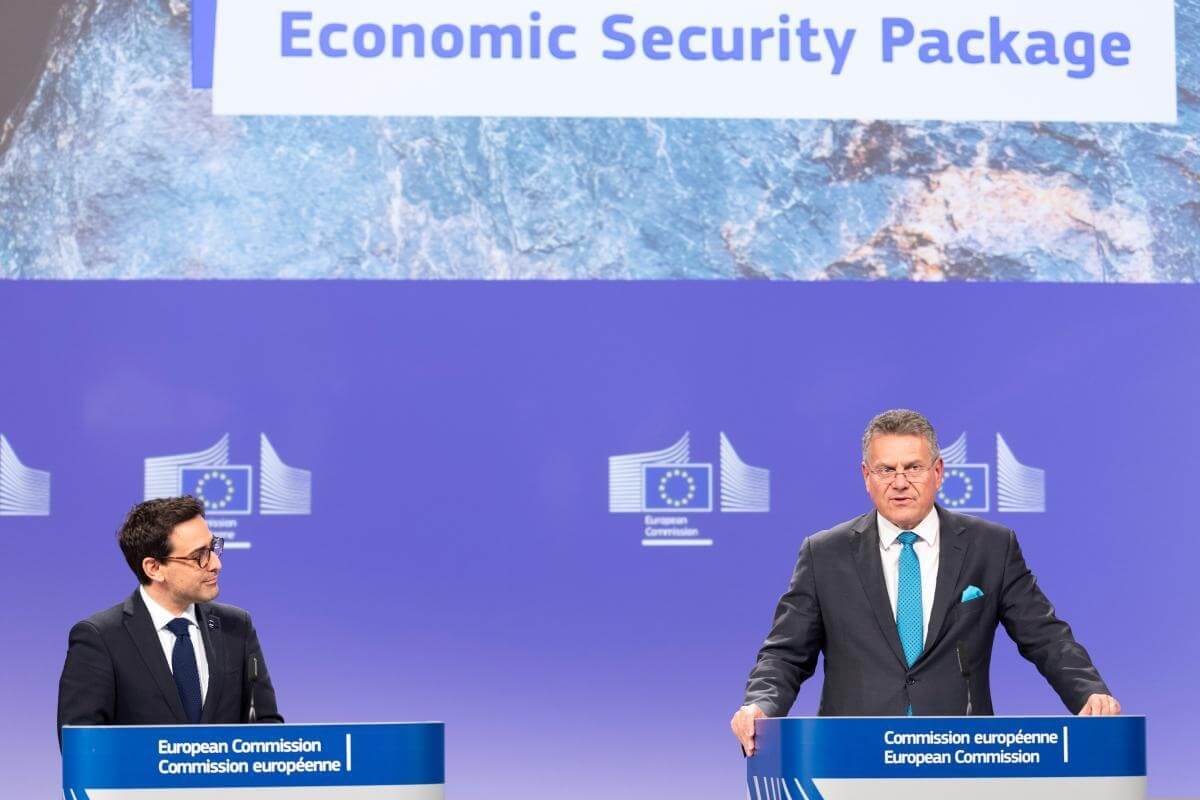

Economic security has become a defining concern of our time. Triggered by Russia’s weaponisation of energy, China’s control of critical raw materials and the coercive trade tactics of US President Donald Trump, it now shapes decisions in governments and boardrooms from Brussels to Tokyo. The recent Joint Communication by the Commission and the High Representative, ‘Strengthening EU economic security’, makes it clear: “the increasingly frequent and targeted use of economic tools to advance strategic objectives has become a defining feature of today’s geopolitical landscape”.
Responding to this environment requires more than tactical fixes. The EU calls for “a paradigm shift, moving from a reactive posture towards a more proactive and systematic deployment of tools”. The Communication recognises that the paradigm shift entails a real cost, with distributional consequences: “in certain cases, the EU, its Member States and industry will increasingly need to be ready to accept economic costs for the benefit of reduced vulnerabilities and enhanced overall security”.
The political urgency is clear and the task appears straightforward: reduce vulnerability to coercion or disruption, protect strategic industries and secure vital supplies, making European industry more resilient. In practice, however, economic realities are far more difficult: negative externalities, blurred lines between public and club goods, deep uncertainty and painful trade-offs. Policy that ignores these dynamics may prove ineffective or even counterproductive: failing to protect Europe while weakening the prosperity on which strength depends. Yet, this economic dimension of economic security remains poorly understood.
Resilience under uncertainty
Economic security is shaped by Knightian uncertainty – risks whose probability cannot be known. Europe faces polarised but uncertain outcomes: for instance, whether to invest now in secure but costly energy and raw-material supplies or stick with cheaper, riskier sources and hope the worst never comes.
Early action can bring a first-mover disadvantage. Building alternative supply chains or reshoring is expensive and may erode competitiveness if shocks never materialise. Firms that hedge too soon risk losing market share to rivals keeping costs down. Politicians risk criticism if they spend public money on threats that do not appear. Yet delay can be disastrous when shocks arrive.
Addressing the challenge must start at the firm level. Companies optimise for their own costs, not for system-wide resilience. If many rely on cheap but risky suppliers, whole sectors become exposed to disruption or coercion. In other words, the failure of individual firms to mitigate risk creates negative externalities in the form of increased vulnerabilities for the sector and the wider economy.
Demand power, the leverage of being the buyer, can sometimes offset coercion. But when dependency is weaponised, exposure turns dangerous. Managing this risk is difficult: some dangers never materialise, others erupt without warning, as with the pandemic’s shock to medical supplies. The result is chronic under-investment in resilience, as no actor wants to bear costs that competitors may avoid.
Public action is therefore required. Elements of resilience resemble public goods – broadly shared benefits from which no actor can be excluded. Collectively funded public goods are routinely underprovided when resources are scarce. In other areas, economic security operates more like a club good – benefits flow only to those who join and contribute. Such clubs need clear rules and funding and can clash with wider market integration; in Europe, selective security clubs risk fragmenting the Single Market.
The danger multiplies when measures justified as security are in fact driven by protectionism. Decision-makers may badge industrial support as security-driven when it mainly shields domestic champions. Clear aims in procurement and funding rules help guard against this by enforcing transparency.
Even well-designed and well-motivated policies can misfire in a second-best world where distortions persist and rivals react strategically. Subsidies may provoke retaliation or trade disputes. Export controls can spur competitors to accelerate capacity. Anticipating others’ moves is the realm of game theory and reaction functions; ignoring it can turn protection into new vulnerability.
Competitiveness and security depend on each other but often pull in opposite directions. Innovative, open economies absorb shocks better and sustain defence and technological leadership. Yet poorly calibrated security measures – sweeping reshoring, broad trade or investment limits, strict localisation – can raise costs and stifle innovation. Overreach risks hollowing out the very industrial base meant to be protected.
EUrope must instead pursue resilient and contingent openness, trading as openly as possible within the limits of economic security, and seek synergetic wins, such as supplier diversification.
Effective policy
Effective policy starts with intelligence and contingency planning. Uncertainty must be addressed directly. Stress testing, scenario planning, war-gaming and structured forethought can help avoid complacency and costly overreaction. Better intelligence is crucial not only for defensive actions but also to identify where more offensive and proactive policy options present themselves, for instance in the identification of other countries’ chokepoints.
Ideally, policymakers would price negative externalities – but this is rarely feasible. More practical is to embed security criteria in public procurement and funding regimes and integrate them into policy for defence-related and key enabling technologies. Companies must build geoeconomic and geopolitical intelligence, map critical dependencies and plan for shocks. Decision-makers should treat firms as partners; they hold essential implementation knowledge.
Clarity is vital. European public goods should be funded collectively, not through fragmented national measures. For club goods, rules of membership, cost sharing and the impact on the wider market must be explicit.
Economic statecraft will increasingly shape the ability to act in a world of rivalry and coercion. From sustaining allies to protecting critical technologies and supply chains, the stakes are high. Poorly crafted policies can sap growth, alienate partners and deepen vulnerabilities. Understanding the economics will not remove painful choices, but let them be made with open eyes.
Debate often jumps straight to instruments without a clear economic framework. Grounding policy in structured economic analysis is essential to safeguard both prosperity and security when economic interdependence is weaponised.
The economics of economic security hold one final lesson: no policy is likely to succeed if it allows free riding on the costs this paradigm shift imposes, whether by companies or governments. The only effective response to today’s economic security challenge is a common European one.
Fabian Zuleeg is Chief Executive and Chief Economist at the European Policy Centre.
The support the European Policy Centre receives for its ongoing operations, or specifically for its publications, does not constitute an endorsement of their contents, which reflect the views of the authors only. Supporters and partners cannot be held responsible for any use that may be made of the information contained therein.