

The European Parliament’s cordon sanitaire – defended in form, redrawn in substance


The 10th European Parliament (EP) opened amid shifting political winds: the far right is larger, louder and more confident. Yet data show that the cordon sanitaire inside the EP has rarely been stronger. The mainstream stays put – it is the political gravity beneath it that is sliding right.
Eulytix’s analysis of co-sponsorship and amendment collaboration across the 9th (2019–2024) and 10th (2024–2029) terms reveals a sharp contraction in contact between the mainstream (EPP, S&D, RE, Greens/EFA) and the far right (ID/ESN, Patriots for Europe, and other non-attached radicals).
In the previous term, 42% of ID MEPs and 64% of ECR MEPs maintained at least one mainstream link. Today, those shares have collapsed to 24% for the conservatives and 0% for Patriots and ESN. Amendment co-sponsorship has nearly vanished: where 4% (ECR) and 2% (ID) of their amendments once drew mainstream support, those figures now stand at barely 1% and zero. Cross-group sponsorship has also dropped sharply.
From porous to partitioned
The visual difference is striking. In the 9th term, far-right clusters still brushed against the mainstream core. In the 10th, they sit fully isolated while the mainstream forms a dense nucleus.

Brussels’ informal cordon sanitaire – the understanding that pro-European forces do not cooperate with extremist actors – remains intact and, procedurally, reinforced.
The EPP’s dual role
At the centre of this new configuration stands the EPP, now both anchor and firewall: the bridge within the mainstream bloc and the barrier shielding it from the extremes. Its previous outward-looking network, including towards the right, has receded.
The EPP’s credibility as the ‘governing party of Europe’ depends on maintaining distance from the radical right while appealing to voters tempted by it. Its sharper internal clustering suggests a deliberate choice to lead from the centre rather than flirt with the fringe.
The ECR’s balancing act
If the EPP is the firewall, the ECR remains the hinge. Its connective role between the far right and mainstream has weakened – and intentionally so. The ECR is pursuing selective respectability: distancing itself from the Patriots and ID/ESN to project a mainstream conservative profile.
This serves both sides: the mainstream gains a stabilising right-flank partner, while the ECR gains proximity to power. Yet, the ECR remains the key intermediary – the gatekeeper of potential far-right normalisation.
Institutional containment, ideological contagion
Procedurally, containment works. Substantively, the battlefield has shifted. The far right now exerts influence through discourse rather than cooperation.
On migration and asylum – the core terrain of political contestation – the mainstream has moved sharply right. The EPP and Renew have hardened their positions, and the gap with the ECR has nearly closed. The far right now sets the terms of debate without alliances.
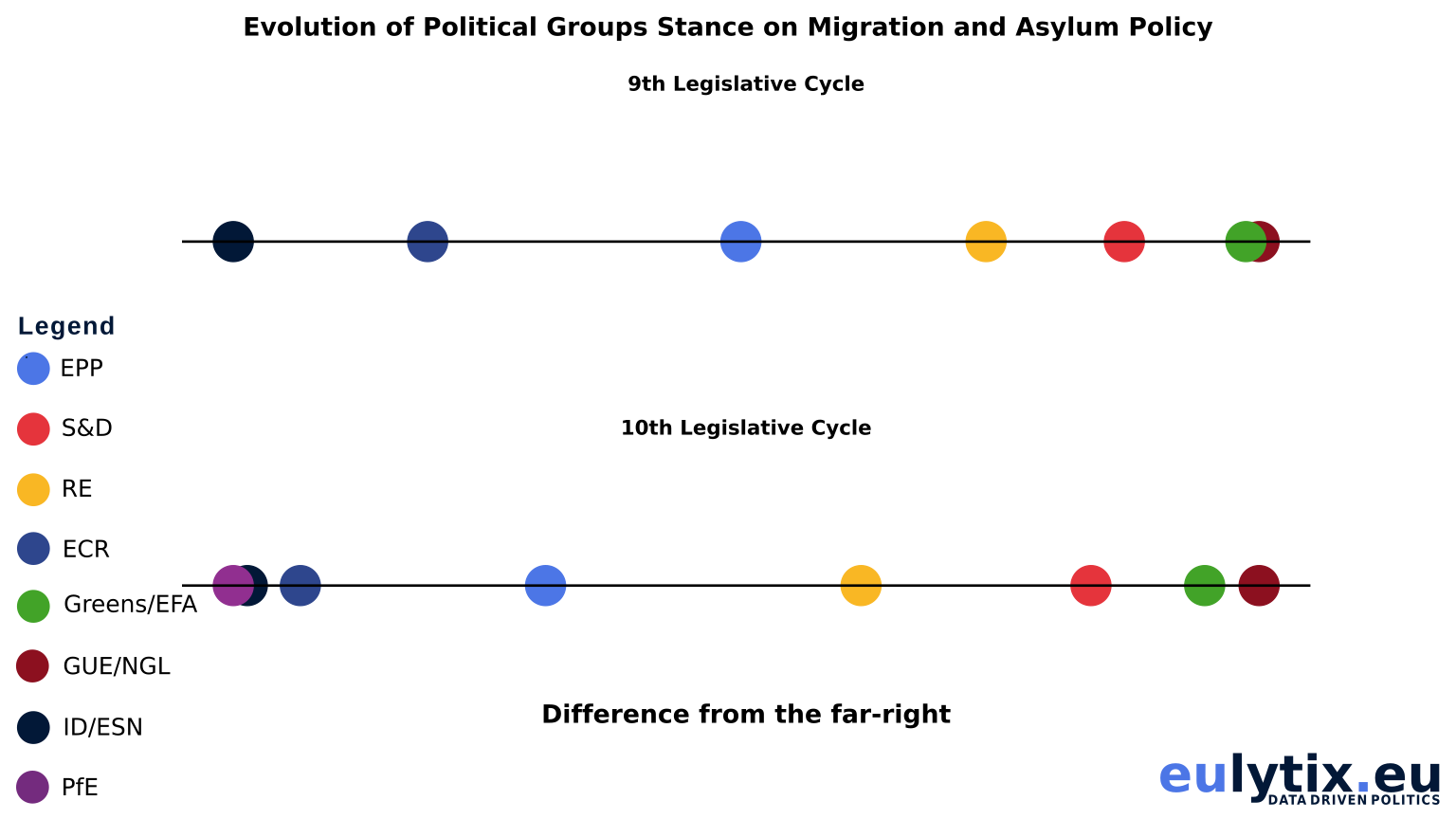
Yet this development is uneven. On media and freedom, for example, mainstream groups still articulate technocratic, pro-European positions, with little ideological seepage. Narrative contagion is thus issue specific.
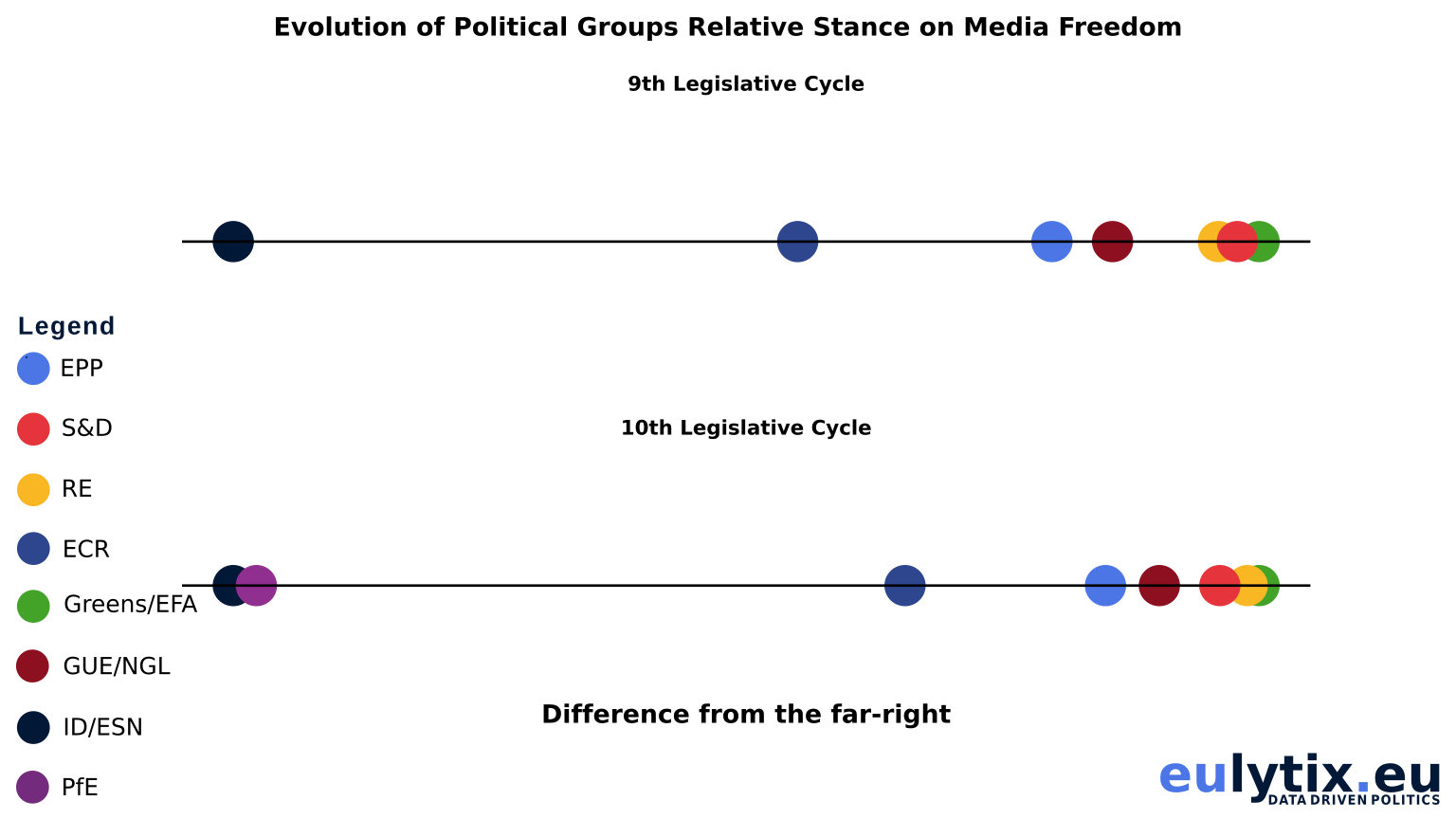
The revealed asymmetry is telling. The cordon sanitaire may block procedural cooperation, but its ability to shield the mainstream from agenda-setting pressure varies by policy field.
The paradox of success
Procedurally, the EP remains a cohesive pro-European arena. Mainstream cooperation is dense and extremists remain marginal in law-making.
But containment is increasingly defensive. As the centre moves rightward on issues like migration and the gap between ECR and the far right collapses, the Parliament risks losing the political battle. A stronger firewall may even fuel the far right’s preferred narrative – the silenced outsider confronting an entrenched elite.
Meanwhile, member states tell a different story, with the far right moving from protest to power in Italy, the Netherlands, Finland and beyond.
From procedural to ideological drift
Roll-call data reinforce this picture. Procedural cooperation between mainstream and far-right MEPs has nearly disappeared, yet the ideological centre of gravity has shifted rightward. This reflects the Parliament’s new composition more than new alliances.
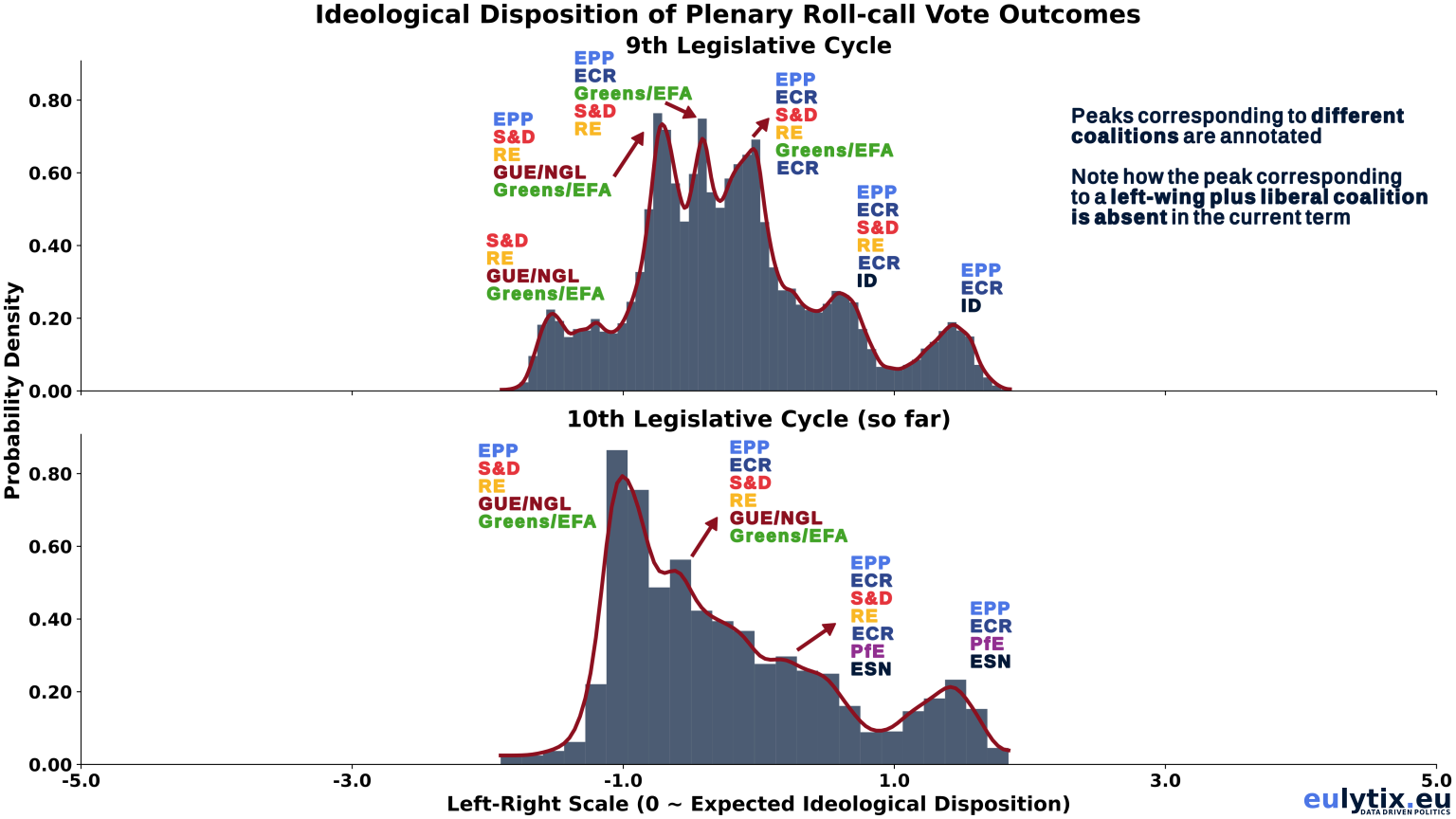
Where the EPP’s previously aligned with the ECR in 62% of sessions, the figure is now 53%. Agreement with far-right groups remains low – but agreement across mainsteam and left-wing groups has increased, keeping decisions anchored in the pro-European centre. What has vanished is the occasional ability of left-liberal coalitions to push progressive outcomes, as they did on aspects of the Green Deal in the 9th term, tilting the overall output rightward.
Agreement between political groups during plenary roll-call votes
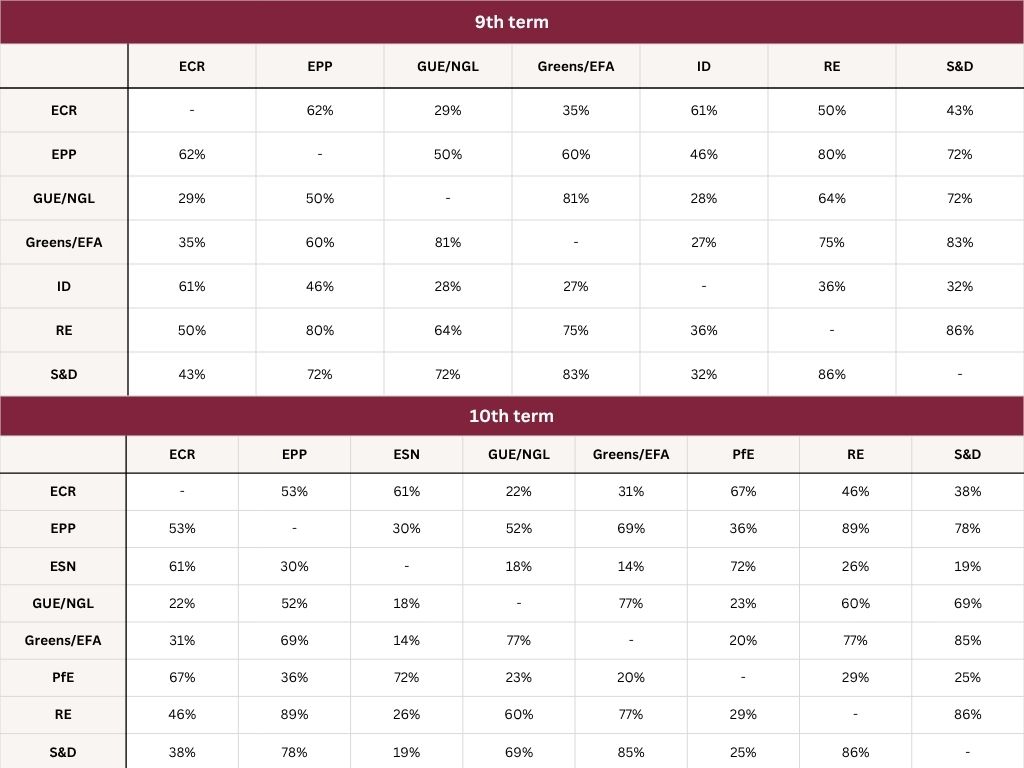
Simply put: the drift stems less from cooperation with the far right than from the evaporation of alternative coalitions.
A moving centre
Before the elections, the question was whether the EPP would hold the centre or be pulled rightwards. The answer is now clearer: it held, but the centre itself moved.
The EPP and Renew remain disciplined on procedure yet materially harder on migration. Meanwhile, the ECR aligns almost perfectly with the far right, erasing the buffer between conservatism and radical nationalism.
The result is a firewall that still stands but protects a shrinking centre. Mainstream actors refuse formal cooperation yet increasingly operate within extremists’ ideological frame. The risk is not collaboration but accommodation – a Parliament that keeps radicals out of the committee room while absorbing their worldview in the plenary.
Unless pro-European forces rebuild an alternative centre, the cordon sanitaire may endure in procedure while shifting in substance.
Eulytix has been supported by the National Research, Development and Innovation Office in Hungary under the project number 2021-1.1.4-GYORSÍTÓSÁV-2022-00041.
This commentary forms part of a series leading up to the European Policy Centre's 2025 Annual Conference. Click here to learn more.
Read the full publication here.
Attila Kovács, PhD, is CEO of Eulytix.
Corina Stratulat is an Associate Director and Head of the European Politics and Institutions Programme at the European Policy Centre.
The support the European Policy Centre receives for its ongoing operations, or specifically for its publications, does not constitute an endorsement of their contents, which reflect the views of the authors only. Supporters and partners cannot be held responsible for any use that may be made of the information contained therein.