

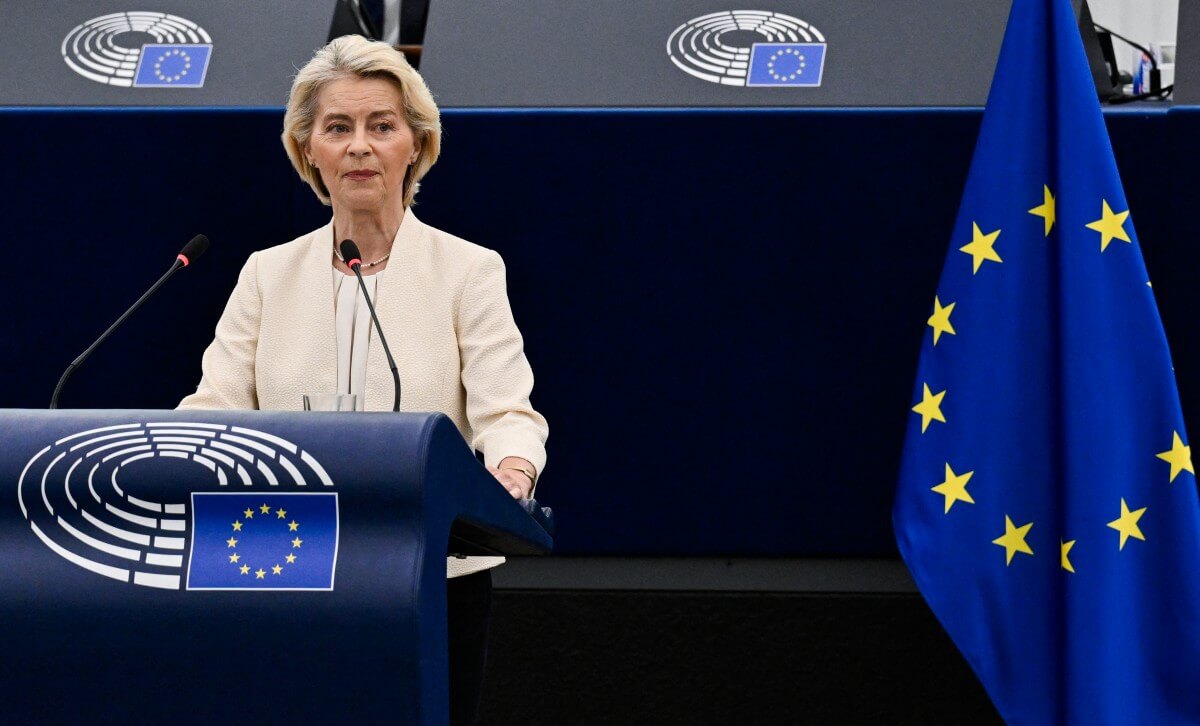

Von der Leyen's annual address identified Europe's pressing challenges, but meeting them means changing how the EU makes policy.
European Commission President Ursula von der Leyen's State of the Union address on Wednesday contained much to welcome. She recognized the need for speed, including on investment, permitting and grid connections. She acknowledged dangerous dependence on China, structurally high energy prices and the case for rethinking Europe's partnerships.
But, disappointingly, implementation and delivery did not feature more prominently.
The European Union does not lack ambition, strategies or diagnoses. The Commission has a long list of initiatives under way. The reports by Mario Draghi on competitiveness and Enrico Letta on the single market have set out much of what must be done.
The problem is the delivery gap: the growing distance between the scale, scope, depth and speed of action required and what Europe actually implements.
Parts of the speech inadvertently illustrated the problem. Von der Leyen proposed a "pact against gold-plating," calling on member states to stop adding national requirements to European rules. Yet the practice has been a known issue for decades. Why would another pact make capitals behave differently? What incentives, monitoring and consequences would make it work?
Likewise, making Canada the EU's first "associate member" could be groundbreaking. But what does associate membership mean? What rights, obligations, governance and enforcement would it entail? A bold announcement without these details risks remaining just that.
Potentiality and actuality
Closing the delivery gap requires a fundamental change of mindset in European policymaking: away from an ex-ante, legislation-heavy and announcement-driven work program toward an approach that centers on strategic objectives, prioritizes results and is fast and adaptable.
First, policy must become mission-focused. Political ambitions must be turned into tangible strategic objectives, with responsibilities, resources and deadlines.
Take energy. If the strategic objective for Brussels is faster electrification and lower costs, work backward: How much additional grid capacity is required, where and by when? Who will deliver it? What happens when milestones are missed?
Second, implementation must be part of the design from the beginning. Wherever possible, the EU should use existing mechanisms, such as mutual recognition, rather than automatically reaching for new rules that take time and add to the legislative burden companies already face.
Consultation cannot simply mean asking stakeholders to comment on an almost-finished proposal. The national and local authorities, businesses, trade unions and civil society organizations that ultimately have to make policies work should help stress-test them before core choices are fixed.
Where are the administrative bottlenecks? Are the necessary skills and financing available? Can current systems deliver the objective? Lessons from implementation must then continuously feed back into policymaking.
Third, Europe needs far more experimentation followed by rapid scaling.
The proposed 28th regime for startups and scaleups offers one model: Rather than waiting to harmonize 27 national systems, it would create an optional European framework alongside them.
Mutual recognition provides another route where national laws do not genuinely need to be identical.
Across the competitiveness agenda, Europe should pilot approaches, evaluate them swiftly and scale what works. The aim is not perfect legislation from the outset but learning by doing.
Fourth, policy must be stress-tested against a radically uncertain world.
China shows why. Grand declarations about using every available instrument can even be counterproductive if Europe does not follow through. Better to identify concrete, credible measures, however limited at first, that the EU is prepared to take, and the specific changes in Chinese behavior they are intended to produce.
The goal must be to reshape incentives and outcomes, not to grandstand.
The same applies to the United States. Europe should determine now how it would respond to renewed tariffs, economic coercion or a further deterioration in the transatlantic security relationship. That means preparing no-regret options, reducing reliance on any single power and building coalitions with like-minded partners.
Finally, there is the governance of delivery. When negotiations among member states lead to delay or weak compromises, willing countries must be able to move ahead.
Common financing is an obvious example. If all 27 capitals cannot agree on joint borrowing for defense, Ukraine or other strategic investments, a smaller group of EU countries, possibly with partners outside the bloc, should draw on existing arrangements where possible or create parallel ones where necessary. Enhanced cooperation and variable integration should become practical instruments of delivery, not institutional last resorts.
Von der Leyen is right that Europe needs to act faster. But speed is not about announcing more measures more quickly. Nor should every European problem produce another law from Brussels.
The starting point must be the strategic objective, followed by the fastest and most effective mechanism to achieve it.
That is a profound change from the EU's traditional policymaking model: from announcing and legislating to implementing, experimenting, learning and delivering. Europe increasingly knows what it has to do. Its future depends on whether it can do it.
This Op-ed was originally published in The Parliament.
Fabian Zuleeg Chief Executive and Chief Economist
The support the European Policy Centre receives for its ongoing operations, or specifically for its publications, does not constitute an endorsement of their contents, which reflect the views of the authors only. Supporters and partners cannot be held responsible for any use that may be made of the information contained therein.