


Spain’s snap election: Why Sánchez called it and what comes next

Spain is something of a political paradox. Its economy has been growing faster than most other major European economies, while Pedro Sánchez’s governments can point to a substantial progressive record, from the green transition and expanded social policies to LGBTQ+ rights, development aid and the regularisation of migrants. Many of these measures have been fiercely criticised by the right. Yet, in the end, it was an issue on which the left should theoretically have had the political advantage – housing – that pushed Sánchez to call an early election.
Spain is experiencing one of Europe’s most acute housing affordability crises. The issue exploded politically after the eviction of Maricarmen Abascal, an 87-year-old woman who had lived in her Madrid home for seven decades. Her eviction triggered large demonstrations and renewed mobilisation around housing across the country.
The government responded with two emergency housing decrees containing stronger protections for tenants and measures intended to regulate the rental market. Their defeat in Congress, however, exposed the weakness that has haunted Sánchez’s government since the 2023 election: it does not have a reliable parliamentary majority. Junts, the Catalan pro-independence party on the centre-right, joined the PP and Vox in voting down the measures.
Sánchez has now turned that parliamentary defeat into an electoral confrontation, calling a general election for 29 November. His argument is clear: if the government cannot secure enough votes in parliament to tackle the housing crisis, voters should give it a stronger mandate.
The starting point is difficult for the left. Recent polling puts the PP ahead of the PSOE and shows Vox as particularly strong. A future PP–Vox government is therefore one of the central possibilities shaping the campaign, although its composition would depend on the result and subsequent negotiations.
Sánchez, however, has been here before. In 2023, the PP also led the polls, yet Sánchez mobilised enough support for the PSOE and later assembled a parliamentary majority that allowed him to remain prime minister.
The biggest uncertainty may lie to the left of the PSOE. The space once occupied by Podemos is fragmented, with several parties preparing to contest the election through a new Frente Amplio platform, while Podemos remains outside it. Whether the left can reorganise quickly enough may prove decisive.
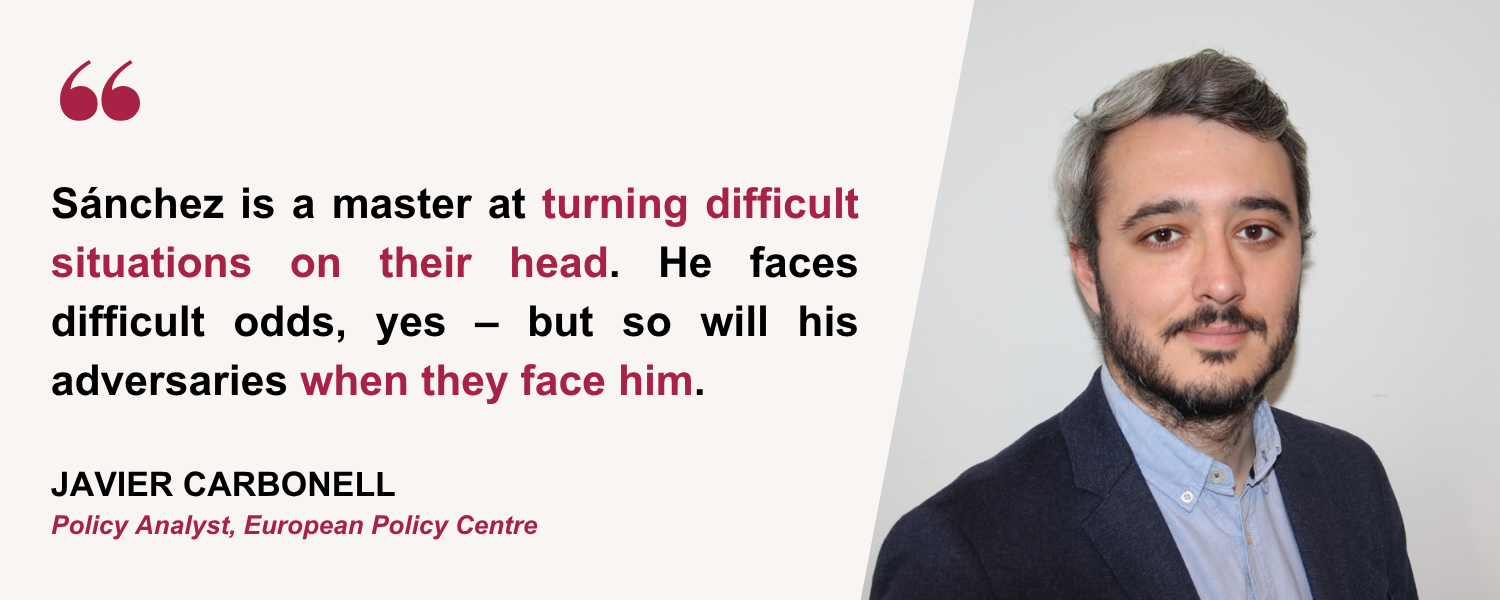
Sánchez is a master at turning difficult situations on their head. He faces difficult odds, yes – but so will his adversaries when they face him.
Javier Carbonell is a Policy Analyst in the European Politics and Institutions Programme at the European Policy Centre.
The support the European Policy Center receives for its ongoing operations, or specifically for its publications, does not constitute an endorsement of their contents, which reflect the views of the authors only. Supporters and partners cannot be held responsible for any use that may be made of the information contained therein.