

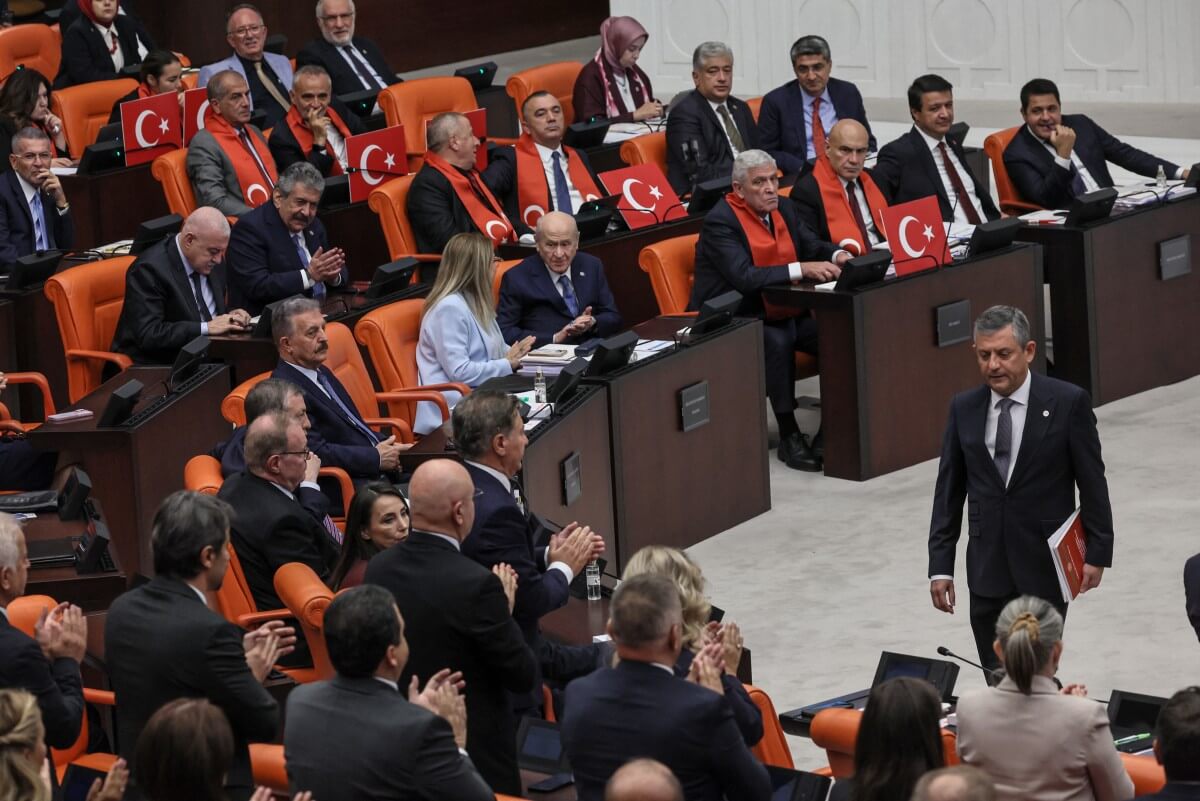

Turkish politics rarely slows down. This summer was no exception. The creation of New Party (Yeni Parti) in July 2026 could prove to be one of the most consequential developments for the country’s political future. In one of modern Turkey’s most dramatic political realignments led by Özgür Özel, 91 of the 135 MPs of the Republican People’s Party (CHP) left it to establish a new political movement. Given its potential consequences for Turkey’s future, this development also matters to the EU, for which Turkey is both a candidate country and a strategic partner on defence, migration, trade, energy and connectivity.
This is not simply another party split. Upon its founding, New Party became the main opposition in the parliament. The polls also place it at least 4 points ahead of the governing Justice and Development Party (AKP), making it the country’s most popular party. Its fate could therefore profoundly affect the future of democracy in Turkey.
Born of political necessity
Creating a new political party was not an easy decision, given that the CHP is the founding party of the Turkish Republic. New Party was not part of the opposition’s original roadmap. It emerged in response to an appeal court decision declaring the CHP’s 2023 party congress null and void. At that congress, progressive forces, led by Özgür Özel and now-imprisoned Istanbul Mayor Ekrem İmamoğlu, had defeated the previous leadership.
The CHP achieved a historic 2024 local election victory but has since faced numerous legal cases. Thirty-six CHP mayors have been arrested over the past two years, including İmamoğlu, the party's presidential candidate, who received the support of 15 million people in the CHP's presidential primary. The number imprisoned continues to rise, while only six have been released.
As legal pressure intensified and efforts to resolve the crisis after the appeal court ruling failed, most MPs concluded that founding a new party offered the best chance of preserving the momentum. The decision also reflected strong public demand for a “new” party with a new strategy.
A new generation of politics
Although New Party defines itself as social democratic, Özel has avoided presenting it as exclusively for social democrats. Instead, he describes it as a home for a new generation of politics, seeking to unite democrats from across Turkey's political spectrum, including conservative, nationalist, Kurdish, liberal and socialist democrats.
This strategy had already taken shape under Özel and İmamoğlu in the CHP, culminating in the opposition’s landmark 2024 local election victory under what they called the “Turkey Alliance”.
Rather than competing over ideological purity, the new movement seeks to build the broadest possible democratic coalition against increasingly authoritarian rule.
Reinventing how parties operate
New Party also promises to change how political parties function internally. It proposes a more participatory model, giving members greater influence over decision-making and local councils a more prominent role in policymaking.
Equally significant is its financing model. Current rules exclude the party from state funding until the next election. It has therefore launched a campaign based on small individual donations and membership fees.
In the first three weeks of the campaign, 152,000 people contributed financially while more than 600,000 joined the party and paid membership fees. By 31 August, these contributions had generated around €10 million, a figure that continues to rise. This allows the leadership to present the party as a movement created and financed by the people. The campaign’s digital dimension is also significant. More than 400,000 members joined through the online registration system on the party’s website.
Risks
The opportunities are evident. New Party could emerge as a new centre of political gravity, attracting broader support and potentially becoming Turkey’s next governing party. Yet the risks are equally significant. The party will continue to face immense legal and political pressure. Its presidential candidate İmamoğlu, still the opposition's most popular political figure, is imprisoned and facing numerous legal cases. There are also 63 cases seeking to lift Özel's parliamentary immunity. Although the process is not automatic and parliament rarely lifts MPs’ immunity in such cases, the threat remains a sword of Damocles over Özel and, by extension, New Party.
Why Europe should pay attention
The EU should not view this simply as another episode in Turkey’s often turbulent domestic politics. This represents the most ambitious attempt in years to reinvent the democratic opposition under increasingly restrictive political conditions.
The EU now tends to approach Turkey primarily as a strategic partner rather than as a candidate country. This partly reflects an assumption that Turkey is unlikely to resume democratisation in the foreseeable future. While the country’s severe democratic backsliding is undeniable, and restoring democratic governance will be exceptionally difficult, EU policy should not overlook the opposition’s resilience, popularity and continued public support.
With democratic backsliding at unprecedented levels, New Party could offer an important opportunity for Turkey’s democratic future. Its ambition partly resembles that of Péter Magyar’s Tisza movement in Hungary: to build a broad coalition capable of challenging an entrenched governing party.
The Turkish circumstances are different and undoubtedly more challenging. Yet there are also important similarities: weakened democratic institutions, a highly dominant governing party, fragmented opposition forces and growing public demand for political change.
Whether this ambitious attempt succeeds remains to be seen. Turkish politics has repeatedly demonstrated that optimism alone cannot overcome institutional constraints. But New Party is already reshaping the political landscape by attempting what few opposition movements have achieved: transforming a broad democratic coalition into a new movement and becoming the country’s most popular political party from the very first day.
For that reason alone, its development deserves close attention, in Brussels and across Europe.
Dr. Demir Murat Seyrek is an Academic Fellow at the European Policy Centre and an Adjunct Professor at VUB and the Brussels School of Governance.
The support the European Policy Centre receives for its ongoing operations, or specifically for its publications, does not constitute an endorsement of their contents, which reflect the views of the authors only. Supporters and partners cannot be held responsible for any use that may be made of the information contained therein.