

A three-pillar strategic investment strategy for Ukraine


Ukraine faces unprecedented challenges: defending itself against Russia, maintaining macro-economic stability, rebuilding its infrastructure, and advancing EU accession reforms. Although Ukraine has demonstrated remarkable resilience, the scale of these tasks exceeds the country’s financial capacity and demands sustained international support. For recovery and reconstruction, alone, the World Bank estimates investment needs of $524 billion over the next decade.
The Ukraine Recovery Conference in Rome last week brought welcome news: it resulted in €11 billion in reconstruction deals, a €2.3 billion top-up for the Ukraine Facility’s investment framework, and the launch of a European Flagship Fund for the Reconstruction of Ukraine, initially seeded with €220 million via the European Investment Bank. These commitments represent meaningful progress—but they remain well below what is required to meet Ukraine’s investment needs. Meanwhile, US support has declined, and little can be expected from the next Multiannual Financial Framework (MFF), with opposition from Hungary and Slovakia weakening a unified EU-27 response.
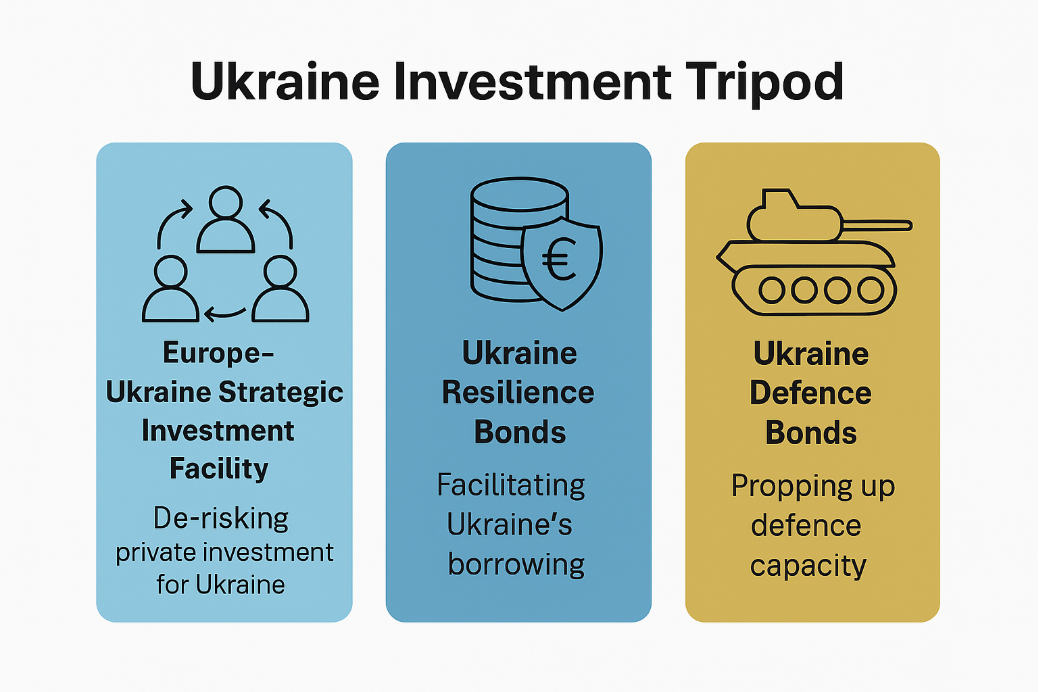
To effectively support Ukraine, the solution may lie in a tripod of off-budget instruments, backed by coalitions of willing EU member states and like-minded third countries such as the UK, Norway, Türkiye, and others. Frozen Russian assets could be considered as a security guarantee in the event of further Russian aggression. Each pillar would address one of Ukraine’s most pressing financing challenges:
-
Mobilising greater private investment
-
Enabling increased long-term Ukrainian government borrowing
-
Expanding military support
First, a Europe–Ukraine Strategic Investment Facility (EUSIF) could be established to help mobilise private investment in Ukraine. It should complement the existing investment framework under the Ukraine Facility, adopting a similar open-architecture model but with significantly greater resources and a stronger focus on attracting foreign direct investment (FDI). EUSIF should deploy a broader set of de-risking instruments—including political risk insurance, export credit guarantees, loans, equity, first-loss guarantees and securitised, tradeable assets. To maximise its appeal to participating countries, the facility should prioritise high-impact sectors of mutual interest, such as defence and clean energy. In doing so, it would enhance European competitiveness, strategic autonomy, and security, while deepening Ukraine’s integration with the rest of Europe.
Second, the provision of security guarantees for Ukrainian sovereign borrowing, specifically for defence and reconstruction, should be advanced to improve Ukraine’s access to international bond markets. Under this scheme, Ukraine Resilience Bonds (URBs) could be issued by the Ukrainian government as long-term public debt, backed by coalition guarantees covering both financial and political risk. As with EUSIF, these guarantees should be conditional on robust anti-corruption measures and external oversight, ensuring alignment with Ukraine’s reform and recovery objectives.
Source: EPC
Third, a similar coalition should consider issuing common debt to jointly finance military support for Ukraine. While the European Peace Facility has played a key role in facilitating national military assistance, its expansion has been repeatedly blocked by Hungary. Moreover, the Facility merely reimburses member states for bilateral contributions, rather than enabling a genuinely joint effort. A common debt-financed instrument could raise funds more affordably than individual member states and benefit from economies of scale through joint procurement. Introducing a minimum sourcing requirement for participating countries could also strengthen the defence industrial base of European and like-minded partners.
Such a holistic approach will be essential to enable Ukraine to withstand Russian aggression over the long term and evolve into a prosperous democracy ready for EU membership. Failing to act decisively would not only pose serious risks to the EU’s security but also squander the opportunity to harness Ukraine’s military and economic potential for Europe’s security, competitiveness, and economic resilience.
Fabian Zuleeg is Chief Executive and Chief Economist at the European Policy Centre.
Philipp Lausberg is a Senior Policy Analyst in the Europe's Political Economy programme at the European Policy Centre.
The support the European Policy Centre receives for its ongoing operations, or specifically for its publications, does not constitute an endorsement of their contents, which reflect the views of the authors only. Supporters and partners cannot be held responsible for any use that may be made of the information contained therein.