

(Re)affirmative (in)action – EU summits talking backwards
Europe’s leaders are talking themselves round in circles and backsliding on what must be done urgently if the EU is to remain relevant to its citizens and in the wider world.
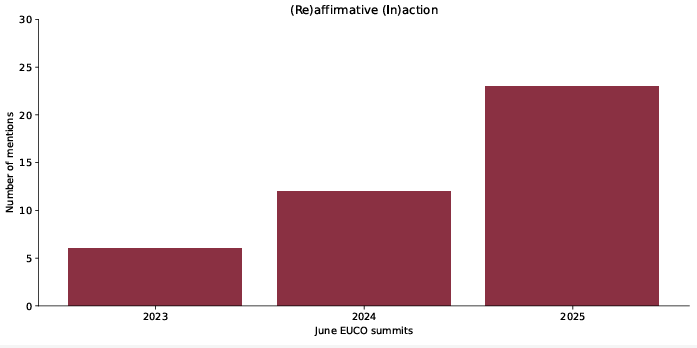
A quick analysis of the Conclusions of this week’s European Council confirms a disturbing trend. Variants of the words “reiterate” (14) and “reaffirm” (9) crop up fully 23 times (including five times in the separate statement they put out on Ukraine). For example, “The European Council reaffirms the commitment to the objectives of the Single Market and reiterates its calls to remove remaining barriers.”
A year ago, the same count yielded just 12 such reiterations and reaffirmations (when the Ukraine conclusions were in the main text). That was, nonetheless, twice the number at the June summit of 2023. The monotony of European Council conclusions is nothing new. But in June 2020, the heads of state and government managed to issue a concluding statement that neither reiterated nor reaffirmed anything at all.
Does it matter? Sure, some things the EU is never going to fix between one summit and the next. So, we should not be too astonished if condemnation of West Bank settlements has to be reiterated.
What is really troubling is the number of times that member states are repeating calls for actions that they themselves have to take. If the European Council “reiterates its calls to remove the remaining barriers” to the Single Market, who exactly is not listening, if not the very governments of the 27 sitting at the EU Summit table?!
Of course, half-heartedness and hypocrisy around barriers to internal trade are as old as the Union itself. But this week’s Conclusions also highlight how the European Council does not even seem to be able to act on its own supposed agreements, even when these are quite recent. Witness, again in the Middle East, “The European Council … reiterates its call on the Council to take work forward on further restrictive measures against extremist settlers” in the West Bank.
The European Council is reminding itself to do something that it supposedly agreed to do just last year…
The EU has learned over nearly seven decades that when members stop moving forward together, they risk moving backwards in disunity. Yet, on a host of key issues, from support for Ukraine, to the reforms required to be able to absorb new members, or to enhance competitiveness and economic security in an age of geopolitical upheaval, not only is there a lack of clarity and ambition in the texts that EU leaders seem able to agree to, but the hollowness of this summit language, pegged to the lowest common denominator of consensus, is being exposed by all this “reiterating” and “reaffirming”.
Also worrying is that sometimes they are not even reaffirming vital objectives on which they previously promised to deliver. Where, for example, is the “roadmap for future work on internal reforms” that the European Council called for in the June 2024 Conclusions? Not only has this not been drawn up, it does not even merit a mention this time around.
With the Union about to embark on its seven-yearly bloodletting over the next Multiannual Financial Framework (MFF) from 2028 onwards, it is time to end the window-dressing and start acting. If that means abandoning consensus on meaningless phrases so that a vanguard of the willing can make the changes Europe needs, that for once will be something worth affirming.
EPC calls for a supragovernmental avantgarde
Turning the tide: towards open economic security
Beyond confederation: a wider and deeper union
Alastair Macdonald is a Strategic Communications Advisor to the European Policy Centre. This piece is the fruit of a post-Summit conversation with EPC Chief Executive and Chief Economist Fabian Zuleeg and EPC Director of Studies Janis Emmanouilidis.
The support the European Policy Centre receives for its ongoing operations, or specifically for its publications, does not constitute an endorsement of their contents, which reflect the views of the authors only. Supporters and partners cannot be held responsible for any use that may be made of the information contained therein.