

Saxony-Anhalt Election: What It Means for Germany and the EU


Saxony-Anhalt marks a new political watershed: never before has a party officially classified as right‑wing extremist achieved such a dominant first place in a Landtagswahl. The magnitude of the Alternative für Deutschland’s (AfD) victory is unprecedented in the history of the Federal Republic. According to the latest projections, the AfD reached 43.8%, far ahead of the centre right Christian Democratic Union (CDU) at 17.2%, with the Greens at 8.9%, the Social Democratic Party (SPD) at 9.3%, and Die Linke at 8.6%. The populist left Bündnis Sahra Wagenknecht (BSW) party entered the Landtag with 5.3%, adding a new and unpredictable actor to the parliamentary landscape.
Yet the AfD missed an absolute majority. With 39 projected seats, it falls short of the 42 needed to govern alone. This single fact prevents an immediate far-right takeover of the Landesregierung. However, if the AfD supports or tolerates a minority government, it would still indirectly shape the state’s position in the Bundesrat, where the government as a whole casts the vote and coalition partners must agree on a unified stance for each dossier. The immediate institutional impact on EU decision-making is therefore limited for now. But the political impact is profound at the regional, national and European level.
Coalition formation will be extraordinarily difficult. The CDU insists on maintaining its Brandmauer (cordon sanitaire) against the AfD and continues to reject cooperation with Die Linke. However, without the Linke’s votes or at least its abstention, Sven Schulze, the CDU leader in Saxony-Anhalt, cannot be re-elected Ministerpräsident, even if all other parties (except the AfD) were to vote for him in the parliament of Saxony-Anhalt. Every liberal democratic governing option – whether a formal coalition or a minority arrangement – depends on the Linke’s support. This makes the party an unavoidable actor in any non-AfD constellation, despite the CDU’s long-standing refusal to cooperate with it.
The role of BSW adds another layer of complexity. With 5.3%, the party has entered the Landtag and slightly reduced the AfD’s seat share. However, because BSW has shown openness to cooperating with the AfD in eastern Germany, its presence does not strengthen democratic coalition‑building. Instead, it further fragments the parliamentary landscape and expands the AfD’s potential support base in the parliament of Saxony-Anhalt. This paradoxical effect makes the formation of a liberal‑democratic majority even more difficult and gives the AfD additional leverage in the coalition arithmetic.
The result sends a clear message to Berlin. It reflects deep dissatisfaction with Chancellor Merz and the CDU–SPD federal coalition, whose approval ratings have steadily eroded. The AfD’s dominance in Saxony-Anhalt reinforces the perception that the federal government has lost control over key debates – migration, economic insecurity, social cohesion – and continues to fail to offer a convincing alternative to far-right narratives. The CDU faces renewed internal conflict over its strategic direction, while the SPD confronts its near collapse in the East, even though its election result in Saxony-Anhalt is better than some had expected. In any case, the election will intensify pressure on the federal coalition government to recalibrate its agenda and communication.
The European implications are significant even without AfD representation in the Bundesrat. German state elections shape the political environment in which Berlin negotiates EU files. A far-right victory of this magnitude strengthens radical-right actors across Europe, emboldens sovereigntist narratives, and constrains Germany’s room for compromise on climate, migration and budgetary issues in Brussels. The vote is a continental warning signal, especially given the important upcoming elections in key EU states in 2027, including in France, Poland, Spain and Italy.
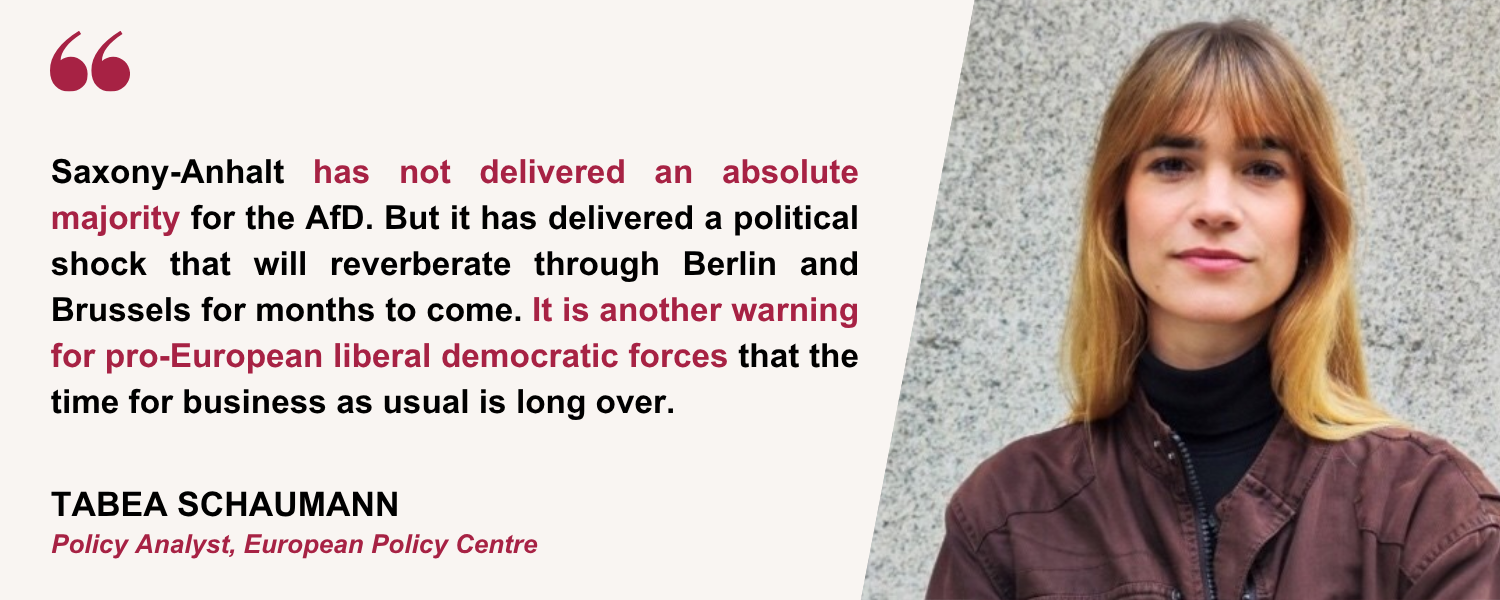
What happens next is constitutionally clear: the new Landtag must convene no later than 6 October, thirty days after the election. Yet, what happens politically is anything but clear. Saxony-Anhalt has not delivered an absolute majority for the AfD. But it has delivered a political shock that will reverberate through Berlin and Brussels for months to come. It is another warning for pro-European liberal democratic forces that the time for business as usual is long over.
Tabea Schaumann is a Policy Analyst in the Executive Office of the European Policy Centre.
The support the European Policy Center receives for its ongoing operations, or specifically for its publications, does not constitute an endorsement of their contents, which reflect the views of the authors only. Supporters and partners cannot be held responsible for any use that may be made of the information contained therein.