


Two years on: Why Europe’s far right keeps growing
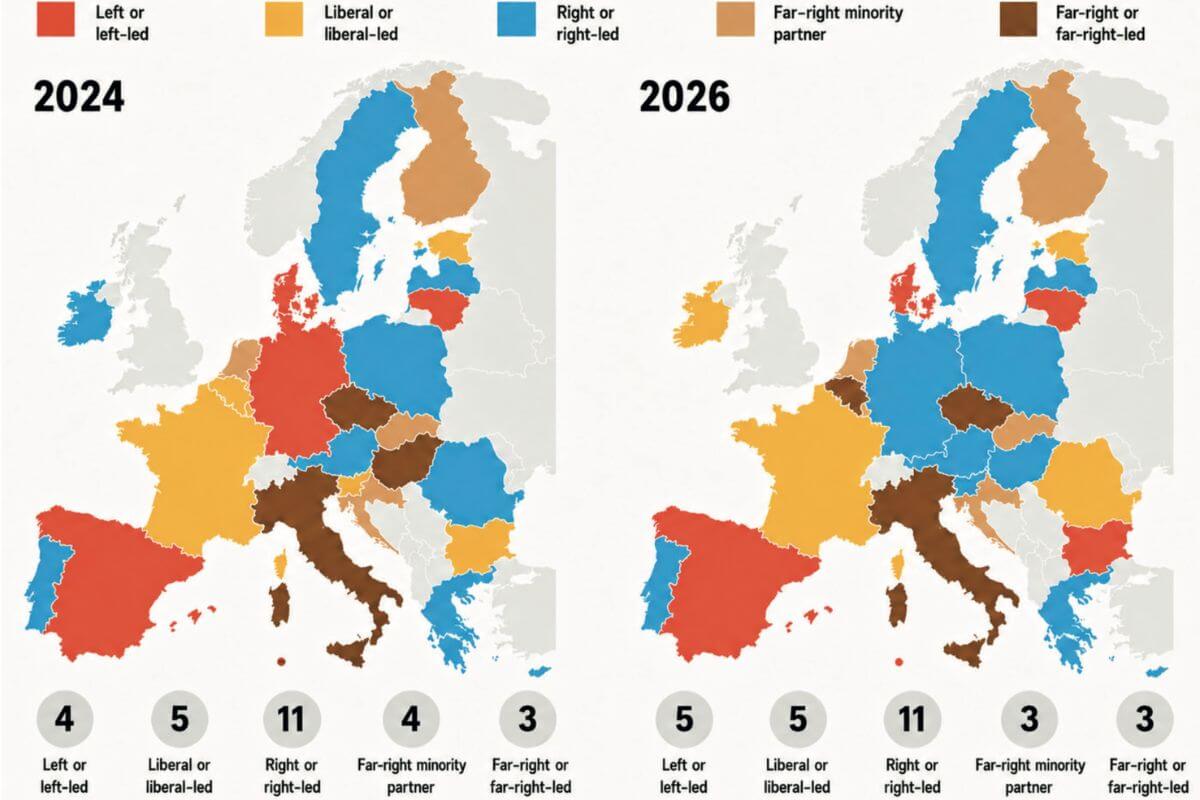



Two years after the 2024 European Parliament elections, the main trends of that moment remain intact. Mainstream parties continue to lose ground, anti-establishment forces continue to grow and the reversal of far-right fortunes has so far failed to materialise. This paper tests four optimistic narratives regarding the far right’s decline and explores why they have all failed.
The first narrative holds that participation in government damages far-right parties, as voters observe the consequences of their policies and reject them. The evidence is mixed: minority partners do tend to suffer electorally, but far-right-led governments have largely maintained or increased their support. Even where individual far-right parties lose support, other anti-establishment or far-right actors often appear to capture the same electorate.
The second narrative argues that the far right’s internal divisions would become an electoral liability. While far-right groups remain deeply divided – particularly on defence, trade, and foreign policy – these contradictions have not translated into electoral costs. Pro-democratic parties have not pressed the attack forcefully enough, and voters have remained largely indifferent.
The third narrative focuses on the Trump effect, suggesting that European far-right parties’ association with the new American administration would become a liability. Far-right leaders have indeed distanced themselves publicly – on Greenland, the Venezuela raid, the Iran war, and trade – and successfully repositioned themselves without alienating their base, while pro-democratic forces have failed to exploit the opening. Trump appears to have shaped far-right behaviour more clearly than far-right electoral support.
The fourth narrative concerns Ursula von der Leyen’s strategy of normalising the ECR group while excluding PfE and ESN. In electoral terms, this strategy has not been successful: the EPP has lost support, the excluded groups have gained the most, and the ECR has not clearly benefited from its closer association with the mainstream.
The far right’s continued growth reflects deep structural drivers – inflation, distrust in political institutions, immigration, and global economic competition – that short-term political strategies have so far failed to address. The one cautiously positive note is that far-right polling has stabilised since late 2025, suggesting a possible plateau. Whether this holds will depend on whether pro-democratic parties are willing to move beyond reactive tactics and confront the underlying conditions driving the anti-establishment wave. Two years on, that shift remains overdue.
Read the full Discussion Paper here.
Javier Carbonell is a Policy Analyst in the European Politics and Institutions Programme at the European Policy Centre.
Tabea Schaumann is a Junior Policy Analyst in the Executive Office of the European Policy Centre.
Levente Kocsis serves as Chief Data Scientist at Eulytix.
The support the European Policy Center receives for its ongoing operations, or specifically for its publications, does not constitute an endorsement of their contents, which reflect the views of the authors only. Supporters and partners cannot be held responsible for any use that may be made of the information contained therein.