

Ukraine’s government is undermining its own path to Europe
Recent legislation rushed through the Ukrainian Parliament strike at the heart of Ukraine’s anti-corruption architecture. With accession talks already under strain, Ukraine has given yet another reason for further delay. In parallel, financial assistance should be more clearly linked to tangible reform progress rather than political expediency—which was clearly overlooked by the EU. Ukraine cannot afford to become another Georgia, where rollback of reforms has left a once-promising European democracy adrift.
By rushing through legislation that places independent anti-corruption agencies under the control of the Prosecutor General’s Office, the Ukrainian Parliament has taken a dangerous step backward. This move not only threatens to undo years of hard-fought reforms but also undermines Ukraine’s EU membership aspirations. The legislation, adopted by the parliamentary majority of President Volodymyr Zelenskyy’s Servant of the People party and supported by remnants of pro-Russian factions, former Prime Minister Yuliya Tymoshenko’s party (Batkivshchyna), and a handful of partitioned opposition MPs, places the National Anti-Corruption Bureau of Ukraine (NABU) and the Specialised Anti-Corruption Prosecutor’s Office (SAPO) under the authority of the Prosecutor General. These are not technical bureaucratic tweaks. The international response was muted, limited to expressions of 'serious concern' from G7 ambassadors, echoed by the EU Enlargement Commissioner, and lacking any meaningful pushback.
NABU and SAPO were created in the aftermath of the 2014 Revolution of Dignity, when Ukrainians rose up against state capture, Russian influence, and systemic corruption. These institutions were deliberately designed to have the authority and independence to serve as an infrastructure to combat corruption at the highest level of government, undertaking the reform process following the end of the Revolution. NABU investigates corruption in the highest echelons of government—ex-presidents and judges. SAPO oversees these investigations and prosecutes the cases in court. They are among the least mistrusted institutions in a country where public confidence in the justice system is often scarce.
Under the new law, the Prosecutor General can interfere in NABU’s investigations, reassign cases, and even shut them down at the request of the legal defence. SAPO, too, can now be stripped of its functions and replaced by an organisation loyal to the prosecutor general. This move is a recipe for silencing inconvenient investigations and protecting political elites. President Zelenskyy justified the law as a measure to align Ukraine’s criminal procedures to combat Russian influence in these institutions. But that argument falls flat—NABU has presented evidence showing that concerns about potential Russian influence were previously addressed within the institution, undermining any claim that this law is needed for national security reasons. Dismantling the independence of anti-corruption institutions or handing politically sensitive investigations to the very office they were created to be independent from unmasks the real objective: consolidating control over anti-corruption probes and shielding allies from scrutiny.
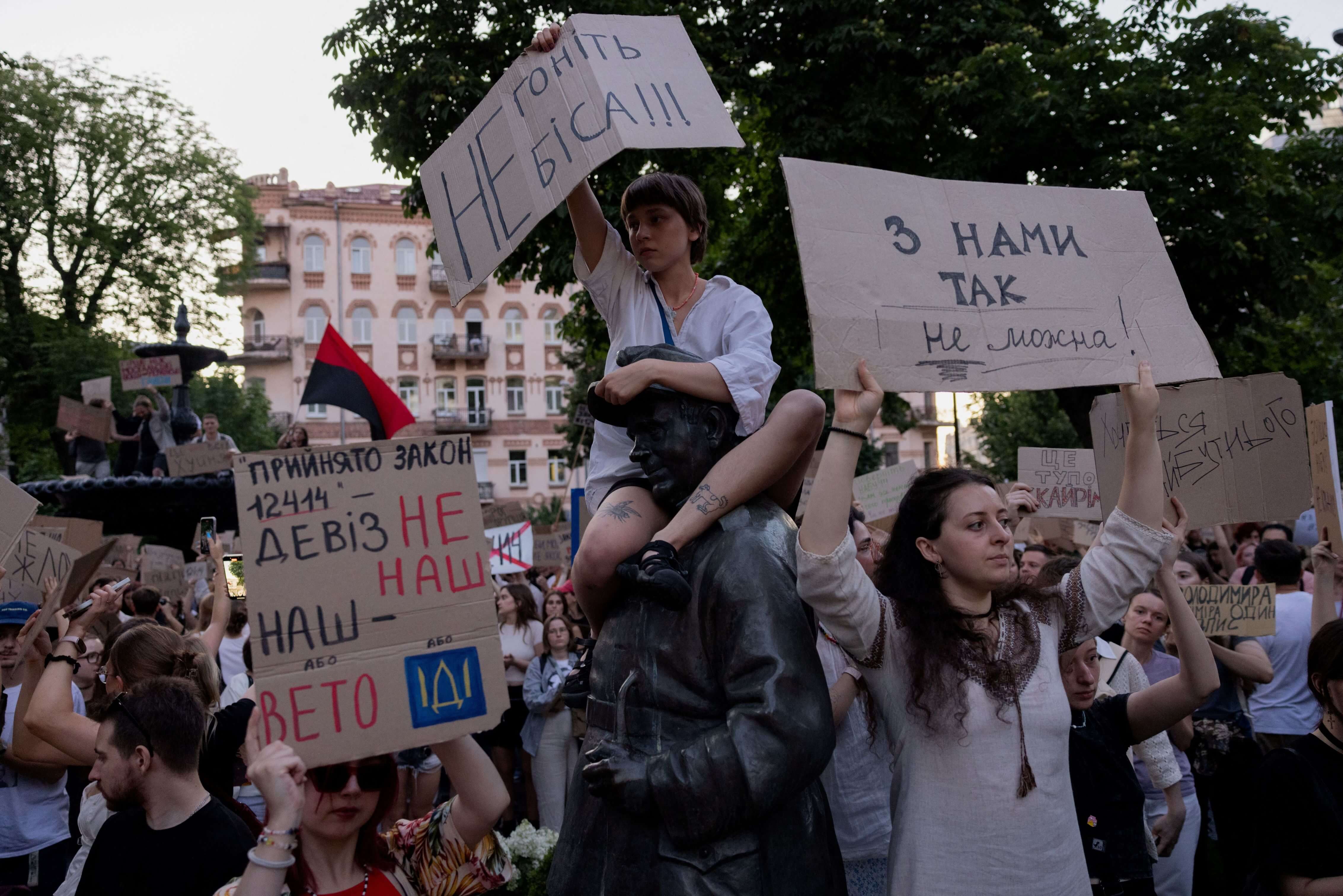
Unsurprisingly, Ukraine’s vibrant civil society has responded with alarm. For the first time since 2022, citizens have taken to the streets to protest and demonstrate their anger and opposition to this development. Many people have drawn comparisons to the infamous 16 January 2014 “dictatorship laws” passed under former President Yanukovych, which attempted to stifle dissent just before his ouster. The recent legislation, while more subtle in form, is equally corrosive in substance. Once again, civil society and ordinary Ukrainians find themselves forced to defend the gains of the Revolution of Dignity, not only from Russia’s aggression, but from backsliding by its own government.
Let us be clear: anti-corruption and rule-of-law reforms were not just nice-to-have goals. They were prerequisites for Ukraine’s EU candidacy. By signing this legislation into law, President Zelenskyy personally takes responsibility not only for reversing the important steps taken by Ukraine, but also for undermining crucial EU support, including on the country’s path toward EU and NATO membership. In the case of the EU, the ‘fundamentals cluster’ is the backbone of the accession process. Dismantling these reforms erodes Ukraine’s credibility and plays directly into the hands of the Kremlin, which thrives on portraying Ukraine as no different from the autocratic regimes it seeks to escape.
The EU must not look the other way. With accession talks already under strain due to Hungary vetoing the opening of the fundamentals cluster, Ukraine has given yet another reason to further delay. To preserve any chance of moving forward, the law must be reversed and a renewed commitment to anti-corruption reform demonstrated. The EU and other partners, including the G7, World Bank, and IMF must, in turn, make these expectations unequivocally clear. In parallel, financial assistance should be more clearly linked to tangible reform progress rather than political expediency—which was clearly overlooked by the EU.
Conditionality works, and the EU has the leverage to protect the democratic gains it helped nurture in Ukraine. European Commission President Ursula von der Leyen should immediately travel to Kyiv to make it clear to Office of the President: these actions are unacceptable, and the EU will not extend political goodwill to Kyiv if it further undermines the reforms that underpin its European aspirations.
Ukraine cannot afford to become another Georgia, where rollback of reforms has left a once-promising European democracy adrift. But, thanks to its civil society and the sacrifices of its citizens, Ukraine is not there yet. The EU must stand with the people of Ukraine—those who believe in a European future based on transparency, justice, and rule of law—not with those who are quietly dragging the country back into the shadows.
Lev Zinchenko is a former Programme Assistant with the Europe in the World Programme at the European Policy Centre.
The support the European Policy Centre receives for its ongoing operations, or specifically for its publications, does not constitute an endorsement of their contents, which reflect the views of the authors only. Supporters and partners cannot be held responsible for any use that may be made of the information contained therein.