

Why Europe’s companies cannot afford mercantilism or illiberalism
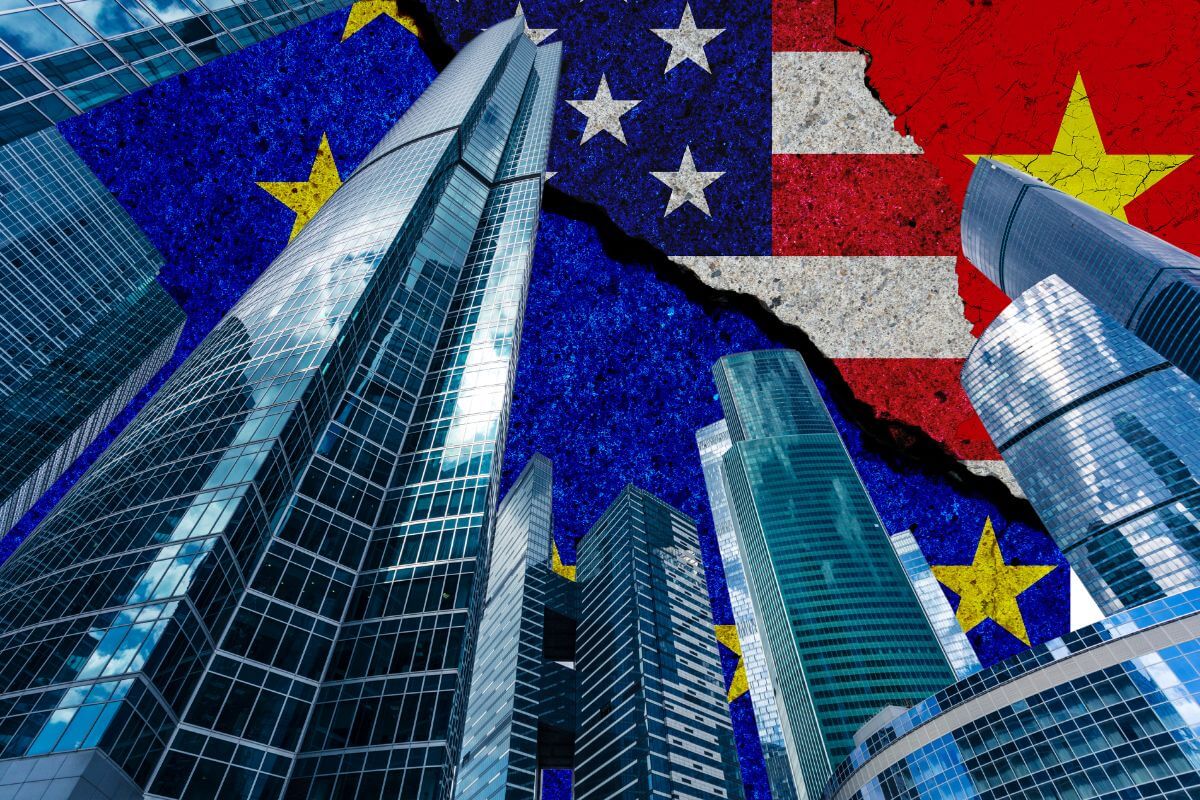

Across the globe, mercantilist and protectionist policies are gaining ground, with Donald Trump’s punitive tariffs only one example. Global economic guardrails are being cast aside, while the rules-based order and international organisations are in a perilous state. Unconstrained predatory industrial policy is becoming the norm rather than the exception. In this neo-nationalist geoeconomic landscape, the space for seeking prosperity through open and free trade is shrinking. Economic flows are increasingly viewed as zero-sum: for us to win, someone else has to lose.
Free trade and open markets have greatly benefited Europe, one of the most trade-exposed regions in the world. European companies depend on global markets and on the frameworks that provide protection and predictability. This has not been a perfect environment, but it was certainly more favourable than the one now emerging.
The growing use and abuse of economic levers for political ends requires a stronger focus on economic security. Interdependence and increasingly integrated value chains have proven risky in times of crisis, as Europe’s dependence on Russian gas showed. At the same time, the temptation to turn to protectionism has grown. While that may seem appealing in the short term, it raises prices, stifles innovation and ultimately reduces growth and prosperity.
Protecting an open economy and free trade, with as few restrictions as economic security considerations allow, is central to the future competitiveness of European industry. Yet the situation is deteriorating rapidly, driven by politics and ideology. Mercantilist and protectionist tendencies go hand in hand with a turn towards illiberalism, nationalism and growing authoritarianism.
As the rule of law is undermined, clientelism rises. Illiberal leaders use the power they accumulate to favour friends, family and political supporters, while attacking the legal frameworks that constrain them. Sectors become concentrated among those favoured by the leader, and smaller businesses, along with those out of political favour or based in another country, struggle to compete. We can already see this process in real time. Friends and family of US President Donald Trump are winning business and consolidating sectors with his approval, with tech scion and Trump ally Larry Ellison reportedly seeking to acquire media conglomerate Warner Bros. Similar dynamics are visible in Europe, including in Hungary.
Sidelining the law can sometimes produce quicker outcomes, for example by bypassing permitting procedures. In the long run, however, it rewards loyalty rather than excellence, leading to weaker economic outcomes. Moreover, weakening the rule of law in favour of often mercurial authoritarian decision-making undermines the predictability businesses need to plan and invest.
The cross-border implementation and enforcement of a common set of rules not only enables the Single Market; it is its essence. Without a common legal framework, there can be no Single Market. The European Union acts as a restraint on economic nationalism, protectionism and democratic backsliding. It is not separate from European liberal democracy but a crucial, interlocking part of it.
For European companies, the liberal democratic economic and political order has been the basis of global success. In the evolving geoeconomic environment, they now risk being on the menu, while predatory nationalist actors come out on top. But this is not inevitable. By defending liberal democratic and economic values, principles and institutions, Europeans and other like-minded countries can offer a counterexample: an economic and political model that works for all, rather than for a select few.
Economic freedom and success, and political freedom and the rule of law, still go together. But they cannot be taken for granted. It is time to defend the economic and political model that has underpinned Europe’s prosperity for the past eight decades.
Fabian Zuleeg is Chief Executive and Chief Economist at the European Policy Centre.
The support the European Policy Centre receives for its ongoing operations, or specifically for its publications, does not constitute an endorsement of their contents, which reflect the views of the author only. Supporters and partners cannot be held responsible for any use that may be made of the information contained therein.