


America’s new Defence Strategy and Europe’s moment of truth

The Pentagon published its new National Defense Strategy (NDS) late on 23 January, and defence experts across Europe did not have to look hard to spot a strategic shift. The 2026 NDS is not an incremental update but a deliberate reordering of American defence priorities and expectations.
The most consequential shift is the move from integrated deterrence to an explicit hierarchy of priorities. Rather than attempting to manage multiple challenges simultaneously, the new strategy ranks threats and missions plainly. Defending the US homeland and deterring China sit at the top. Everything else, including Europe, is secondary.
Fortress America. Homeland defence now serves as the organising principle of American strategy, not a supporting task. The NDS frames borders, air and missile defence, cyber resilience, and the Western Hemisphere as core military priorities. It openly revives a Monroe Doctrine–style approach, naming Greenland, the Panama Canal, and Gulf of Mexico as key terrain to be controlled and defended. Forward deterrence abroad is no longer the default expression of US security; territorial defence at home is.
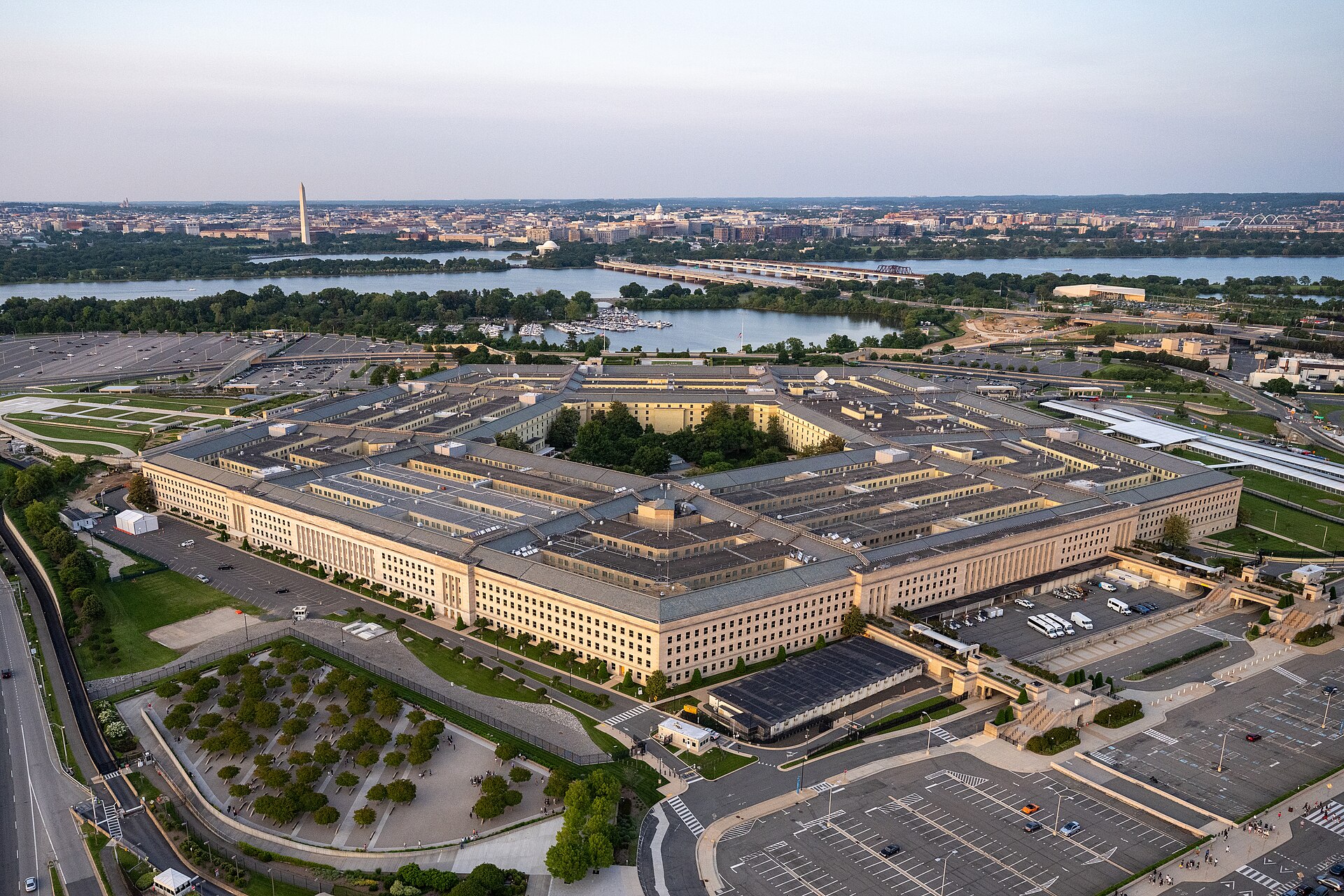 An aerial view of the Pentagon, Washington, D.C., May 15, 2023. (DoD photo by U.S. Air Force Staff Sgt. John Wright)
China policy is sharpened accordingly. Where earlier strategies spoke of competition management and guardrails, the 2026 NDS is explicit about deterrence by denial, particularly along the First Island Chain, although there is no explicit mention of Taiwan. The goal is not escalation dominance or regime change but preventing regional hegemony by any other power, by making aggression infeasible. Ambiguity is replaced by clear redlines.
In the new alliance policy, reassurance gives way to conditional partnership. Burden-sharing is no longer encouraged but required. NATO’s new 5% of GDP defence spending benchmark formalises what the document implies throughout: Europe must handle Europe, South Korea must handle North Korea, Middle Eastern partners must handle Iran. US support remains, but it is selective, incentivised, and contingent on performance rather than promises.
Russia too is seen through this lens. Moscow is described as dangerous to eastern Europe but manageable, not because the threat has disappeared, but because Europe is judged capable of carrying primary responsibility for conventional deterrence. The United States shifts from leader to enabler.
Industrial power underpins this strategy. The US defence industrial base is elevated to a strategic asset to be mobilised as during World War Two and the Cold War. Production capacity, scale, and sustainment are framed as decisive factors in deterrence rather than a supporting foundation.
The 2026 NDS marks a stark turn toward declarative realism. The ideological basis is stated plainly: America First, peace through strength, and the end of democratic idealism and open-ended nation-building. Trade-offs are no longer smoothed over and priorities are plainly asserted.
What this means for Europe
Europe is no longer a priority theatre for US conventional primacy. Washington will remain in NATO, retain its nuclear deterrent role, and provide high-end enablers. It will no longer underwrite Europe’s conventional defence by default. European allies are described as rich, capable and therefore responsible for managing the Russian threat themselves.
This is also a continuation of the recent changes in alliance politics. Influence in NATO is measured by deliverable military output rather than political alignment. States that spend, produce, and deploy gain access and influence while those that do not lose leverage without being formally excluded.
US forces in Europe are therefore likely to become thinner, more rotational, and more conditional. The assumption that large US ground forces will rapidly reinforce Europe in a major contingency becomes less reliable. Readiness, stockpiles, mobilisation timelines, and command and control capacity matter now more than ever.
Ukraine fits squarely into this framework. US support is not withdrawn, but ownership is shifted. The war is framed as a European security problem that Europe must resource and resolve, with the United States acting as an enabler rather than the backbone of sustainment.
The strategy makes Europe’s long-discussed strategic autonomy unavoidable, not as separation from the United States, but as responsibility within the alliance. A European pillar inside NATO is no longer optional. It is the only way to reconcile US prioritisation of China with credible deterrence against Russia. The NDS offers no governance model for this transition, leaving Europe to fill the gap through NATO adaptation, EU defence integration, and/or coalitions of willing and capable states.
The 2026 NDS does not signal US withdrawal from Europe, but it does end the era of automatic American primacy. Europe is seen as capable, and therefore accountable for its own defence.
The hour of Europe has arrived, perhaps inconveniently soon for anxious European governments. If Europe builds military power commensurate with its economic weight, overcomes industrial fragmentation and takes the baton of defence leadership, this shift could finally produce a credible European pillar that strengthens NATO. If it does not, the gap between US expectations and European capabilities risks becoming the alliance’s most dangerous fault line.
Chris Kremidas-Courtney is a Senior Visiting Fellow at the European Policy Centre.
The support the European Policy Centre receives for its ongoing operations, or specifically for its publications, does not constitute an endorsement of their contents, which reflect the views of the authors only. Supporters and partners cannot be held responsible for any use that may be made of the information contained therein.