


Tehran may be losing the export battle but its capacity to hamstring the global economy remains unchecked
The Strait of Hormuz crisis is offering new lessons about how power works in the 21st century. Europe should take heed.
Despite reports of a new ceasefire agreement, the situation remains unstable and negotiations between Washington and Tehran have been opaque. Iran has previously threatened a complete closure of the Strait if it judges ceasefire terms to have been violated – a condition which shows that the economic warfare could still be ramped up.
In a world where key chokepoints are weaponised, the only two options are to shape events or be shaped by them. Right now, Europe is being shaped.
Its energy security strategy remains largely reactive and dependent on a US naval presence to keep critical waterways open, and on market diversification that is proving to be too shallow when a disruption materialises.
Having spent the years since 2022 diversifying away from dangerous energy dependencies – replacing Russian gas with LNG and building strategic reserves – the current situation reveals the underlying vulnerability was displaced but not yet solved.
Latest data from the first days of June shows that Iranian crude exports have collapsed by 84% in a single month, falling 87% below the average of the previous year. Production itself has been cut by 800,000 barrels per day.
The US has not only been sanctioning Iranian oil but also deployed warships to deter very large crude carrier movements, making the insurance and compliance cost of shadow fleet participation increasingly prohibitive.
This has forced Tehran into smaller, slower, more expensive tanker classes that reduce export capacity even when individual shipments do get through.
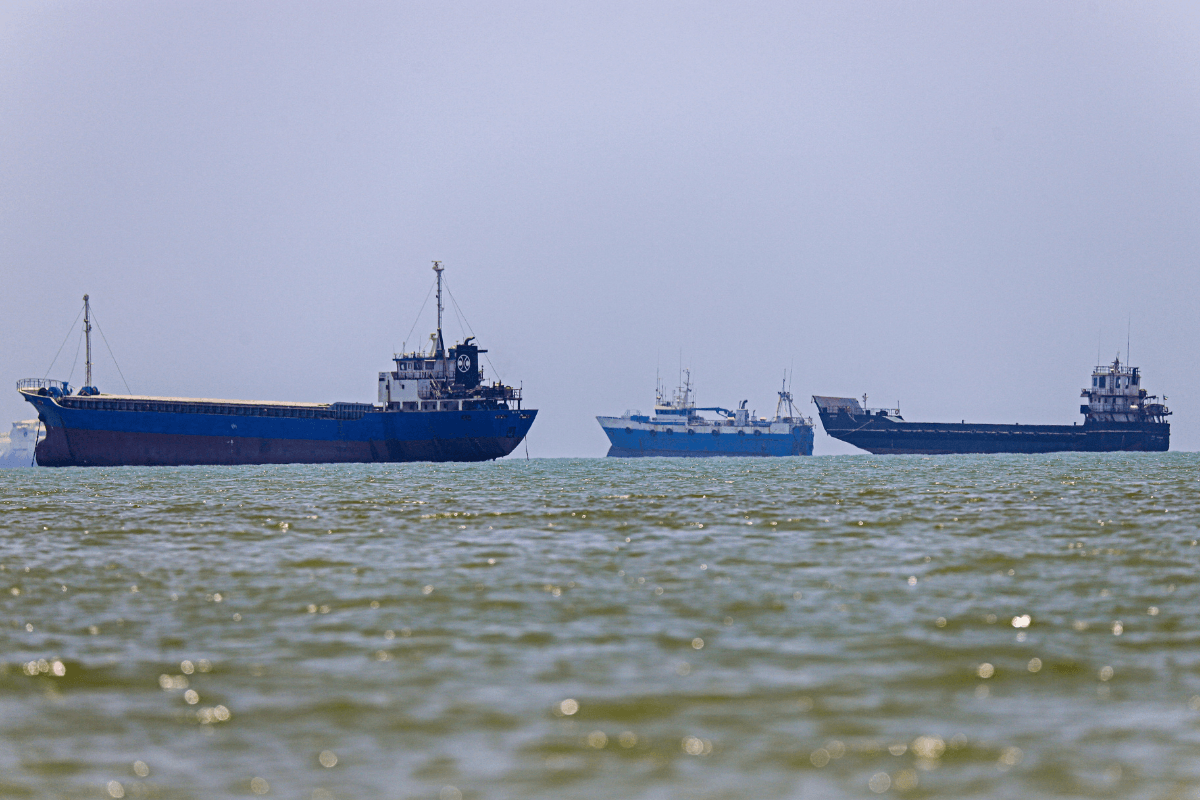
During the Iran-Iraq War in the 1980s, the US intervened to protect commercial traffic through the Strait of Hormuz. Today, Washington is selectively suppressing Iranian oil traffic while Iran is simultaneously blocking other vessels, including many commercial crude carriers. It is two actors using one chokepoint as a weapon simultaneously.
The post-Gulf War sanctions regime against Iraq offers a second, cautionary comparison. Those sanctions succeeded in suppressing Iraqi oil revenues and constraining rearmament, but they leaked persistently through the Oil-for-Food programme and regional workarounds involving Jordan and Turkey. The lesson was that sanctions without enforcement can leave large gaps, and the political will to close them erodes over time.
The most important enforcement gap today is also the most revealing. Chinese-affiliated vessels accounted for nearly a quarter of all ships exiting the Gulf since March, and this appears to be by arrangement rather than by accident. The US has been applying maximum pressure on Iranian revenue while declining to directly confront Beijing over its continued purchase of sanctioned crude. The exemption China enjoys signals precisely where Washington is willing to escalate, and where it is not.
The shadow fleet is also transforming in ways that will likely outlast this crisis. The emergence of mainstream shipowners taking on tankers with documented sanction histories suggests the lines between the legitimate and shadow maritime economy are beginning to blur.
This greying of the global shipping fleet is creating long-term governance gaps that existing sanctions regimes were not designed to address. Of course, the UN law of the sea (UNCLOS) was flawed from the start since geopolitical horse-trading gutted flag state accountability before the ink was dry.
Iran's effective closure of the Strait is also an act of economic warfare whose costs are spread across global markets. Insurance premiums have spiked and rerouting shipments adds expenses to supply chains far beyond the Gulf. Tehran may be losing the export battle but its capacity to hamstring the global economy remains unchecked.
What June 2026 tells us about economic warfare is that whether wielded by a superpower or a sanctioned state, it can produce collapsing export revenue, production cuts, exhausting workarounds, and amplify risk across global markets. It’s also more viable when conducted with enough ambiguity to avoid triggering the escalatory responses that a more direct confrontation might invite.
European energy markets remain exposed to Gulf disruption, and the all-time high prices in late May were an early signal of what a prolonged crisis means for European industrial competitiveness. The EU is not a party to this conflict but is nonetheless absorbing its consequences.
This Op-Ed was originally published by Euractiv. Read the original here.
Chris Kremidas-Courtney is a Senior Visiting Fellow at the European Policy Centre.
The support the European Policy Centre receives for its ongoing operations, or specifically for its publications, does not constitute an endorsement of their contents, which reflect the views of the authors only. Supporters and partners cannot be held responsible for any use that may be made of the information contained therein.