

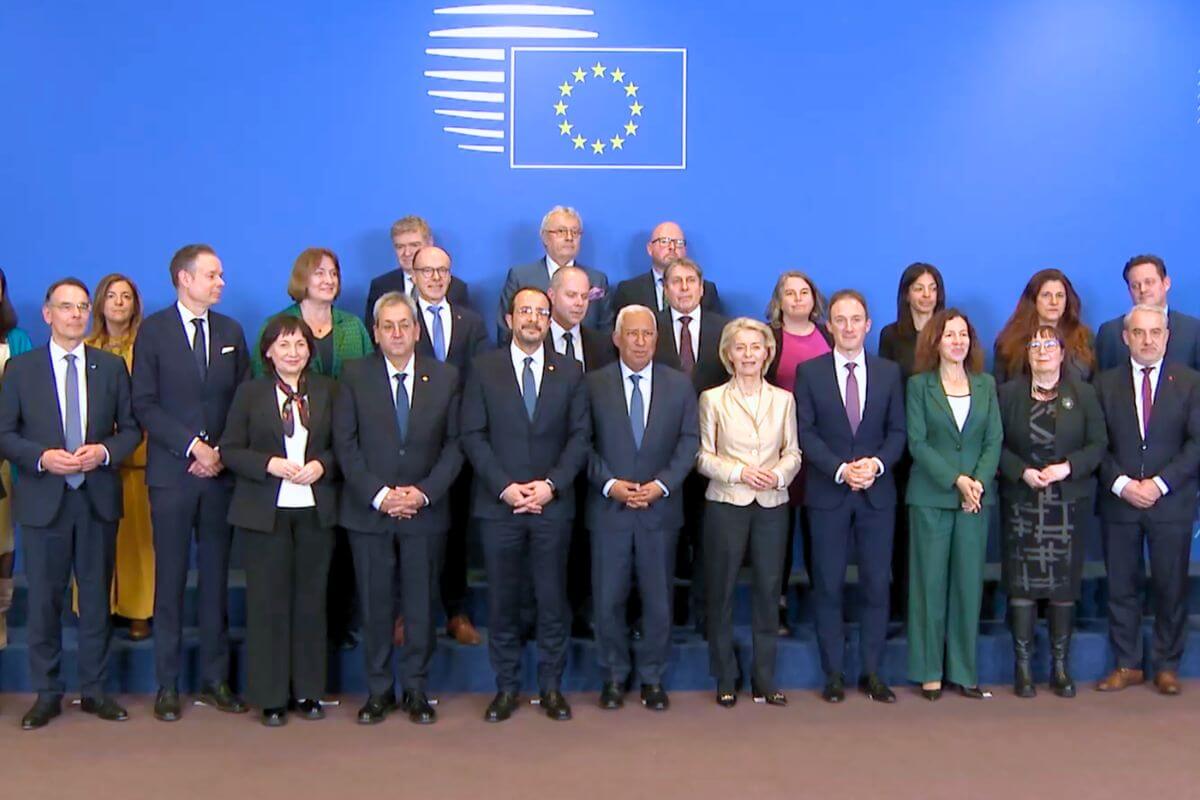

The generation now holding power across Brussels and Europe’s major capitals learned to govern in a world defined by stability, integration, and a gentler sense of urgency. Threats were distant and underwritten by American security guarantees. Issues like defence and security lived on the periphery of politics, not at its centre.
That old world has ended but the generation raised in that era remains in charge.
Russia’s invasion of Ukraine, instability along Europe’s periphery, and the erosion of global economic and security buffers have forced a recognition that the EU must take its own defence more seriously. Budgets have increased and new initiatives have launched, yet the pace and scale of change remain out of step with the moment.
Europe’s institutions – and the people who lead them – were shaped in conditions that rewarded a different set of instincts. For decades, consensus-building and process held primacy over speed. Risk aversion was the norm while managing risk to the point of acceptance was unthinkable. These instincts were formed in a system where risk was avoided at all costs, delays were normal, and hardball was off the table.
Today, those same instincts produce hesitation and painfully slow changes, with the result that Europe reacts to major crises rather than shaping them. These instincts extend beyond institutions and governments into the private sector. When the CEO of Rheinmetall dismissed Ukrainian drone production as lacking sophistication, he exposed a mindset anchored in an era where technical perfection defined effectiveness. Today, “good enough” systems that can be produced, adapted, and replaced at speed are shaping outcomes.
“Right now, Europe is led by a generation that can’t meet this moment,” defence strategist Jonas Singer said recently.
The emerging security environment is defined by compressed timescales. Decision timelines are shorter while industrial demands are higher and more distributed. The distinction between peacetime and conflict has eroded amidst a decade-long Russian hybrid campaign. The ability to decide and act fast, adapt, produce at scale, and operate under pressure is becoming the central determinant of credible deterrence.
Meeting those requirements demands a different approach to power – one that accepts imperfection in exchange for speed, that decentralises control to increase resilience, and that tolerates political and bureaucratic risk in order to reduce strategic risk. This is where the generational dimension becomes visible not as a matter of age, but of experience.
Many of Europe’s current leaders built their authority in a period where stability was the baseline condition. Their professional success depended on preserving that stability, extending single market integration, and managing crises which seldom risked escalating beyond their ability to control them. Acting decisively in ways that disrupt existing systems was rarely rewarded and mostly discouraged. Yet this is the generation that is leading in an era that demands fast and decisive action.
We must now accept that systems built for efficiency often break under pressure. Supply chains designed around cost fail when disrupted; decision-making built on consensus is insufficient when speed becomes decisive. And a leadership culture built on fragile assumptions of continuity becomes like a haemophiliac, bleeding out the moment it meets reality.
The necessary shift in mindset is hard for any institution, and harder still for those who built their authority under conditions that have now shifted drastically. Strategic change is not only about policy, but who controls it. As conditions change, so does the kind of leadership required to face it.
The current working culture in Europe also mistakes announcements for results. This is visible in how recent EU defence progress is described. Announcing large sums does not create capability. Much of what is presented as new funding remains conditional, recycled, or dependent on private uptake. Even where money is real, it must pass through industrial systems not yet configured for speed or scale. The result is a widening gap between political signalling and operational reality.
This gap is most visible at the sharp end. After four years of war, European air defence stockpiles remain limited relative to the demands of sustained conflict. Time and funding have been available but production at the required pace has not followed.
Closing this gap requires accepting risk in ways Europe has avoided for decades. It may also require making first moves as a coalition of the willing before consensus fully forms.
This runs against the grain of how the EU has operated. A serious crisis on Europe’s eastern flank would compress decision-making into days, requiring immediate force mobilisation and rapid procurement. The question is whether Europe’s current leadership culture and system could act at the speed of relevance.
Experience still matters. What Europe lacks is a leadership culture comfortable with speed, uncertainty, and the courage to take calculated risks. Europe has the resources to respond but until urgency translates into action, it will fail to deter an aggressive Russia.
This op-ed was originally published in Euractiv. Read the original here.
Chris Kremidas-Courtney is a Senior Visiting Fellow at the European Policy Centre.
The support the European Policy Centre receives for its ongoing operations, or specifically for its publications, does not constitute an endorsement of their contents, which reflect the views of the authors only. Supporters and partners cannot be held responsible for any use that may be made of the information contained therein.