

Moldovan Deputy PM Popșoi on security, blackouts and EU accession
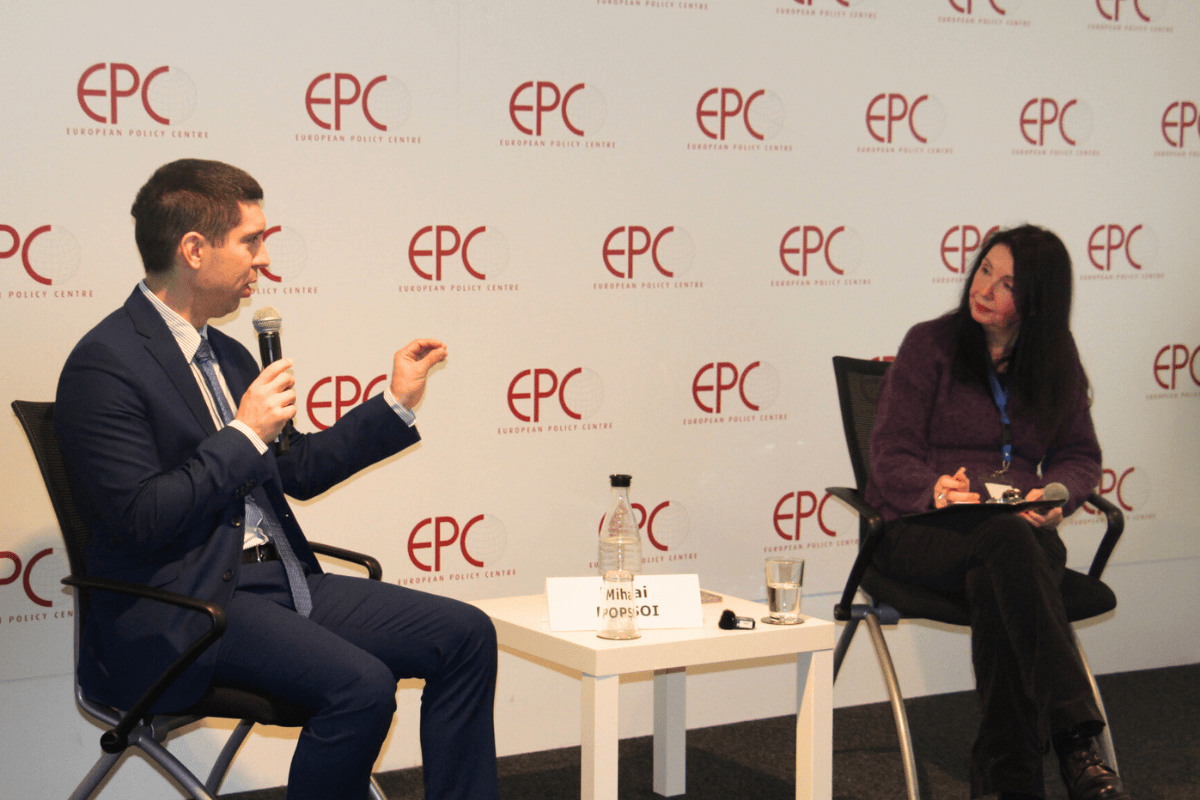

On Monday morning, the European Policy Centre hosted a discussion on Moldova’s security outlook and European future – at a moment when blackouts, drone incidents and election risks remain part of daily strategic planning.
Speaking at the EPC, Mihai Popșoi, Moldova’s Deputy Prime Minister and Foreign Minister, offered a deliberatively paradoxical assessment: “In one word, the security situation is good. But if you want me to elaborate, I would say it is not good”.
Four years into Russia’s full-scale war against Ukraine, he said the parallels with the Second World War are “uncanny”, and recent disruptions – including blackouts – underline how exposed countries remain in the absence of robust air defence.
Popșoi stressed that Moldova is nevertheless stronger than it was at the start of the war. He pointed to rapid energy diversification, the synchronisation of Moldova’s grid with the EU, and growing interconnections with Romania. Together, he framed these steps as a strategic break from dependence on Gazprom and a turn away from the Commonwealth of Independent States.
On resilience, he highlighted the creation of a national crisis-management centre, a Strategic Communications Center that “maps information operations … almost in real time” to help calibrate responses, and a new cyber agency and academy. Protecting election infrastructure, he warned, is critical amid attacks designed to undermine democratic legitimacy.
Crucially, Popșoi stressed that Moldova has protected democratic rights even under pressure: “If you have to choose between freedom and security, you don’t deserve either”, he said, crediting a whole-of-society effort involving civil society, independent media and the diaspora. He cited an investigative journalist’s undercover work exposing a criminal network as a turning point in public mobilisation.
On partnerships, Popșoi said ties with the United States are “rock solid”, notably in energy security. He also pointed to the irony of Moscow promoting Moldova’s neutrality while violating it through its military presence in Transnistria.
Looking ahead, he urged partners to intensify efforts towards a just and lasting peace in Ukraine, while continuing support for sovereignty and energy, border and cyber security. Popșoi also signalled Moldova’s ambition to contribute more to European missions and to make full use of its Presidency of the Council of Europe, with political integration following economic integration.
Marko Milutinovic is Communications Officer at the European Policy Centre.
The support the European Policy Centre receives for its ongoing operations, or specifically for its publications, does not constitute an endorsement of their contents, which reflect the views of the authors only. Supporters and partners cannot be held responsible for any use that may be made of the information contained therein.