

Recasting the EU’s single market for the permacrisis era

As Brussels progresses its new ‘One Europe, One Market’ roadmap, the EU faces a bigger question: is aiming to complete the single market enough for an age of economic coercion, strategic rivalry and weaker global rules?
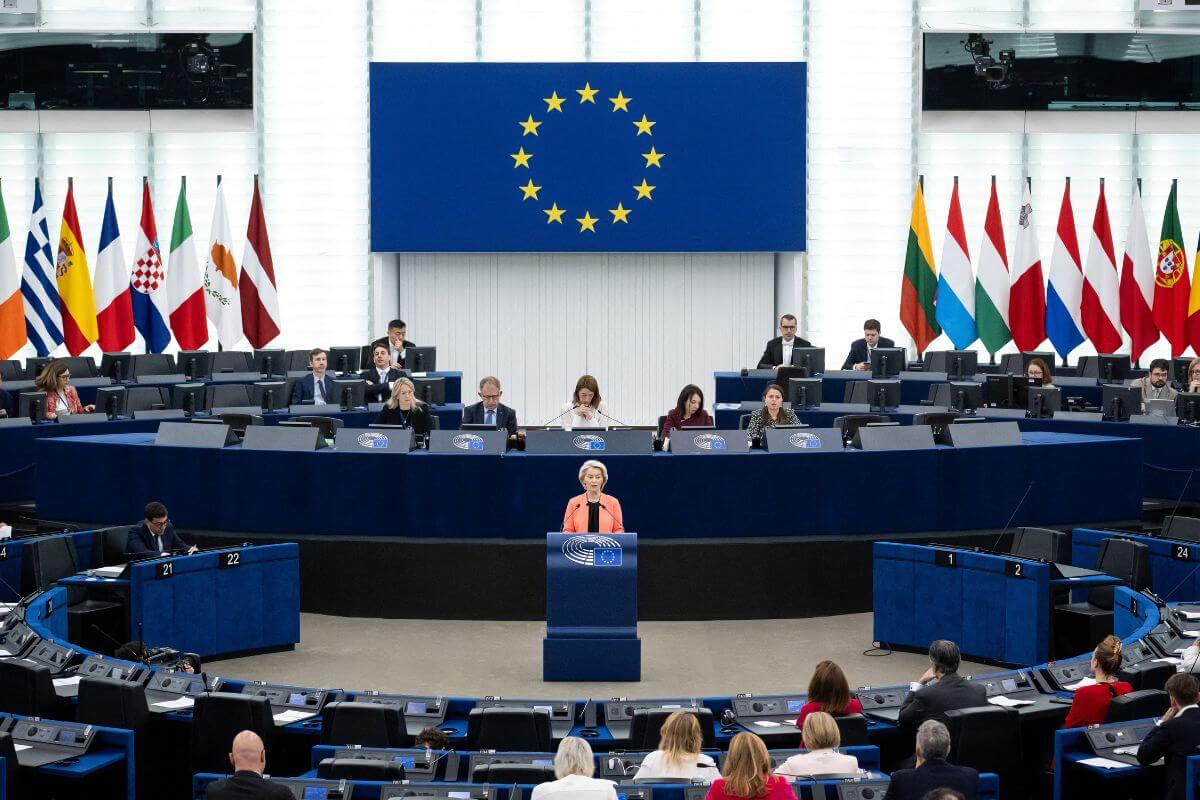
As the European Parliament opens its debate on the One Europe, One Market roadmap, a larger question looms over the chamber: will aiming to complete the single market be enough to protect Europe in an era of economic coercion, strategic rivalry and weakening global rules?
The roadmap, endorsed last month by the institutions, commits the Union to deepening the single market by 2027 as the centrepiece of its competitiveness agenda. The urgency is clear. Europe is grappling with slower growth, intensifying geoeconomic pressure and rising doubts about whether its economic model still fits the world it now faces.
That is precisely why the debate cannot stop at completing the market Europe already has.
The European Union’s single market is often called its “jewel in the crown”. It helped dismantle barriers to trade, investment and mobility, pushed competition across borders and gave European firms the scale of a vast home market comparable to that of the United States.
But the single market is still incomplete. Common rules are unevenly enforced, national barriers remain in key sectors such as services and capital, and member states still protect domestic interests when it suits them. That weakens Europe’s competitiveness and leaves much of the market’s potential unrealised.
More importantly, the framework was built for a world that no longer exists. In a more hostile and fragmented world, preserving the single market’s achievements will require going beyond it. The next phase of European integration must be about more than markets: it must be about building the economic scale, strategic capacity and democratic resilience Europe now needs.
When the project was designed, the main task was internal: removing barriers between EU countries and stopping governments from distorting competition. It assumed a broadly rules-based global economy in which openness was rewarded and economic coercion was constrained.
That assumption no longer holds.
States are intervening far more aggressively in their economies. Tariffs, subsidies, export controls and industrial policy are now standard tools of geopolitical competition. Trade is no longer just about efficiency; it is increasingly about power and security.
For Europe, whose prosperity has long depended on openness, that creates a serious problem. Supply chains, critical technologies and raw materials can all be weaponised. The global rules that once helped protect open economies are weakening, while the costs of dependency and insecurity are still poorly reflected in the EU’s economic framework. Economic security and resilience have therefore become core policy concerns. Yet the traditional single market was never designed to manage strategic dependencies, security risks or the growing need for coordinated investment in critical sectors.
At the same time, the EU’s internal divisions have deepened. Some governments exploit loopholes, free ride on common rules or become weak points through which external actors can bypass European safeguards.
This is the core tension facing Europe today.
To stay competitive in a fragmented world, Europe needs deeper integration. But to preserve the integrity of the system, it also needs stricter enforcement, fewer loopholes and stronger protection against internal free-riding and external exploitation.
That is the broad message of the reports by Enrico Letta and Mario Draghi. Europe cannot rely on the classic single market alone. It needs a wider economic strategy that supports innovation, strategic investment and economic security.
In practice, that means moving towards what could be called a Single Economic Territory: a much deeper form of integration that combines a functioning single market with stronger policy coordination, common investment capacity and shared safeguards.
The question is how to get there.
Towards a Single Economic Territory
First, the EU must make the existing system work properly. Enforcement of single market rules has to become tougher. National deviations, regulatory arbitrage and gaps in security safeguards should no longer be allowed to define access to the whole European market.
But Europe must also confront a political fact: deeper integration will not always be possible with all 27 member states moving together.
Some governments are reluctant to share more economic sovereignty. Others are less committed to the rule of law and the democratic principles that underpin the European project. If every step forward depends on full unanimity, Europe risks paralysis.
A more realistic answer is to let those willing to go further move first.
An inner circle of countries could build stronger economic governance, closer policy coordination and greater collective investment capacity – in effect laying the foundations of a Single Economic Territory.
The wider single market would remain in place. But its deepest benefits would be linked to stronger rules, clearer responsibilities and a willingness to defend Europe’s economic and democratic resilience.
Of course, differentiation carries risks. It could create new tensions between participating and non-participating countries and make the wider system more complex.
But the alternative – insufficient progress and vulnerable governance – is far more dangerous.
If designed carefully, this kind of two-tier structure could strengthen rather than weaken the EU. Participation should also remain open to any member state willing to meet the commitments required.
It would also tie the full benefits of deeper integration more clearly to respect for the rule of law, common rules and the capacity to resist external actors seeking to exploit Europe’s divisions.
Many defenders of the classic model of European integration will be uneasy with that approach. But politically, it may be the only realistic way forward.
Fabian Zuleeg is Chief Executive and Chief Economist at the European Policy Centre.
The support the European Policy Centre receives for its ongoing operations, or specifically for its publications, does not constitute an endorsement of their contents, which reflect the views of the author only. Supporters and partners cannot be held responsible for any use that may be made of the information contained therein.