


A Room of One’s Own is all you can afford: Why young women move to the far right


It has become common to argue that young men in Western countries are moving steadily to the right, while young women are shifting leftwards, widening the gender divide within Generation Z. Even where this pattern holds, it obscures a more complex reality: that young women are also voting for far-right parties in growing numbers and actively participating in the broader rightward and anti-feminist shift seen in many European countries.
This paper argues that while young men exhibit a relatively uniform turn to the right, young women are increasingly polarised. Most are moving further left, but a significant minority are also drifting toward hard-right alternatives, rejecting feminism and embracing traditional gender norms. It is not that young women are moving away from far-right parties, but simply that they are moving towards them at a slower pace. In this sense, young women’s political trajectories are no less concerning for the future of liberal democracy than those of young men.
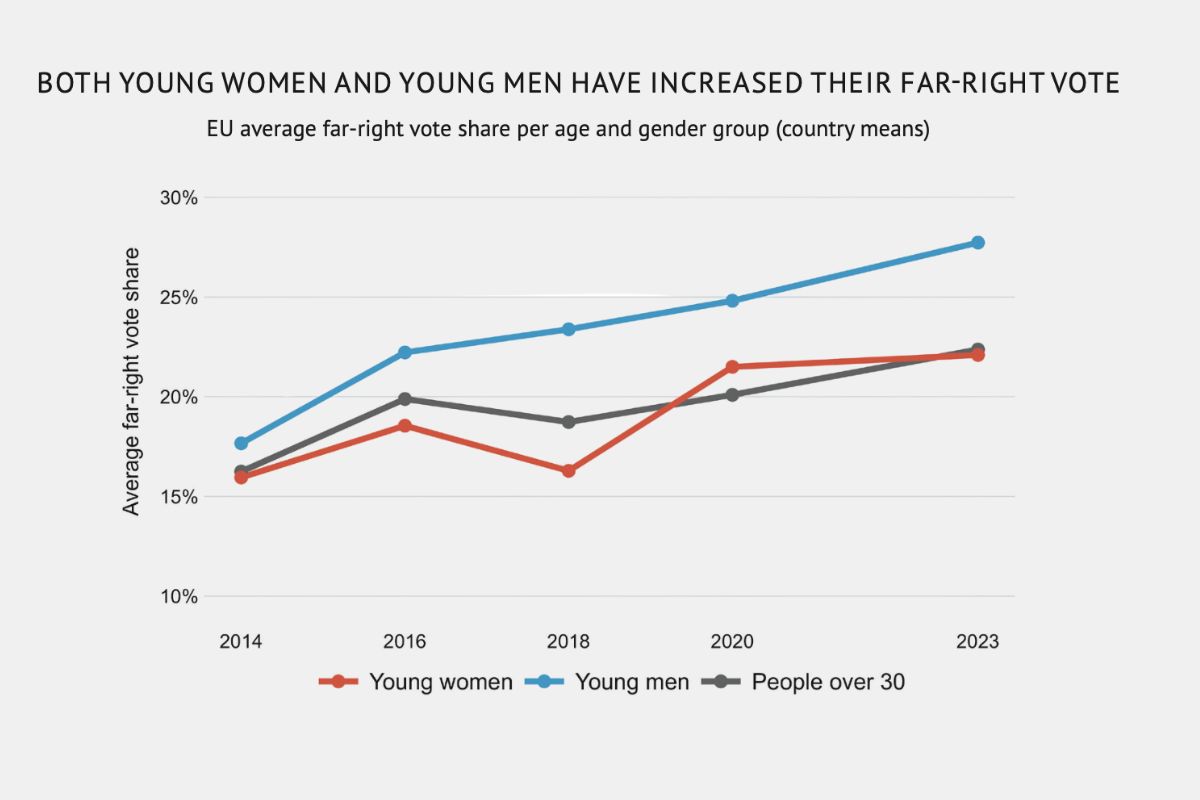 This development is hardly surprising. Over the last years, far-right vote share has increased across all demographic groups amid a broad social-conservative turn. However, gender-specific drivers are also at play, with housing insecurity and labour-market discontent topping the list for young women. In many Western European countries, young women now outperform young men in higher education graduation rates and even in earnings. Yet they enter the labour market at a time when young people have lower wealth, incomes and purchasing power than previous generations. The precarious labour market, increasing cost of childrearing and housing crisis make traditional female roles outside the labour market appear less risky and more appealing. The far right has mobilised this frustration, romanticising a fictitious, idealised past that operates as a sharp critique of an unaffordable present.
Addressing the rightward shift among young people requires looking beyond young men alone and taking seriously the political radicalisation occurring among young women. More broadly, it demands tackling the structural drivers of this trend, rooted in Europe’s housing, labour-market and family crises. A robust economic agenda must centre on affordability, wealth redistribution and youth housing access. Because many far-right political and cultural narratives are amplified on digital platforms, stronger enforcement of existing EU legislation in the online sphere is essential.
Far-right and anti-feminist narratives are no longer fringe; they have become mainstream, especially among younger generations. Gender-equality movements must adopt a more counter-hegemonic, anti-establishment stance that treats the far right not as a political outsider, but as the the new status quo, exposing its limits and offering credible alternatives. Only by confronting the gender backlash head-on – alongside the green, migration and democratic backlashes – can a genuinely pro-democracy mobilisation of Europe’s youth emerge.
Read the full Discussion Paper here.
Javier Carbonell is a Policy Analyst in the European Politics and Institutions Programme at the European Policy Centre.
The support the European Policy Center receives for its ongoing operations, or specifically for its publications, does not constitute an endorsement of their contents, which reflect the views of the authors only. Supporters and partners cannot be held responsible for any use that may be made of the information contained therein.