

Financing Europe’s Future: Can the Commission’s MFF proposal deliver?











Realism, nothing but realism – at last!
Georg Riekeles, Europe’s Political Economy Programme
EU budget discussions have long been dominated by ‘can’t do this and can’t do that’ attitudes. Frugal member states that don’t want to spend more, beneficiaries of cohesion funds not wanting to lose a cent, and MEPs “who don't see the status quo as a problem”. What all these positions have in common is that they don’t add up to more than misguided conservatism and the slow agony of Europe, as Draghi famously warned.
Old fogeys! But here comes the European Commission with a realistic and forward-looking proposal—well done for that. The EU’s number one challenge in addressing today’s pentuple economic, technological, social, climate, and security-related shocks is a lack of capacity to spend and invest. If we look at today’s escalating geo-economic competition, the US and China have gained an edge through massive resource mobilisation directed at strategic sectors.
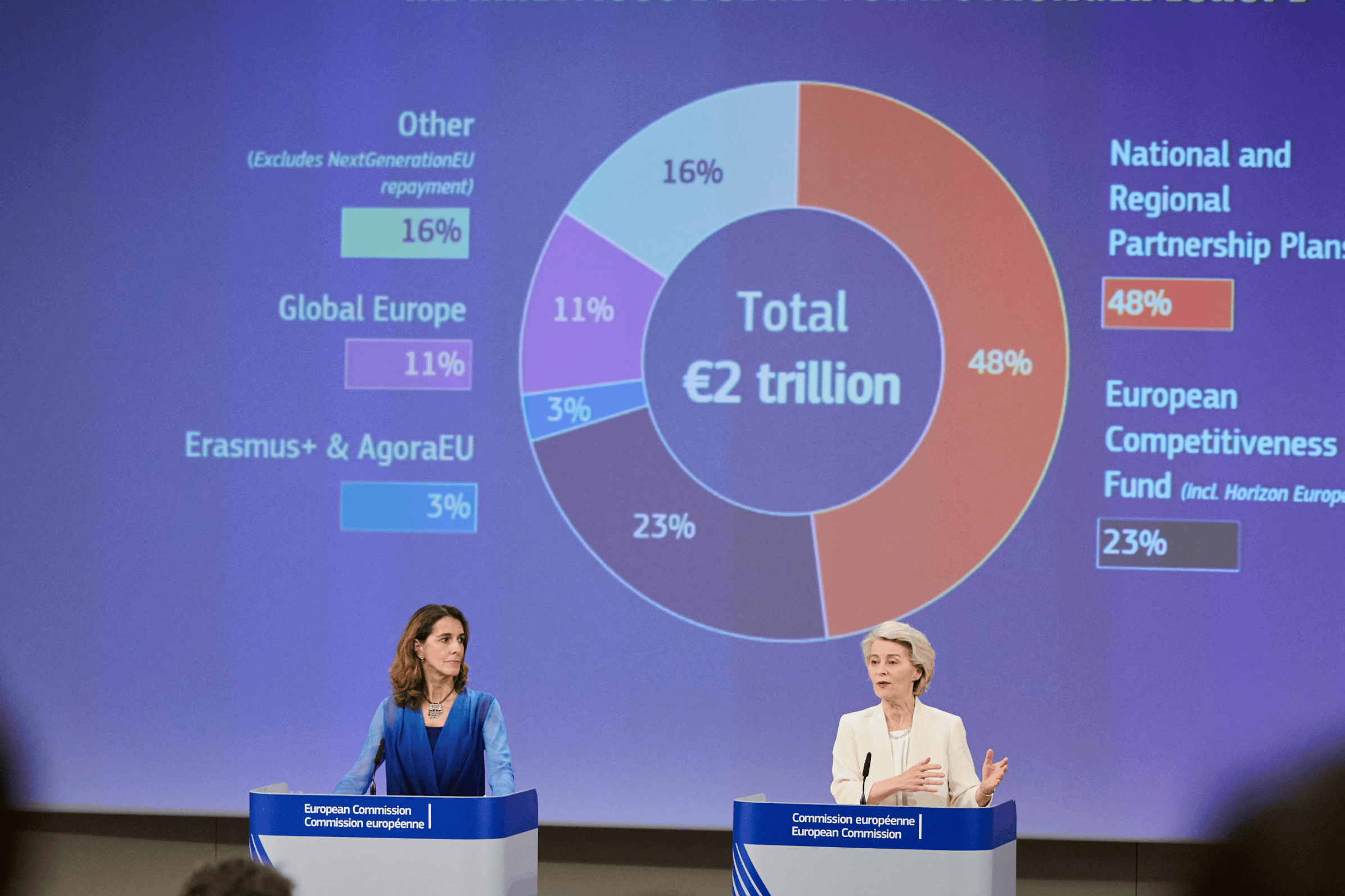
The Commission’s proposal is (too) modest when it comes to overall budget increases. Despite the headline two trillion figure over seven years, it represents a mere 0,04 percentage point of GNI increase, if one reasons at today’s prices and discounts the cost of serving EU debt (as member states said they would). Yet, at the same time, through clever—and necessary—reallocations of funds and priorities with member states, this could be the start of a real and bold shift towards an EU strategic investment capacity.
“Member states will never accept this” goes the usual litany. Let’s not fall into that trap. We’re too much in the habit of thinking negatively and in terms of the status quo, cementing the EU’s incapacity to act rather than building positive dynamics. It’s as if we’ve internalised the frugals’ “nein” rather than an ability to seize opportunities.
In Denmark, Prime Minister Fredriksen is leading the way, rejecting old taboos and telling fellow citizens that her country will no longer play in the frugal camp. A positive sum settlement and leap forward, also beyond what currently is on the table, should not be excluded. Europe will need “funky solutions” (as one analyst called them), such as redoubling own resources and joint borrowing to finance, not old debt, but new common investments from energy grids to defence, both ahead of and in the next MFF. Let these debates begin!
The next Multiannual Financial Framework: the same procedure as every time?
Fabian Zuleeg, CEO
The Commission has published its proposals for the next Multiannual Financial Framework (MFF). Given the difficult negotiations ahead and the ability of all member states to wield a veto, it is high time—especially as the current one runs out at the end of 2027. The Commission’s proposals— a significantly bigger budget with new own resources, more focused on priorities such as security and defence—are ambitious, considering the mega-challenges and transformational pressures that the EU is facing.
Alas, this is unlikely to be the final outcome of the negotiations. While all member states profess that they want to see improvements, they have very different views on what that entails. Inevitably, ‘juste retour’, the balance between what each country pays in and what it receives, will play an important role. Given the strained fiscal situation in all member states, the chances are slight that they will accept this substantive increase in the future EU budget, or that they are willing to provide the EU with a real increase in its ability to raise its own funding. We have already seen member states pushing back against these proposals; this crucially includes Germany, the largest net payer by far.
Rather than focusing on what to do with about 1% of the EU’s GDP, we should instead focus on how else we can finance EU-wide priorities, including through common borrowing. Given the limitations of the MFF, particularly its vulnerability to national vetoes, this is best done outside the usual framework. If the end result is a static or potentially smaller MFF, but increased funding for issues such as security and defence by coalitions of the willing, the MFF negotiations should be seen as a success.
Conditionality vs. juste retour
Eric Maurice, European Politics and Institutions Programme
For the European Commission, the challenge in designing the next MFF was to increase efficiency in the context of growing needs and limited resources. The main logic of the proposal is a two-fold switch from the past: from a programme-based budget to a policy-based budget, to better target the use of EU funds; and from cost-based payments to performance-based disbursements, to maximise the value for money.
With the MFF, the overarching instrument for all EU policies, the Commission is achieving the mainstreaming of conditionality in the Union’s governance system. The current MFF already included rule of law conditionality, as well as different tools like the horizontal enabling conditions—but they were of limited scope.
The proposed MFF will generalise the ‘reform-for-funds’ blueprint developed under the post-Covid-19 Recovery and Resilience Facility (RRF), to be disbursed only when pre-agreed policy/governance reforms or investment are done. Member states’ recovery plans included recommendations from the European Semester or the Rule of Law report, as a way for the Commission to ensure compliance.
The 2028-2034 MFF will link more systematically these different types of conditions across the board. For it to work, the MFF should correct the RRF’s shortcomings: lack of transparency, of involvement of local and regional levels, and of cross-border projects in the plans. The Commission will also need to improve its performance monitoring and reduce accountability gaps.
More fundamentally, the mainstreaming of conditionality and performance-based payments will increase the member states’ accountability to the Commission. It also goes frontally against the member states’ logic of ‘juste retour’—i.e. their expectation that their contributions to the budget and the benefits thus reaped will be equal. This logic has long been an obstacle to achieving more European added value through the EU budget. Behind the bargaining on budget numbers, the negotiations over the MFF will also be a culture clash between the Commission and member states.
The Competitiveness Fund: Europe’s green gamble
Brooke Moore and Anna Crawford, Sustainable Prosperity for Europe Programme
The new European Competitiveness Fund (ECF) would merge several existing programmes to facilitate funding for clean technologies and industrial decarbonisation. While easing investment in these areas is welcome, the proposed structure risks sidelining nature and biodiversity, thus weakening foundations essential to long-term economic and societal resilience.
Under the previous MFF, the LIFE programme—though only €5.4 billion—was the sole EU fund fully dedicated to biodiversity, contributing to the MFF's broader annual biodiversity spending targets. Now, LIFE has been absorbed into the ECF, with biodiversity largely confined to narrower labels like bioeconomy, while also being dispersed across various other budget lines. This risks sidelining biodiversity in favour of industrial priorities. As a public good, biodiversity underpins the EU's competitiveness and security. Over half of global GDP is tied to ecosystems, and biodiversity is essential for food and health. These are not peripheral concerns, and biodiversity requires coordinated, EU-level investment—not only to supplement national efforts and address cross-border challenges, but also to provide clear policy signals and long-term direction for public and private actors.
Beyond LIFE, the Common Agricultural Policy (CAP) is still presented as a primary biodiversity funding stream. Yet it remains unreliable, with longstanding concerns over insufficient environmental ambition now compounded by the relaxation of green requirements for farmers in the Omnibus III legislative package that risks further weakening environmental efforts, compounded by reduced allocation for agriculture in the new MFF.
These shifts reflect a broader trend of betting heavily on prospective future solutions while neglecting immediate priorities like preventing biodiversity loss. Technological innovation and industrial decarbonisation are vital, but they cannot substitute for the irreplaceable role of healthy ecosystems in mitigating and withstanding the impacts of climate change. The ECF must therefore include clear safeguards, including binding earmarks for biodiversity, nature protection, and restoration.
The Competitiveness Fund: A bold step towards more strategic investment
Philipp Lausberg, Europe’s Political Economy Programme
The Competitiveness Fund is arguably the most important and revolutionary element of the European Commission’s MFF proposal, marking a shift towards large-scale strategic investment into the triple clean, digital and security transition. With a proposed size of €451 billion, the Fund has the firepower to de-risk and mobilise significant private and public investment. It concentrates on technological innovation, manufacturing, and infrastructure where the economies of scale and spill-over effects of EU funding can provide most added value, and where the EU’s funding gap compared to the US and China has been most drastic.
Moreover, the proposed Competitiveness Fund addresses many structural shortcomings of the previous MFF. It unifies 14 programmes based on a single rulebook, focused investment windows, and an open implementation architecture à la InvestEU—which would make EU spending more streamlined, directional, and effective.
However, the major challenge will be securing the support of frugal member states for such an ambitious budget. Regardless of the outcome of the upcoming negotiations, there will likely be a need to rely on off-budget instruments in certain areas, such as defence.
Moreover, the creation of a complementary off-budget vehicle should be considered to address the shortage of strategic equity investment which cannot be easily generated through the proposed Competitiveness Fund, based on the InvestEU model. This will be crucial to address the EU's problem with scaling up innovation and competing with the US and China, which have made equity funding a cornerstone of their strategic investment strategy. The vehicle could be financed by the EU, willing member states, private investors and selected sovereign wealth funds, and could provide the financial backing for a set of sub-funds focussed on critical value chains and assets where Europe’s sovereignty is at stake, such as AI, chips, quantum, robotics, mining, and clean tech.
Migration under the new MFF: flexible funding, competing priorities
By Helena Hahn and Annalisa Buscaini, European Migration and Diversity Programme
The European Commission has proposed tripling the overall funding for migration and border management, including for EU agencies. Ongoing discussions suggest that at least 10% of the external action budget may again be earmarked to tackle the root causes of irregular migration. Home Affairs funds would be combined with cohesion and agricultural funding, among others, under ‘National and Regional Partnerships Plans’. Such Plans would be flexibly tailored to member states’ needs, easing access to funding.
The proposal will require heavy negotiations. However, migration funding under the next MFF will have to account for both competition between policy areas, and higher levels of unpredictability. It will be a litmus test for EU global leadership, considering geopolitical shifts and rising humanitarian needs. It will also have to ensure adequate resources for domestic priorities, such as meeting the needs arising from the implementation of newly adopted asylum reforms, as well as reducing labour and skills gaps.
Trade-offs can already be foreseen within funding for external priorities. Given the Commission’s strong focus on enlargement, it may become difficult for the EU to cushion the impact of reduced aid from other sources, particularly the US. This could amplify instability in the EU’s neighbourhood and beyond and take away necessary resources to develop human capital in partner countries. There will be internal competition between migration priorities, too, which would have to be reconciled within the Plans. Illustrating this, if the EU is serious about leveraging migration to address labour market gaps and boost competitiveness, it must ensure adequate funding for migrants’ integration.
Beyond reconciling different priorities, funding flexibility will also be key, as highlighted by the many domestic and international emergencies connected to migration the EU will continue to face. But to benefit from flexibility, crisis funding is not enough. Member states’ political willingness to ensure proper implementation and exit self-inflicted crises is also necessary.
AgoraEU: Investment in culture and democracy, or diluted action?
Liza Saris, Transnationalisation Programme/Connecting Europe
The European Commission’s proposal for the upcoming Multiannual Financial Framework announces a new programme: AgoraEU. AgoraEU merges the Creative Europe and Citizens, Equality, Rights and Values (CERV) programmes, with a significant role for media. It has a total budget of €8.6 billion, a doubling of the current budgets of Creative Europe (€2.4 billion) and CERV (€1.5 billion). This is a welcome investment in Europe's civil society and culture, sectors that are witnessing increasing political and financial challenges, though difficult negotiations are to be expected in the current political climate. The merge reflects the Commission's strategy to simplify the budget with fewer programmes, potentially streamlining the EU's democracy and values work within an impactful programme that stimulates cross-sectoral cooperation and maintains sector specificities—while simplifying access to funds for beneficiaries.
AgoraEU will consist of three strands: Culture, Media (audiovisual and news), and Union Values (rights, equality, citizenship, and civil society). The Culture and Union values (CERV) strands largely follow the logic of their predecessors, while the Media strand includes media literacy and combating disinformation. With media taking a prominent role in countering disinformation and protecting democracy, the programme can be a strategic vehicle for implementing the European Democracy Shield, the Commission's key instrument in this field.
For civil society, this represents a fundamental shift from sector-specific funding to broader funding. This can increase competition between civil society organisations (CSO) and media and cultural organisations for funding resources. The merging of CERV's specialised support areas also raises concerns about a potentially diluted focus followed by reduced support for CSOs in specialised areas. The promised easier access to funds will heavily depend on the new regulations for and effective communication about the programme. Considering the limited resources available to grassroots organisations, the discontinuation of CERV may lead to confusion and require time to access the new fund.
AgoraEU's budget and cross-sectoral approach offer significant opportunities for strengthening European democracy and culture. However, it ultimately depends on how the programme framework will be designed, the final budgets and regulations of the individual strands, and how they cater for the sector's specificities.
Own resources: The EU’s proposed levy on companies faces hard questions
Fabian Zuleeg, CEO
The European Commission’s proposals for the next Multiannual Financial Framework (MFF) mark the starting point for the discussion on not only expenditure, but also on new own resources, i.e. independent EU revenues. In the new proposal, the Commission has put forward a Corporate Resource for Europe (CORE): an annual lump-sum contribution by companies in the EU with an annual turnover above €100 million, expected to generate around €6.8 billion annually. Details are missing, but it raises some fundamental questions.
Regardless of the labelling, this looks like an additional corporation tax. Raising more revenue from companies when European competitiveness is under pressure is unlikely to fly with many member states. CORE also seems to have some design flaws that make it economically and legally doubtful. It is levied on revenue not profit, so would it be applied even if a company is making a loss? How would it interact with tax incentives, for instance to re-invest profit in research & development? What would be the impact on sectors which have high revenues but low profits? There is also a question of compatibility with corporate tax systems at the national level. A lump sum above a certain threshold implies that the maximum tax rate (as percentage of revenue) will be paid by those just above the threshold. From then on, CORE is regressive: the bigger you are, the lower the rate that you pay. This clashes with fair taxation principles, especially progressivity: earning more means paying more.
Proposing CORE might simply be a tactical move, a sacrificial lamb, knowing that member states will reject it, facilitating the path for other proposals. This would raise even more fundamental questions: is this how we should make policy at EU level, and what is the signal the EU is giving to European companies at this critical moment?
Measuring what matters: sustainable and inclusive wellbeing in the MFF
Danielle Brady, Social Europe and Well-Being Programme
For the first time, the MFF will mainstream social expenditure, adopting a target of 14% of the budget, and plans to track social funding across the entire framework. This complements the 35% climate spending target aligned with the EU’s six environmental objectives. These commitments represent a positive step toward embedding sustainable and inclusive wellbeing in the EU budget, addressing both social and environmental priorities.
However, to ensure these ambitions translate into meaningful outcomes, they must be underpinned by a robust monitoring framework. Current monitoring practices often focus narrowly on short-term outputs, limiting insight into long-term impacts. A sustainable and inclusive wellbeing (SIW) framework offers a comprehensive foundation for evaluation, centred on three key dimensions:
-
Ensuring current wellbeing: addressing factors like health (human and environmental), housing, employment, and security.
-
Ensuring future wellbeing: encompassing biophysical and social conditions.
-
Limiting wellbeing inequalities for current and future generations: the distribution of wellbeing determinants and opportunities across spatial scales and social groups.
However, implementing such comprehensive metrics entails trade-offs. More extensive and complex indicators may prolong approval processes, increase administrative burdens, and place additional strain on already stretched institutions. Effective monitoring systems must strike a balance between thoroughness and practicality, employing flexible approaches. While tools like the “Do No Significant Harm” principle offer simplicity, they lack nuance. More sophisticated, SIW-aligned metrics are needed to capture social and environmental impacts. Though SIW metrics may appear bureaucratic, conditionality can be reframed as a positive incentive using existing instruments, such as the Social Convergence Framework under the European Semester, operating ex-post to avoid upfront burdens.
Technological advances offer promising solutions. AI and improved digital infrastructure can enable effective yet manageable monitoring, assessing policy alignment with EU goals, tracking real-time social and environmental impacts, and reducing administrative burden, while enhancing quality and timeliness of evaluations.
Reaffirming a long-term commitment to support Ukraine
Svitlana Taran, Europe in the World Programme
The proposal for the next MFF introduces a new multi-year aid package for Ukraine. This package will replace the €50 billion Ukraine Facility (2024–2027) established under the current MFF.
The new package places greater emphasis on non-repayable support to Ukraine. This shift aims to reduce Ukraine’s debt burden and improve the sustainability of its public finances—under the Ukraine Facility, €33 billion is allocated in loans and €17 billion is non-repayable support and budgetary guarantees.
A central element of the new package is the Ukraine Reserve, a special instrument under the Global Europe umbrella dedicated to providing non-repayable grants and budgetary guarantees. Funded through the annual EU budget, the Reserve is proposed at €100 billion for 2028–2034. To ensure the predictability of support, the proposal also sets an annual ceiling of €14.286 billion available for the Ukraine Reserve, which is significantly higher than the €5 billion annual limit established under the Ukraine Facility.
In addition, Ukraine will remain eligible for support in the form of loans through common EU borrowing, backed by the headroom mechanism of the EU budget, with no limits on total amount of loans during 2028–2034. As with the current Ukraine Facility, disbursements are expected to be strictly conditional on Ukraine’s progress in implementing reform benchmarks.
Positioning EU support outside MFF ceilings will ensure budgetary flexibility, given the unpredictability of Ukraine’s financing needs. They will depend on the course of the war and developments in its public finances, trade, and labour markets. Ukraine will need continued, though gradually less, macroeconomic support. Reconstruction and EU accession will also demand substantial resources and expanded incentives to attract private investment. Military aid will remain outside the MFF, covered by the European Peace Facility.
Overall, the new MFF is a positive step for Ukraine, signalling continued EU commitment to providing predictable, long-term support—though it is yet to be reaffirmed by the member states. The scale of Ukraine’s needs across key areas may exceed the established resources, requiring additional off-budget funding and a coordinated international response led by the EU, in close cooperation with other partners.
Ensuring ambition in health preparedness
Samuel Goodger, Social Europe and Well-Being Programme
History teaches us that under-investment and harsh austerity measures, across the other spheres of state intervention, bring short-term savings at the expense of reducing the scope of future growth—which creates stagnation. The EU’s own research has found enormous spillover gains from the Recovery and Resilience Facility, which particularly benefited progress in health, skills, and education. Therefore, let’s not lose sight of how sustainable welfare and health systems are crucial to securing Europe’s social model and promoting the green, digital, and security transitions.
The Commission’s recent EU Preparedness, Critical Medicines, and Life Sciences initiatives, among others, are promising. Looking forward, the proposed 2028-2034 Multiannual Financial Framework’ Competitiveness Fund’s €23bn for Health and Bioeconomy must adequately drive progress in European R&I, catalysing greater private investment. Further, the Union Civil Protection Mechanism’s ambitious €11bn funding folds in the prior EU4Health’s health preparedness tools, including securing medicine supplies. This risks still being too focused on medical emergencies, despite the inclusion of commitments to improve cross-sectoral coordination and address capacity gaps.
Throughout the latter tool and the National and Regional Partnerships pillar, the MFF’s support must reach the EU’s healthcare workforce—among the most vulnerable to labour shortages—to make it more resilient. Holding Member States to account, it must also actively promote a shift towards prevention-based healthcare, such as immunisation and innovative screening campaigns—the first defence against costly treatment down the line.
The allocation of hundreds of billions in research and innovation, and cohesion and social investments is on the line. These should foster progress and EU convergence, and reward member states’ commitments to health. Beyond a strict emphasis on growth and economic competitiveness, relative to the US and China, health is a crucial proxy for our prosperity. A healthy population is a resilient, prepared, and secure population.
The support the European Policy Centre receives for its ongoing operations, or specifically for its publications, does not constitute an endorsement of their contents, which reflect the views of the authors only. Supporters and partners cannot be held responsible for any use that may be made of the information contained therein.