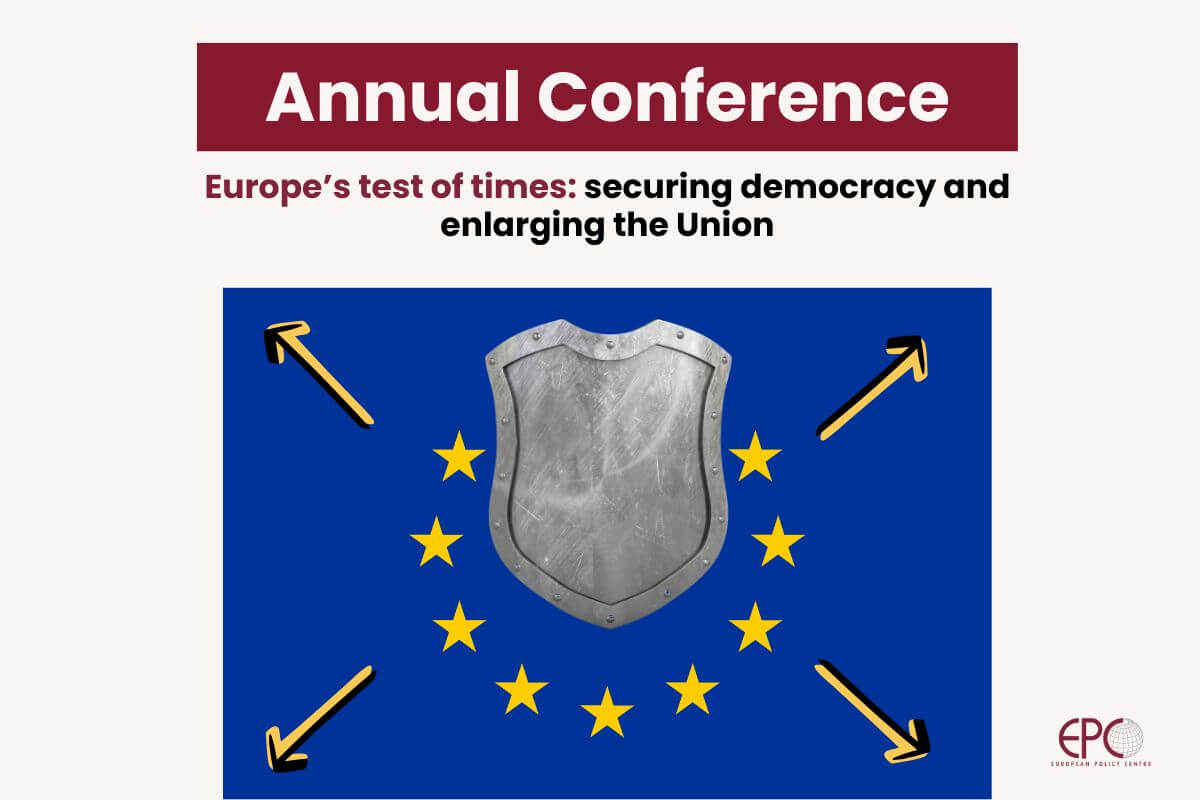
Europe’s test of times: securing democracy and enlarging the Union

Europe is entering a convergence of crises it can no longer out-manage or out-delegate. Russia’s war has redrawn the continent’s security map. Disinformation, hybrid warfare and foreign interference now strike at the democratic core of our societies. And inside the European Union (EU), the far right is no longer knocking on the door – it is already rearranging the furniture.
The EU is scrambling to respond: the European Democracy Shield, new rules on transparency, stronger media protections. But here is the uncomfortable truth: security without democracy is an illusion, and democracy without security is a house of cards.
This is why enlargement has moved back to the centre of Europe’s strategic equation. Accession used to be our most reliable export of reform and stability. Today, it is also a question of continental security – and a test of democratic resilience. Europe cannot be safe if its neighbourhood is fragile. And no enlargement will stick unless democracies can withstand pressure, manipulation and capture. Security and democracy now rise or fall together – and Europe is running out of room for error.
Reform and enlarge — parts of the same survival strategy
The EU must deepen democracy at home while preparing to widen its borders. Anything less would undermine the credibility of the entire European project.
The old Brussels debate – ‘enlarge or reform first?’ – has become a strategic distraction. Sceptics point to institutional inertia, political fatigue and internal divisions as proof that Europe cannot widen and deepen at the same time.
This is a false dilemma. The EU cannot credibly enlarge without reform, and it cannot reform without a vision of a Union that is bigger than today’s. These are not competing agendas but two halves of the same one. If Europe separates them, it fails both.
Hybrid threats make this urgency even sharper. External actors target exactly the cracks where enlargement and internal reform meet: institutions, elections, media ecosystems, rule of law and public trust. Brussels may continue to treat enlargement as a technical file, but it has become Europe’s stress test – and the results will be public.
Democracy under siege — inside the Union and at its doorstep
Democratic erosion is no longer a warning sign on the EU’s horizon; it is happening in plain sight. Illiberal actors exploit polarisation, weaken institutions, capture media and undermine checks and balances. Far-right narratives move from the margins to the mainstream. And the EU’s current toolkit is simply not built for the political world we now inhabit.
Foreign interference supercharges this vulnerability. Russia’s propaganda machine, China’s covert influence and manipulative digital platforms turn uncertainty into a political weapon. Their aim is not persuasion – it is corrosion, to hollow democracy from within.
For the Western Balkans and the Eastern Trio, this is daily reality. Shrinking civic space, smear campaigns, strategic corruption and disinformation do not wait for accession chapters. These societies sit on the frontline of Europe’s democratic security. Accelerating enlargement without addressing this would be naïve at best, reckless at worst.
Europe therefore needs not only a plan for how the Union grows, but a strategy for how the Union stays democratic as it grows.
EU-wide democratic safeguards that bite
The past decade shows that democratic resilience will not magically improve on the day of accession; the most serious backsliding has happened after entry. Conditionality is strongest before membership – just when it is most politically convenient to ignore it.
This must change. Europe needs a new model of democratic safeguards that applies to all member states, old and new. A stronger Rule of Law cycle, meaningful conditionality and structured engagement with civil society should become standard practice – not an exceptional punishment for candidates or those who cross a red line.
The EU must also build tools to counter political capture, strategic corruption and disinformation – challenges that do not respect borders and exploit institutional blind spots.
For new members, transitional monitoring should support the early years of membership, turning reform commitments into lived reality. This is not about mistrust; it is about responsibility. You cannot build a stronger Union by hoping for the best.
For older members, the message must be the same. Backsliding is not a Balkan anomaly; it is an EU problem. A credible enlargement policy requires a credible defence of democracy at home. Universal safeguards will show that Europe means what it says – about everyone, not just about those next in line.
Rendezvous with history?
Europe’s next chapter will be written in an era of pressure – geopolitical, democratic and institutional. The choice is stark: a Europe that grows bigger and stronger by aligning democracy and security, or a Europe that retreats into fragmentation and irrelevance.
In this era, enlargement and reform are Europe’s twin tests, and security and democracy its twin pillars. If we fail one, the whole structure tilts. History is calling. The rendezvous is now. Will Europe show up?
This commentary forms part of a series leading up to the European Policy Centre's 2025 Annual Conference. Click here to learn more.
Corina Stratulat is Associate Director and Head of European Politics and Institutions Programme at the European Policy Centre.
Johannes Greubel is Senior Policy Analyst, Head of Programme and ‘Connecting Europe’ Project Lead at the EPC.
The support the European Policy Centre receives for its ongoing operations, or specifically for its publications, does not constitute an endorsement of their contents, which reflect the views of the authors only. Supporters and partners cannot be held responsible for any use that may be made of the information contained therein.