

From ambition to endurance: EUMC General Seán Clancy on Europe’s defence shift

For three decades, Europe operated within what General Seán Clancy called a “reassuring strategic story”. That era, he argued at the EPC Thought Leadership Forum on 23 February, is over.
The Chair of the EU Military Committee (EUMC) warned that Europe now faces a strategic environment that is harsher, faster and “no longer forgiving”. The debate has shifted from abstract discussions about autonomy and burden-sharing to operational realities. Defence, he stressed, requires a whole-of-society approach: societal preparedness, supply chains, industry, sanctions and more.
The defining feature of today’s threat landscape is simultaneity. Crises are not sequential; cyber, hybrid, space and conventional pressures unfold at the same time. Readiness must therefore be systemic, ensuring the ability to sustain, adapt and replace capabilities across peace, crisis and conflict alike. “Deterrence without endurance is fragile,” General Clancy said, adding that “deterrence is as much about supply chains as it is about weapons.”
In his role as the chair of the EU’s highest military body, General Clancy emphasised the need to align initiatives such as the Permanent Structured Cooperation (PESCO), the Readiness Roadmap 2030, the European Defence Fund and the European Defence Industrial Strategy. He praised the Defence Omnibus and called for unified rather than fragmented national approaches.
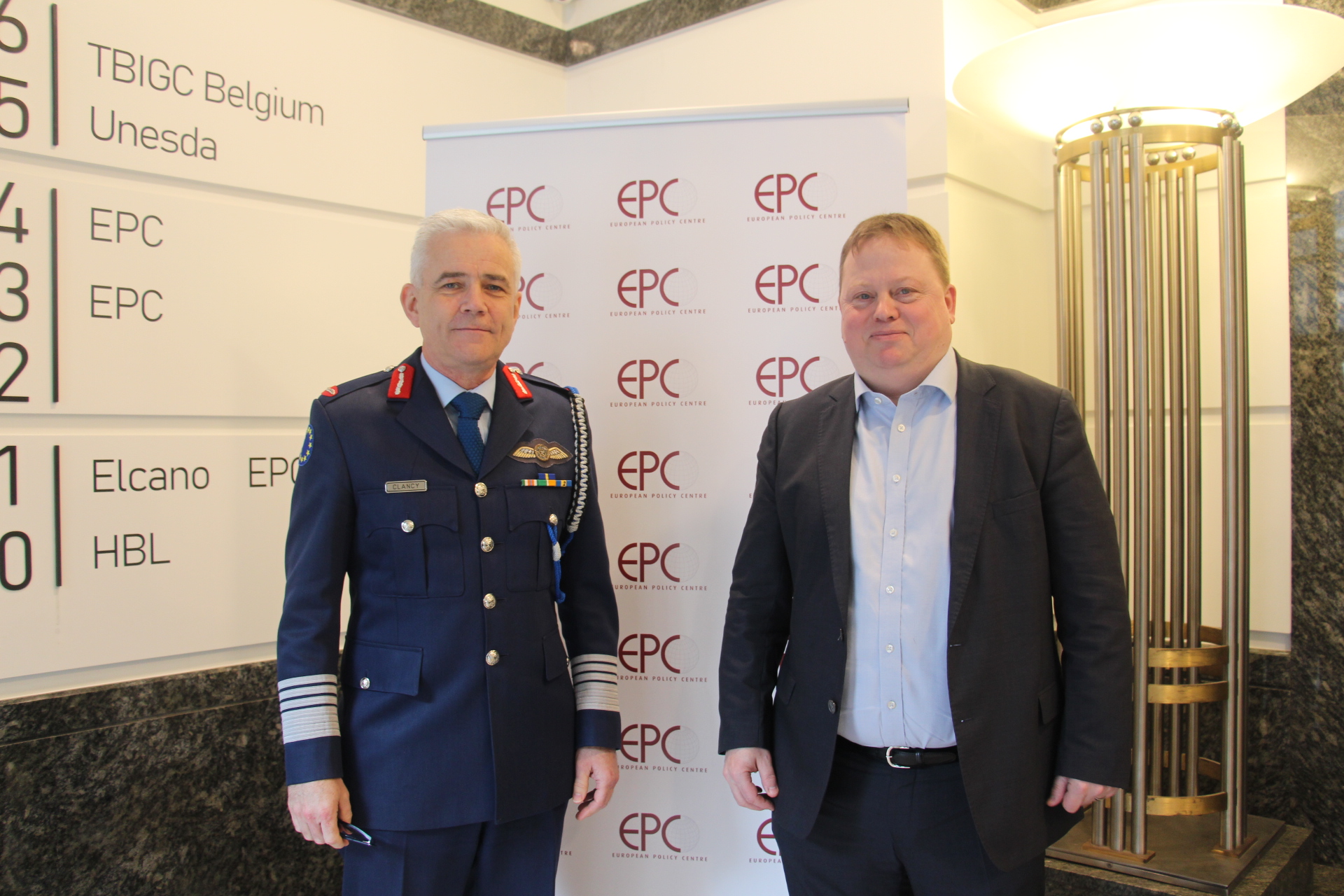
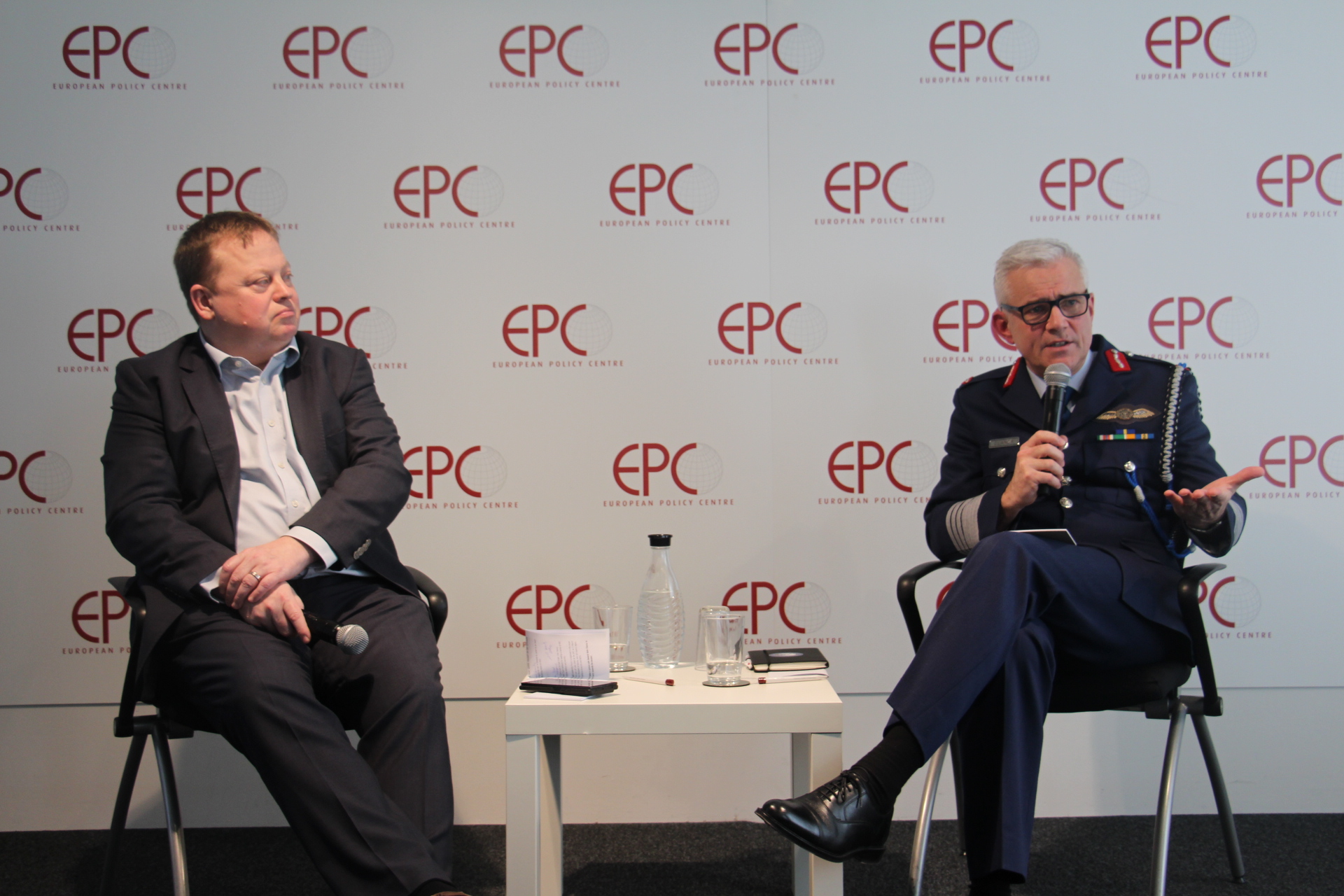 The event was moderated by EPC Chief Executive Fabian Zuleeg (left) and featured a keynote speech by General Seán Clancy (right). Photo by: EPC.
On transatlantic relations, General Clancy was clear that NATO remains the bedrock of European defence. The shift in US strategic focus should not be interpreted as abandonment, but as a rebalancing of responsibility – and an opportunity for Europe. The debate, he argued, is not “autonomy versus alliance, but dependence versus partnership.”
Strengthening Europe’s conventional capabilities within NATO requires close EU–NATO complementarity: NATO underpins collective defence and nuclear deterrence, while the EU contributes industrial, regulatory and financial instruments. Deepening partnerships with the United Kingdom, Norway and other like-minded actors is also part of that equation.
Turning to Ukraine, he described the war as “a preview of the war we must prepare for tomorrow.” Ukraine’s resilience, he argued, is built on its rapid adaptation – notably in the use of drones, precision systems and electronic warfare. Supporting Kyiv is in Europe’s strategic self-interest, testing its own industrial scale and ability to sustain high-intensity support over time.
Looking ahead, General Clancy called for a European security strategy that is more than “a catalogue of activities”. It must rest on common threat assessments, he said, to avoid “debating symptoms instead of causes” and to bring coherence across instruments and institutions.
Credibility will not be measured by declarations, but by endurance.
The EUMC bridges political ambition and military feasibility. As the EU’s highest military body, the Committee advises the High Representative for Foreign Affairs and Security Policy (HR/VP) and the Council’s Political and Security Committee, as well as oversees the military dimension of the Common Security and Defence Policy.
Jessica Moss is the Editor at the European Policy Centre.
The support the European Policy Centre receives for its ongoing operations, or specifically for its publications, does not constitute an endorsement of their contents, which reflect the views of the author only. Supporters and partners cannot be held responsible for any use that may be made of the information contained therein.