

Like-minded traders: What a Euro-Pacific trade alliance could deliver
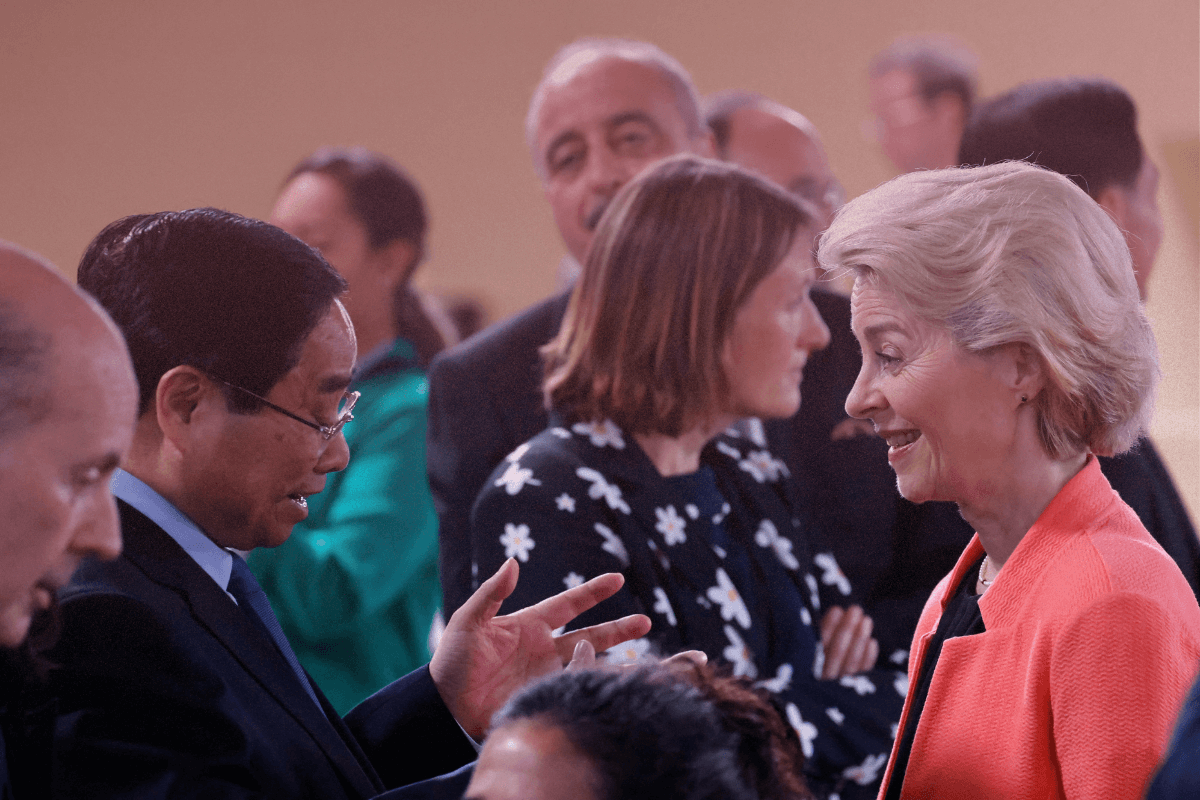





Photo: Vietnam’s Prime Minister Pham Minh Chinh meets European Commission President Ursula von der Leyen at the UN Ocean Conference. Vietnam, set to chair the CPTPP in 2026, will prioritise strengthening CPTPP–EU cooperation.
At a time when rules-based multilateral trade is under assault from the United States, long a pillar of the global open trading system, like-minded nations in Europe and the Pacific whose prosperity hinges on dependable commercial governance must join forces. US economic coercion may only worsen, with the lopsided EU–US trade deal likely to entice President Donald Trump to press for further concessions.i Trump has also hit Pacific allies with high tariffs.
This Policy Brief examines the EU’s strategic options for closer engagement with the Comprehensive and Progressive Agreement for Trans-Pacific Partnership (CPTPP), which includes Australia, Brunei, Canada, Chile, Japan, Malaysia, Mexico, New Zealand, Peru, Singapore, the United Kingdom and Vietnam. Together, the EU and CPTPP trade blocs account for nearly 30% of global GDP. The paper evaluates three potential pathways: full accession to the CPTPP, the creation of a joint dispute settlement mechanism to supplement the paralysed World Trade Organisation (WTO), and the pursuit of enhanced, structured cooperation that delivers pragmatic economic and regulatory benefits without the complexity of formal membership. The third option is clearly the most practical.
The analysis explores the implications for economic diversification and competitiveness, trade governance and geopolitics and internal EU political dynamics. It weighs economic benefits against potential domestic fallout in certain member states (notably France) and possible risks to EU–China and transatlantic relations. It argues that deeper EU–CPTPP ties could both help revitalise rules-based trade and provide a platform for advancing longer-term trade governance reforms.
European Commission President Ursula von der Leyen first floated the idea of closer EU–CPTPP engagement in April 2025 following Trump’s announcement of sweeping US tariffs on most of the world. She pitched the idea to EU leaders at the June European Council to “show to the world that free trade with a large number of countries is possible on a rules-based foundation”.
EU Trade Commissioner Maroš Šefčovič launched the first EU–CPTPP Trade and Investment Dialogue with the 12 CPTPP trade ministers in Australia in November. Discussions covered five key areas: trade diversification, digital trade, trade and investment facilitation, supply chain resilience and the global trade environment, including WTO reform. They issued a joint statement declaring common commitment to rules-based trade and indirectly criticising Chinese and US “market distorting practices, which distort trade and investment flows, affect resilient supply chains and cause excess capacity”.
Read the full Policy Brief here.
Paul Taylor is a Senior Visiting Fellow in the Europe in the World Programme at the European Policy Centre.
Raul Villegas is a former Policy Analyst at the Executive Office of the European Policy Centre.
Svitlana Taran is a Policy Analyst in the Europe in the World Programme at the European Policy Centre.
Varg Folkman is a Policy Analyst in the Europe’s Political Economy Programme at the European Policy Centre.
Elixabete Arrieta is a Junior Policy Analyst in the Europe in the World Programme at the European Policy Centre.
The support the European Policy Centre receives for its ongoing operations, or specifically for its publications, does not constitute an endorsement of their contents, which reflect the views of the authors only. Supporters and partners cannot be held responsible for any use that may be made of the information contained therein.