

Von der Leyen’s downgraded priorities: democracy, social issues and environment
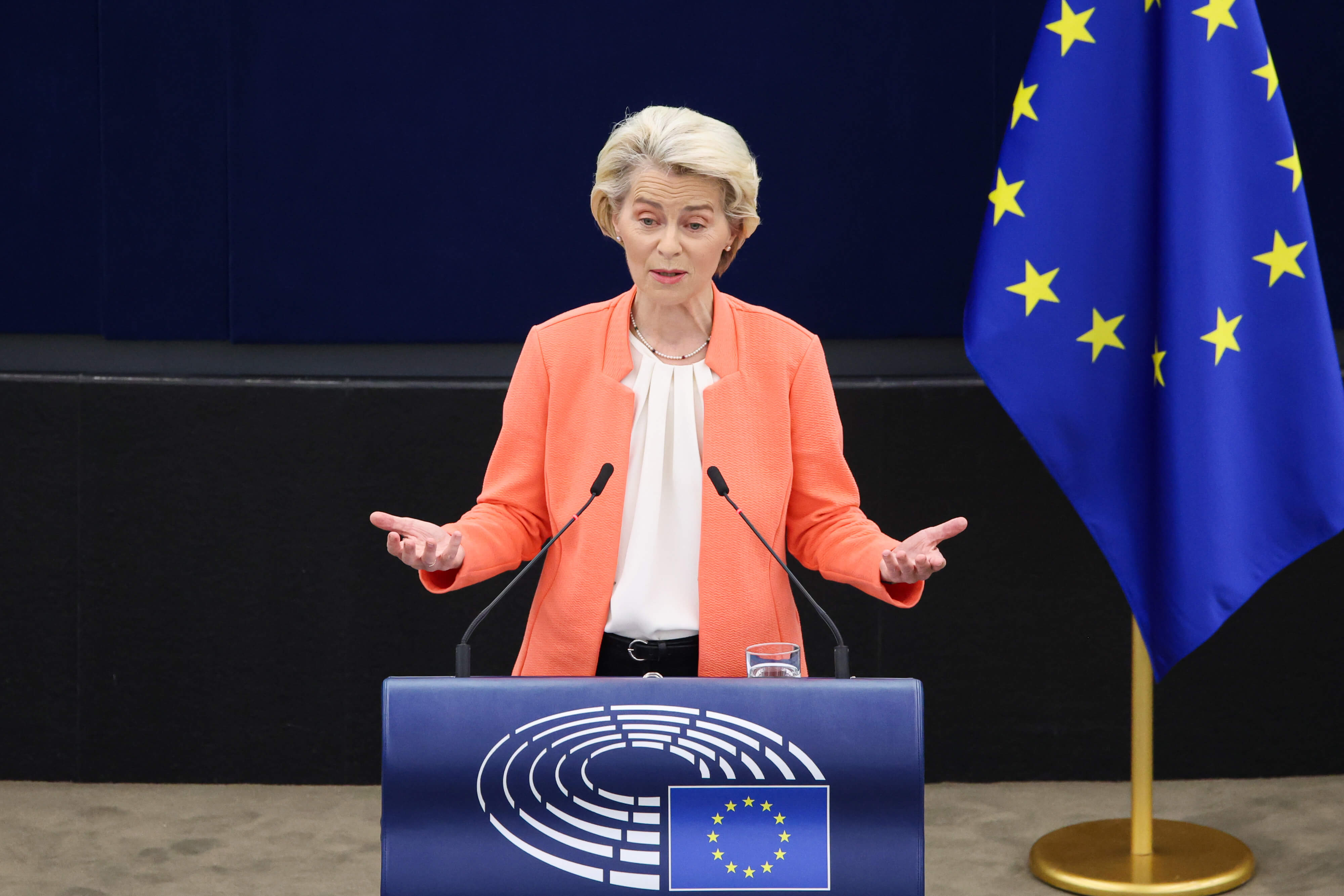

On 10 September, European Commission President Ursula von der Leyen will deliver the first State of the Union speech of her second term. She will defend her record up to date and outline her priorities for the year ahead. She should, however, also rebalance the Commission’s agenda, with more attention to policy areas like protecting EU democracy, social issues and the environment, alongside the two current arch-priorities: defence/security and competitiveness/simplification.
Since von der Leyen’s re-election in July 2024, EU politics has been marked by the consequences of Russia’s war of aggression against Ukraine and by the diplomatic, security and economic fallout of Donald Trump’s re-election as president of the United States. Defence and competitiveness issues have therefore become especially prominent. As our analysis below reveals, since taking office on 1 December 2024, the Commission's communications and legislative proposals linked to these two priorities have dominated the EU’s executive narrative and agenda, overshadowing all other policy areas.
Together with Eulytix, we assessed how the seven key priorities from von der Leyen’s Political Guidelines were reflected in the Commission’s communications and legislative proposals between December 2024 and July 2025. For research purposes the documents, obtained from EUR-Lex, were divided into smaller, more manageable sections of roughly – two to three paragraphs each, using a process known as chunking and a technique called recursive splitting. We refer to these chunks as “passages.” Each of these passages was translated into a mathematical representation of its meaning, known as a semantic vector, produced by a light-weight language model. Using a method called semantic similarity, we identified chunks that are conceptually close to a particular commitment, even if the language is different. This methodology allows us to assess how closely the Commission’s legislative and strategic work aligns with its initial commitments, as well as to understand how the Commission frames its strategy.
For all key Political Guidelines priorities to be equally represented in the Commission’s communications and proposals, they should be mentioned in around 14% of the selected passages. Our analysis (see Figure 1 below) shows this is far from being the case, with several of von der Leyen’s own priorities receiving little attention.
The Political Guidelines chapter on “sustainable prosperity and competitiveness” was mentioned most often, appearing in 30% of the passages (33% in communications and 27% in legislative proposals). The chapter on defence and security , which also includes migration, appeared in 28% of the analysed passages (29% in communications and 27% in legislative proposals).
Figure 1
The distribution of passages relating to chapters in von der Leyen Political Guidelines
Percentage of total relevant passages in communications and legislative proposals
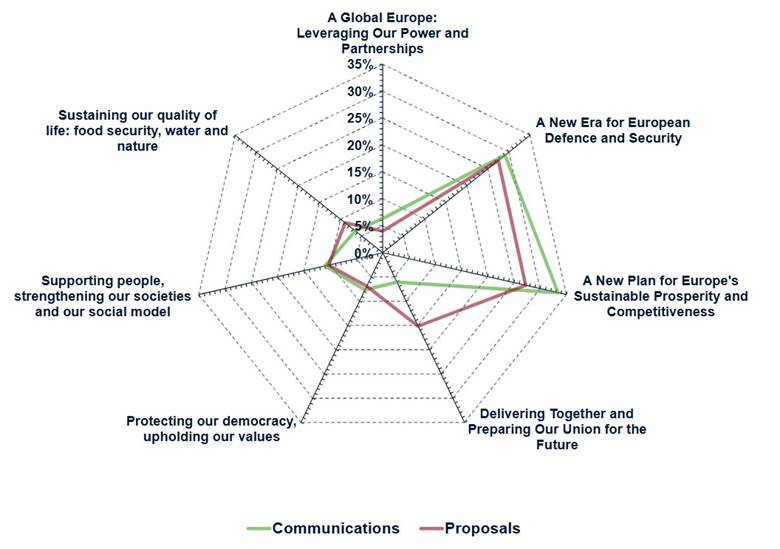
In comparison, the social chapter appeared in 11% of the documents analysed by the Commission. The chapters on protecting EU democracy and values, and the one on food security, water and nature were each mentioned in 7% of passages. The Global Europe chapter, dealing with foreign policy, trade and international partnerships, featured in only 5% of communications and proposals. The chapter on the Union's future appeared in 15% of legislative , initiatives, because of the many draft legal texts for the next Multiannual Financial Framework.It would be unrealistic to expect exact parity between all the chapters of the Political Guidelines. Political objectives are precisely the result of prioritisation among policy areas, according to their importance, urgency, and prominence in the public debate. In fact, a previous EPC-Eulytix analysis showed that the commitments — planned policy actions for the 2024-2029 term — assumed in the Political Guidelines were inequally distributed (see Figure 2). For example, while 21% of commitments were related to defence and security, only 6% concerned the environment. However, the present analysis of the Commission’s record reveals that the asymmetry between priorities has increased compared to the Political Guidelines. The main loser in this evolution is the social chapter, which represented 18% of commitments, but so far has appeared in only 10% of legislative proposals and 10% of communications, where the Commission outlines its views. The protection of EU democracy and values has also been downgraded compared to its share of commitments (12%), with significantly fewer mentions even in agenda- setting communications (7%).
Figure 2
The distribution of identified commitments in von der Leyen Political Guidelines
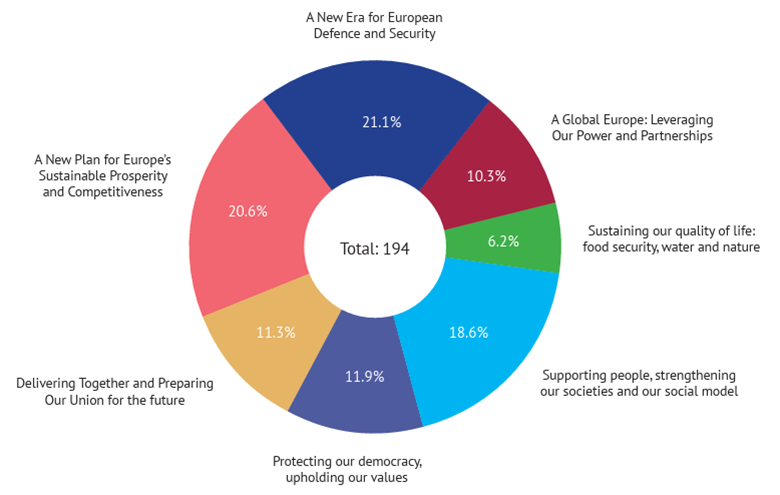
Source: Eulytix via European Commission’s guidelines
The challenges posed by the war in Ukraine and Trump’s hostility against the EU will no doubt be at the centre of von der Leyen’s State of the Union speech on 10 September. The Commission president will nevertheless have to rebalance her political agenda if she intends to fulfil all the commitments she made in 2024.
Ursula von der Leyen should, in particular, indicate that the Commission will balance competitiveness policy with social initiatives to increase the well-being and resilience of European society. She should make clear that the Commission remains committed to implementing the Green Deal and addressing climate and biodiversity degradation. She should also state that the EU’s security includes resolute action against internal threats to democracy and fundamental values.
Eric Maurice is a Policy Analyst in the European Politics and Institutions Programme at the European Policy Centre.
Levente Kocsis serves as Chief Data Scientist at Eulytix.
The support the European Policy Centre receives for its ongoing operations, or specifically for its publications, does not constitute an endorsement of their contents, which reflect the views of the authors only. Supporters and partners cannot be held responsible for any use that may be made of the information contained therein.