

Ahead of the Hungarian elections, show Orbán the democratic red line
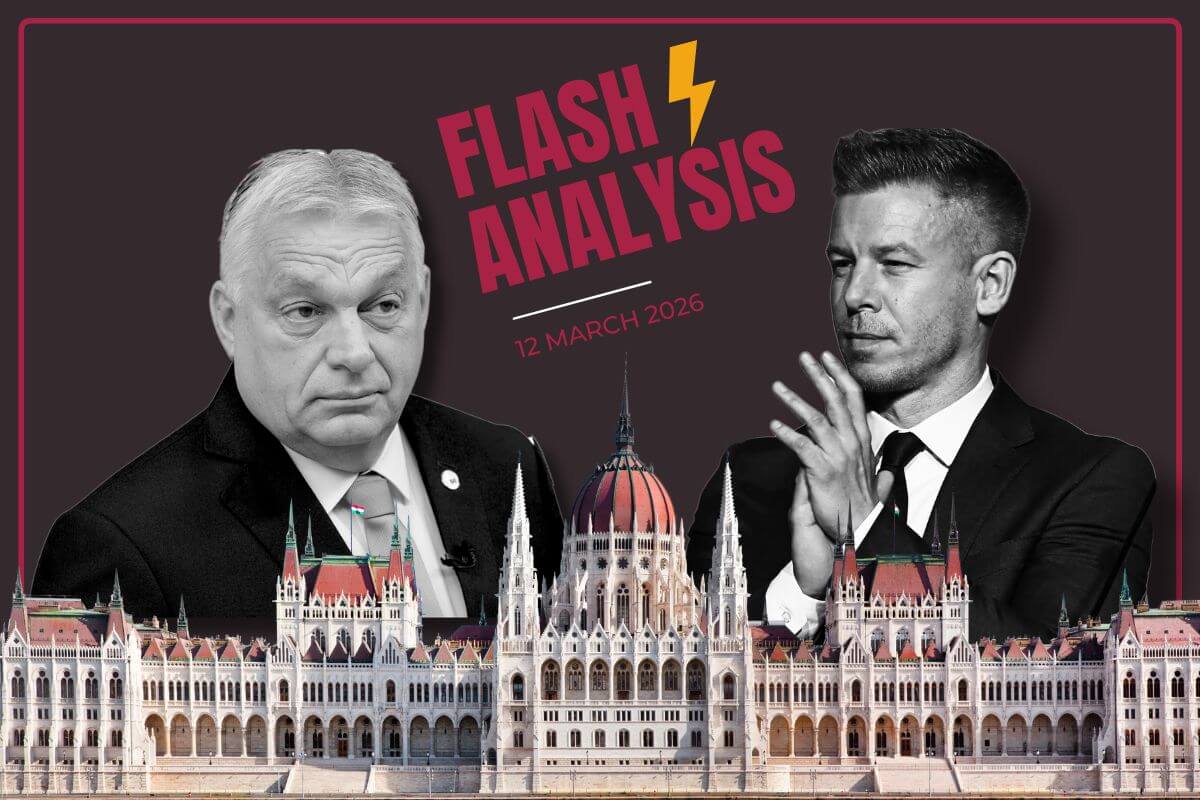

Will Viktor Orbán cling to power by all means necessary? A month out from the 12 April elections, the Hungarian prime minister is trailing his main opponent, Péter Magyar, in the polls, and recent developments suggest that the familiar playbook of vote manipulation may already be in motion.
According to Hungarian investigative outlet VSquare, Russian operators have been sent to Hungary and appear set to replicate the electoral interference activities seen in Moldova in 2025 – but this time with the complicity of the sitting government. Over the past weeks, Orbán has claimed that Ukraine is threatening Hungary’s energy infrastructure and has deployed the military around key facilities, raising concerns over a potential false-flag operation that could then justify declaring a state of emergency to postpone the elections.
The campaign has seen widespread use of AI-generated dis- and misinformation by the regime. Magyar has been portrayed as an EU puppet or a Ukrainian agent. Hungarian authorities recently seized Ukrainian state bank money and gold, claiming they were funds to support Magyar. Meanwhile, a purported sex tape involving Magyar has been rumoured for weeks after a mysterious message was posted online and could surface shortly before the vote.
Even in the event of defeat, some analysts fear that Orbán could challenge the results. He could rely on captured courts and the outgoing parliament – where he still holds a two-thirds majority – to pass constitutional laws or obstruct a transition of power.
These scenarios may never materialise. But if some of them were to occur, the EU would face an unprecedented situation: an illegal and illegitimate government sitting at the table.
EU leaders and institutions should make clear to Orbán that there is an ultimate red line within the Union: election manipulation and refusal to accept democratic outcomes. When they meet behind closed doors at the European Council on 19 March, other EU leaders should demand clear commitments that the Hungarian government will not invoke emergency powers to postpone the vote, interfere with the electoral process or refuse to recognise the outcome. They should also make clear that crossing this line would trigger immediate consequences.
If necessary, this should include taking the Article 7 to its conclusion, stripping Hungary of its voting rights event if countries like Slovakia and Czechia may hesitate. This should also include fast-tracked infringement proceedings, as well as implementation of the budget conditionality for all EU funds to Hungary. Additionally, member states should also be ready to coordinate political and economic measures.
All of this would be politically costly. But the stakes – the EU’s democratic order – could not be higher. What must be prevented is the emergence of a government inside the Union that retains power through electoral manipulation while continuing to participate in EU decision-making. To avoid such a scenario, the Union should make clear that it is prepared to act.
Eric Maurice is a Policy Analyst in the European Politics and Institutions Programme at the European Policy Centre.
The support the European Policy Centre receives for its ongoing operations, or specifically for its publications, does not constitute an endorsement of their contents, which reflect the views of the authors only. Supporters and partners cannot be held responsible for any use that may be made of the information contained therein.