

WTO conference fails to deliver: what comes next?
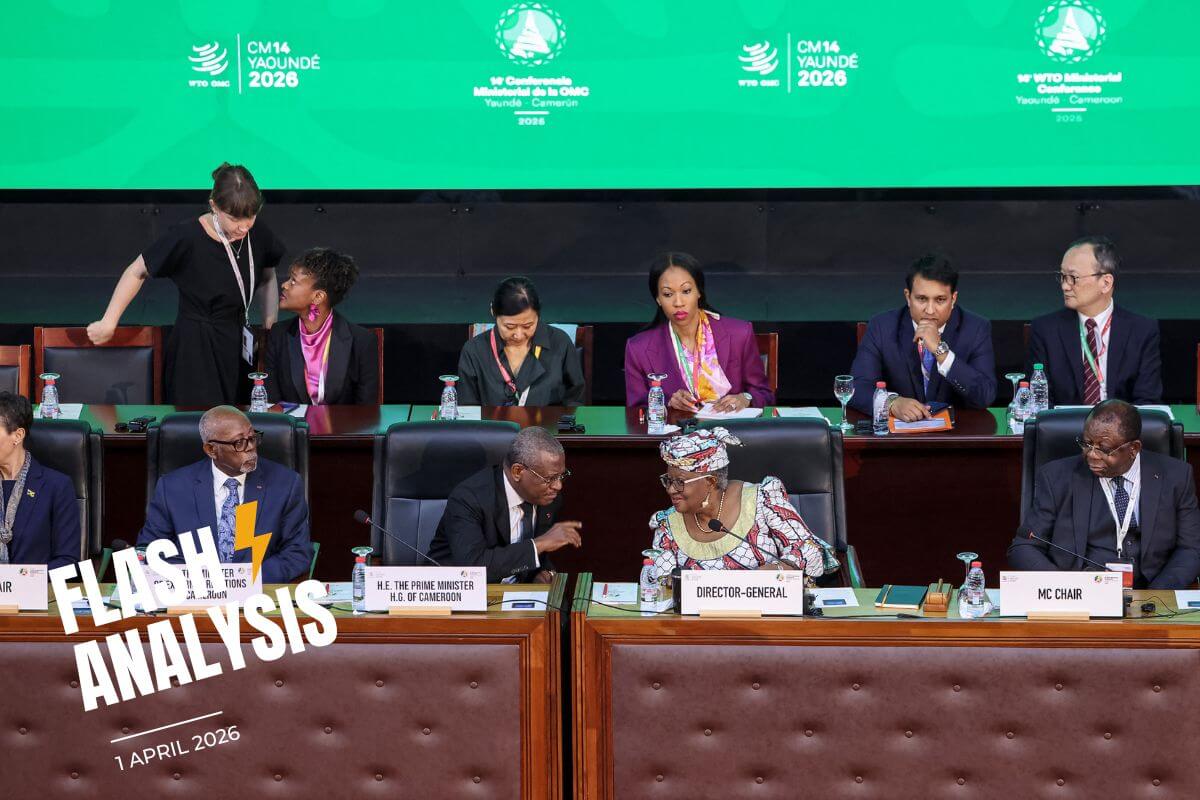

WTO members failed to adopt a final declaration or deliver key outcomes of the “Yaoundé package” at the 14th Ministerial Conference (26–29 March), exposing deep divisions over the future of the multilateral trading system and the growing difficulty of reaching consensus-based multilateral agreements.
The most significant setback was the failure to extend the WTO’s e-commerce and TRIPS-related moratoria, which therefore lapsed. The expiration of the e-commerce moratorium, in place since 1998, allows countries to impose customs duties on electronic transmissions (such as digital downloads and streaming), marking a significant shift for global digital markets. The US and other developed economies pushed for a long-term or permanent extension to preserve a predictable, tariff-free digital economy, with US officials linking support for the moratorium to broader WTO reform. By contrast, a group of developing countries opposed the extension to preserve their right to impose duties and protect their emerging digital sectors. Brazil eventually blocked a final agreement linking the issue to the stalled agricultural negotiations.
No agreement was reached on a WTO reform agenda, either. The EU and the US favour more flexible, multi-layered approaches, including plurilateral agreements, to advance negotiations and modernise rules. Developing countries, led by India, insist on preserving core principles such as non-discrimination and the consensus-based system, prioritising unresolved issues such as agricultural subsidies and public stockholding, and maintaining effective special and differential treatment for developing countries.
No progress was made on another divisive issue: integrating plurilateral initiatives into the WTO’s legal framework, which requires consensus. India blocked the Investment Facilitation for Development Agreement (IFDA), backed by 129 members, including the EU, arguing that such initiatives fall outside the WTO’s mandate and undermine its multilateral character by allowing subsets of members to set rules outside consensus.
The conference nevertheless pointed to a possible alternative: members of plurilateral initiatives may bypass consensus constraints through interim arrangements. A group of 66 of the WTO’s 166 members, including the EU, agreed to provisionally apply a plurilateral agreement on Electric Commerce, allowing progress on digital rules such as e-signatures, paperless trading and consumer protection. It will function as a legally binding interim treaty among signatories while still relying on selected WTO mechanisms, including dispute settlement.
The Yaoundé package could still be finalised and adopted at the next General Council meeting in Geneva. Its outcomes are crucial to prevent further fragmentation of the multilateral trade system and discourage a US withdrawal. Given its active role, the EU can lead coalitions of like-minded countries, including CPTPP members, to advance WTO reform, restore a binding dispute settlement system, and implement and expand plurilateral agreements, including e-commerce and the IFDA, with a view to their eventual incorporation into the WTO framework. Simultaneously, the EU and CPTPP members are likely to continue pursuing alternative pathways to advance trade rules beyond the traditional consensus-based system.
Svitlana Taran is a Policy Analyst in the Europe in the World Programme at the European Policy Centre.
The support the European Policy Centre receives for its ongoing operations, or specifically for its publications, does not constitute an endorsement of their contents, which reflect the views of the authors only. Supporters and partners cannot be held responsible for any use that may be made of the information contained therein.