

EPC conference warns of rising threats to liberal democracy – and how to protect it
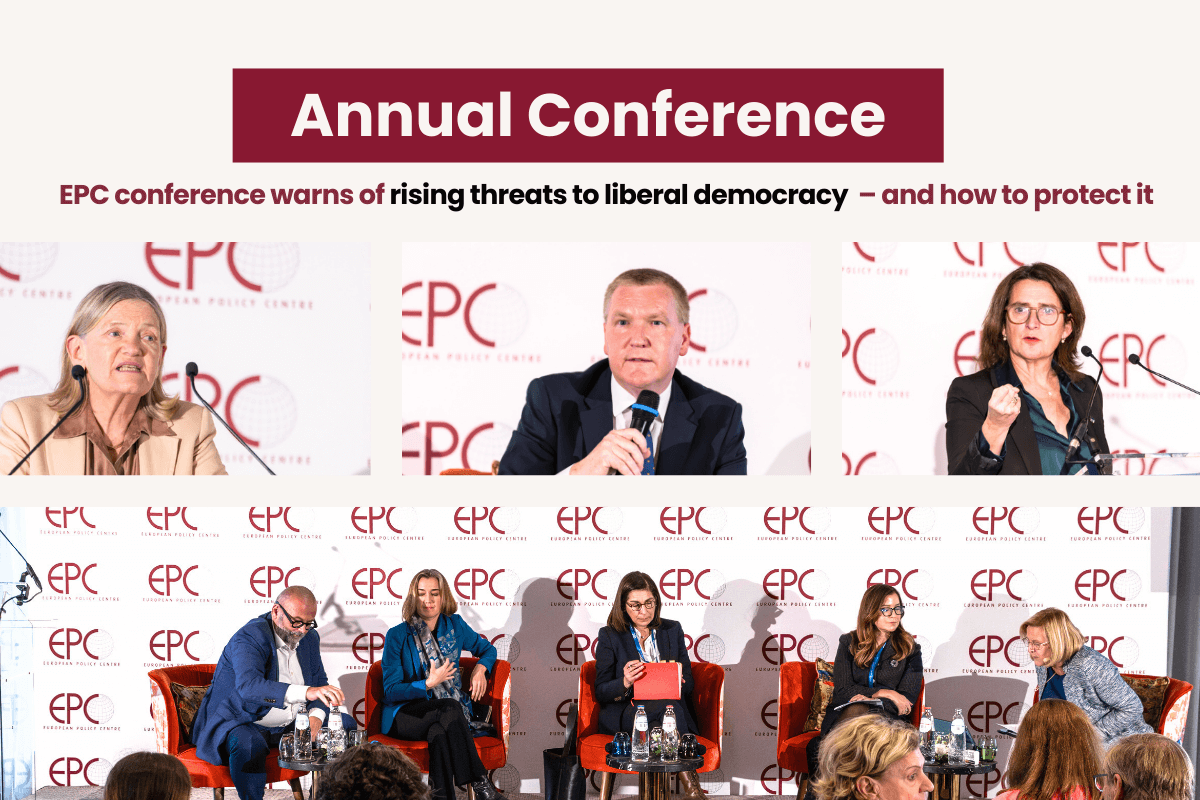
The 2025 European Policy Centre (EPC) Annual Conference placed democracy at the centre of debate, warning that the optimism of the early 1990s has given way to a clear decline in global democratic standards. With Freedom House reporting 16 consecutive years of shrinking political freedoms, speakers highlighted an accelerating authoritarian turn and the forces driving it.
Opening the conference, EPC President Brigid Laffan observed: “The social foundations of democracy have dramatically changed. National democracies evolved from a convergence of bounded territory, bonded people, and a set of enabling factors, notably supportive norms, constitutional foundations, institutions, and policies that resulted from democratic politics and the social contract. These foundations are no longer what they once were”.
European Commissioner for Democracy, Justice, the Rule of Law and Consumer Protection, Michael McGrath, warned that Europe’s democracies face converging threats – despots driving conflict, digital disruption empowering unaccountable algorithms and public disillusion fueling disengagement. Authoritarian regimes increasingly meddle in elections and manipulate information, while major tech platforms amplify polarisation.
In response, the Commission launched the European Democracy Shield. Key actions include establishing a European Centre for Democratic Resilience, expanded fact-checking capacity, AI guidance for elections and protections for journalists and political candidates.
McGrath highlighted the long-term efforts to safeguard Democracy – and the importance of protecting pluralism: “This may not be the generation that built democracy across Europe, but it must be the generation that guards what we have inherited. We must protect our debates and disagreements with the same determination that first built bridges between our nations … And we must remember that democracy is not a moment – it is a mission”.
Panellists sounded the alarm on the healthof liberal democracy. Istanbul Policy Center Director Senem Aydin Düzgit questioned whether democracies can be revived without stronger rule-of-law enforcement and counter-misinformation efforts. MEP Ana Caterina Mendes warned that politicians ignoring citizens’ real concerns create openings for nationalists and authoritarians to exploit social media.
Amanda Sloat, former adviser to President Biden, noted parallels between far-right strategies in the US and authoritarian playbooks abroad. She stressed that liberal parties must reconnect with voters and reform institutions. EPC Deputy Chief Executive Janis Emmanouilidis emphasised the scale of the threat – local, national and international. He urged Europe to craft a credible narrative and raise its ambitions. All speakers agreed that democracy requires engagement, trust and bold action to counter illiberal forces and restore citizens’ confidence.
The conference tackled specific challenges in four policy-focused breakout sessions: “Europe’s next enlargement: A geopolitical bet on democracy”, “Fighting the backlash: Defending climate and equality”, “Welfare in the age of illiberalism: What future for inclusive societies?”, “Democracy on the edge? How technology is testing EUrope’s values”.
In the closing session, “Outlook for liberal democracy in 2026”, EPC Director for European and Global Affairs Almut Möller warned that illiberal think tanks are shifting the landscape. She urged Brussels-based think tanks to collaborate more with regional and international partners. She also highlighted the EU’s evolving role in supporting member states and citizens’ security amid rising electoral pressures.
EPC Chief Executive Fabian Zuleeg called for an offensive strategy against illiberal forces, exposing their disregard for voters and internal contradictions . Lisa Witter, CEO of the Better Politics Foundation, stressed that politicians must engage directly with citizens and give them greater agency. MEP Ilhan Kyuchyuk argued that Europe must develop its own democratic model, distinct from those of the US, China or Russia. Daniela Schwarzer, Executive Board Member of the Bertelsmann Stiftung, highlighted positive political energy outside of Brussels and urged leaders to harness it through a compelling narrative. Witter, however, cautioned against over-focusing on narrative. He urged leaders to instead seize the opportunity for concrete change.
European Commission Executive Vice-President Teresa Ribera closed the conference by highlighting the role that think tanks like the EPC play in keeping EU institutions alert to anti-democratic challenges: NGOs, policy analysts and media help policymakers provide arguments, identify and communicate democratic achievements, and “energise [us)]to carry on”.
But Ribera warned that there is limited time “to win the battle”. She urged a renewed commitment to defending and reforming our democracy: “We need to navigate this turbulence based on our values [...]. If we surrender our standards, we surrender our sovereignty, we surrender our trust … We have so much to defend, but also so much to work on”.
Rajnish Singh is a Media Outreach Executive at the EPC Communications team.
The support the European Policy Center receives for its ongoing operations, or specifically for its publications, does not constitute an endorsement of their contents, which reflect the views of the authors only. Supporters and partners cannot be held responsible for any use that may be made of the information contained therein.