

Nikos Christodoulides: Strategic autonomy next step in European integration
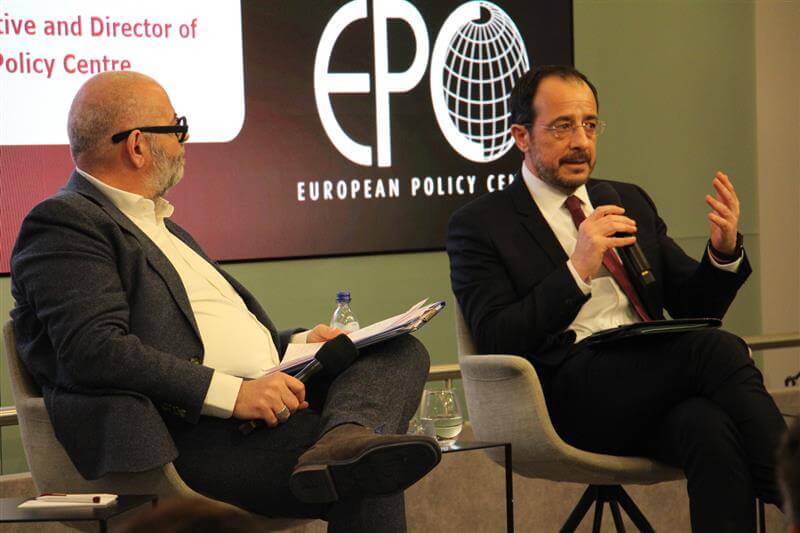
Cypriot President Nikos Christodoulides addressed a special EPC Thought Leadership event in Brussels ahead of the EU Leaders’ Summit, amid rising tensions in Europe and the Middle East, as the US-Israel war with Iran continues. Acknowledging the geostrategic uncertainty, he noted that such periods “test institutions, partnerships, and indeed leadership”, but also highlight the EU’s capacity to act “with resolve and, above all, with unity.”
Against this backdrop, Christodoulides, whose country currently presides over the rotating presidency of the Council of the European Union, argued that the conflict, despite its difficulties, also presents “opportunities for decisions that would never have been possible otherwise”. In particular, stressing deeper integration, “for projecting European power and leadership in the world”, and, most importantly, “opportunities to move decisively towards an EU that is truly autonomous”.
“Autonomy is no longer a theoretical aspiration but a driving force for action – the next necessary step in European integration,” emphasised Nikos Christodoulides. He also pushed back against remarks by NATO Secretary General Mark Rutte, that European autonomy is unattainable, arguing that recent events had demonstrated the opposite. In particular, he pointed to European support for Cyprus following an attempted Iranian drone strike on a British base on the island as evidence that such autonomy is both possible and real.
Greece, France, Italy, Spain, and the Netherlands responded quickly to Cypriot requests for assistance by deploying assets and personnel to safeguard security. According to Christodoulides, this effectively tested Article 42.7 of the Lisbon Treaty. It states that if a member state is the victim of, or threatened by, armed aggression, other EU countries are obliged to provide assistance.
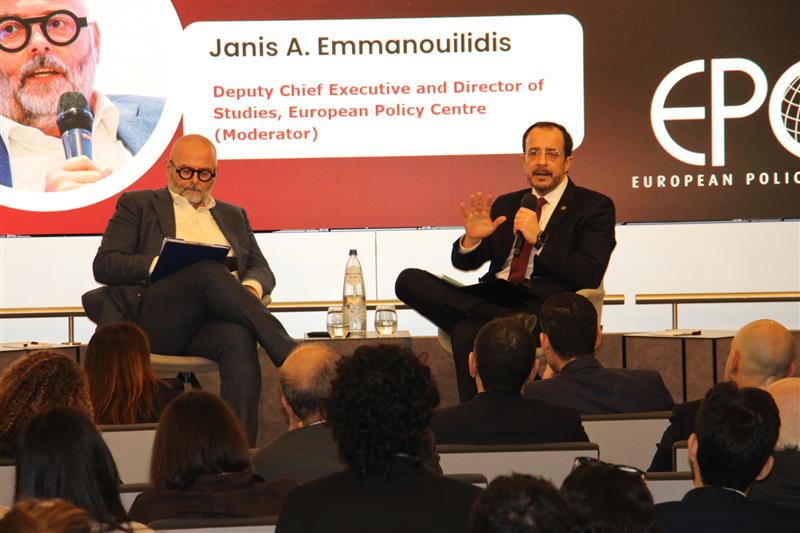
Although the article was not officially triggered, in the event of a future crisis, Christodoulides wanted to see the EU fully capable of implementing it effectively. “Europe must be ready to respond swiftly and decisively, placing the safety and security of all its citizens at the forefront. We must put this mechanism firmly in place; this is something I will raise during the European Council.”
Turning to the priorities of the Cypriot Presidency, Christodoulides stressed that the Russian invasion of Ukraine dispelled any illusion of lasting peace, reinforcing the need for stronger EU security and defence. He highlighted Cyprus’s role in advancing the €19 billion loan to Ukraine agreed by the European Council. The Presidency is prioritising implementation of the Migration and Asylum Pact by June 2026, alongside progress on the Returns Regulation. It is also advancing the EU Grids Package and Omnibus simplification measures, while expanding trade agreements, including EU–Mercosur, and sustaining enlargement efforts with Ukraine, Moldova, and the Western Balkans.
Placing these priorities within a wider geopolitical context, Christodoulides cautioned that “developments in our region are deeply unsettling, reminding us how fragile stability can be”. However, he contended that the current US-Israel conflict over Iran highlights the EU’s responsibility: In a message to the EU leaders attending the Council Summit, he said, “Europe cannot choose the moment in which it must lead. Leadership is required when circumstances are most difficult – and the time for our Union to lead is now.”
If you are interested in high-level discussions, revisit our previous Thought Leadership Forums with:
Theo Francken, Belgian Minister for Defence
Magnus Brunner, European Commissioner for Home Affairs and Migration
Matthew Whitaker, US Ambassador to NATO
Toomas Hendrik Ilves: Hybrid Warfare Is War – EU and NATO Must Act
Rajnish Singh is a Media Outreach Executive at the EPC Communications team.
The support the European Policy Centre receives for its ongoing operations, or specifically for its publications, does not constitute an endorsement of their contents, which reflect the views of the authors only. Supporters and partners cannot be held responsible for any use that may be made of the information contained therein.