

Putin in Beijing: Russia’s growing dependence and Europe’s China dilemma
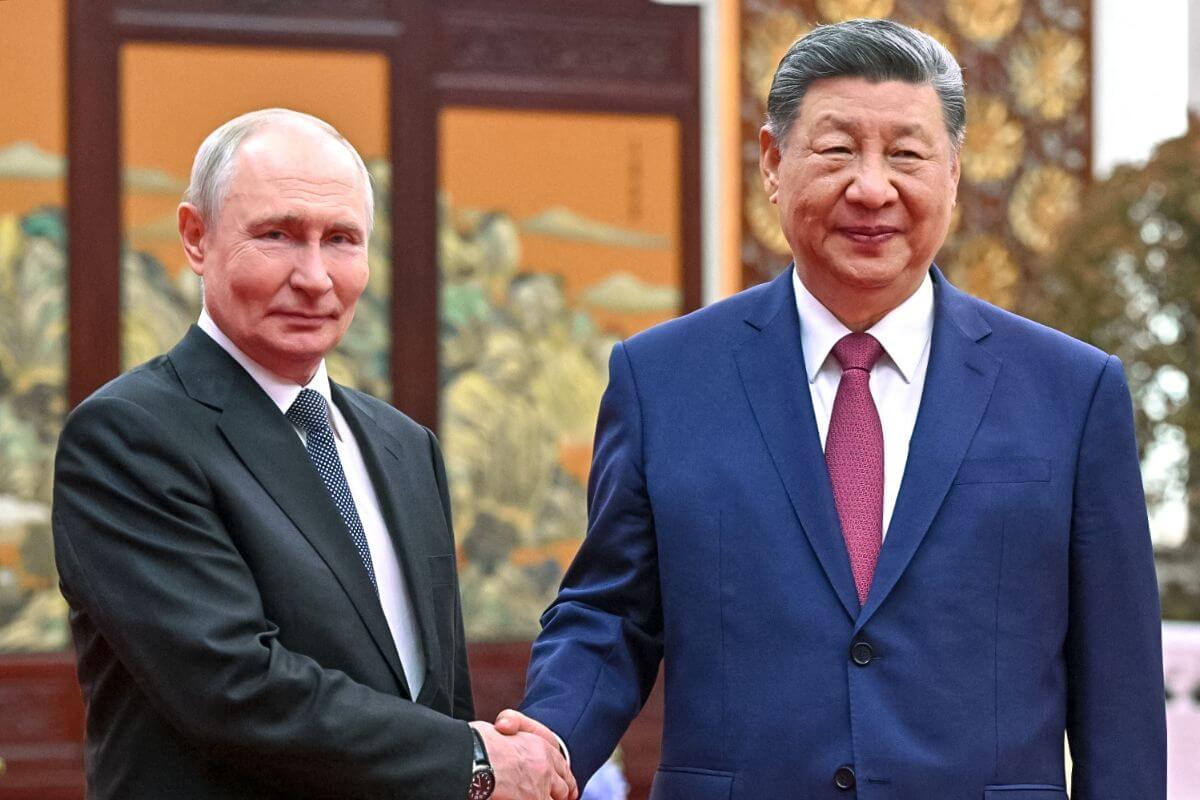

Russian President Vladimir Putin visited Beijing on 19–20 May seeking Chinese economic and political backing and hoping to show the “West” that Russia still has a powerful partner in Chinese President Xi Jinping. Instead, the visit underlined Moscow’s growing dependence on Beijing.
For the EU, this matters because China’s support for Russia is increasingly structural rather than tactical. The EU and its member states should respond with a sharper mix of incentives and costs.
Sustained alignment, clear limits
The “no limits” framing of China–Russia relations remains more political rhetoric than reality. Putin arrived in Beijing seeking backing to offset Western sanctions imposed after Russia’s full-scale invasion of Ukraine and to expand opportunities with China. Beijing has become indispensable to Russia’s wartime economic resilience, even without openly supplying full military backing. For Xi, coming a week after US President Donald Trump visited Beijing, the summit was an opportunity to showcase China as a centre of global diplomacy amid an increasingly multipolar world order.
Their joint declaration criticised US missile defence plans, sanctions and what they described as destabilising Western behaviour. Yet beneath this familiar rhetoric, the visit further exposed an asymmetric partnership in which China holds most of the cards.
While Beijing’s global weight is growing, Russia’s continues to shrink. The two sides signed a slew of agreements to deepen strategic and economic ties, including on AI cooperation, but there were no major breakthroughs, particularly on energy. Without Chinese money and technology — particularly dual-use technology — Putin’s regime would increasingly come under strain.
This gives Beijing unprecedented leverage over Moscow. But it will become increasingly frustrating for Russia, a country historically unused to the role of junior partner and under mounting economic pressure.
No progress on Trans Siberia II
Putin’s war in Ukraine is disastrously impacting the Russian economy and leaving Moscow with few alternatives for selling pipeline gas. Putin, therefore wanted Chinese buy-in for the Trans-Siberian II pipeline project. The Kremlin needs sustained Chinese demand for hydrocarbons as it has few alternative energy buyers and sells oil at discounts due to sanctions.
But the pipeline is not necessarily seen as a priority for Beijing. Power of Siberia I is still not operating at full capacity, and Siberia II would lock China into a decades-long deal that does not clearly serve its interests. Gas is now a bridge fuel for China, which is pursuing carbon neutrality and rapidly expanding renewables, including solar and wind.
Natural gas now accounts for around 10% of China's energy consumption. Less than half is imported, and less than 3% from Russia. China also has more secure, less sanctions-exposed routes, including from Central Asia.
Can the West split Russia and China?
Beijing’s calculation is clear: secure discounted energy and preserve Russia as a geopolitical counterweight to the West. There is therefore little reason to believe that the West can break up the relationship. This is evident from China’s position on Russia’s war on Ukraine. Beijing maintains that the war should end, but does not pressure Putin to end it, despite sticking to its narrative that it should end.
A Russian defeat and possible collapse of the Putin regime would be viewed in Beijing as a major strategic victory for Washington. China sees the war partly through the lens of long-term US-China rivalry. A decisive US-backed victory in Ukraine would weaken one of the pillars of a more multipolar world, less dominated by Washington.
A collapsing Russia could create instability along China’s vast northern border and raise questions about control over nuclear weapons and military assets. Beijing therefore, has strong reasons to prefer a weakened Russia over a collapsed one. It is unsurprising that Xi told Putin it was imperative to stop conflict in the Middle East while remaining notably less vocal on Ukraine.
Implications for Europe
The optics and outcomes reinforced the same picture: a rising China with options and a more constrained Russia with fewer alternatives. This cycle is vicious for Russia but advantageous for China. The crucial policy question for Europe is how China will use its leverage over Russia, what that will mean for EU security and how it should respond. Russia and its war on Ukraine remains an existential security threat, both traditional and hybrid in nature. This is even more important given that Trump has prioritised negotiation and deal-making with Russia over sustained pressure or escalation in support of Ukraine.
Because China’s support for Russia is structural, Europe will struggle to pressure Beijing into significantly reducing its support to Moscow. However, Beijing still wants stable trade with Europe, access to European markets, and to avoid secondary sanctions. Europe therefore, has cards to play. It can shape China’s cost-benefit calculations and limit the scale of China’s support to Russia. Europe has already used its economic weight and market access to discourage overt support, including reducing some direct flows of sensitive dual-use goods.
Going forward, alongside stronger support for Ukraine, the EU should adopt a three-pronged approach: constraint, leverage and selective engagement. This should include tighter sanctions enforcement on dual-use exports, further restrictions on Chinese firms aiding Russia’s defence-industrial base, export controls on advanced technologies and secondary sanctions on companies helping sanctions evasion. The EU must also continue its de-risking agenda to reduce strategic dependencies, not least on rare earths and critical technologies.
Finally, Europe should use its proposed Industrial Accelerator Act and broader “Buy European” agenda more confidently and collectively, linking access to European markets to greater Chinese restraint in supporting Russia’s war economy.
Amanda Paul is Deputy Head of the Europe in the World Programme and Senior Policy Analyst.
The support the European Policy Centre receives for its ongoing operations, or specifically for its publications, does not constitute an endorsement of their contents, which reflect the views of the authors only. Supporters and partners cannot be held responsible for any use that may be made of the information contained therein.