

18th BRICS Summit in New Delhi: Strength in Flexibility

Celebrating two decades of cooperation, the 18th BRICS Summit in New Delhi highlighted the group’s defining tension: BRICS has expanded its representation, agenda and institutional activity faster than it has developed cohesion. India’s 2026 chairship sought to manage this tension by emphasising practical, development-oriented cooperation while resisting BRICS’ transformation into an explicitly anti-Western bloc. With China assuming the chair in 2027, the next test will be whether Beijing can give BRICS greater economic and technological substance without undermining the flexibility that has enabled such a diverse group of countries to work together.
BRICS now comprises 11 members and 10 partner countries. The partner category, created at the 2024 Kazan Summit, allows countries to participate in the group’s political and economic ecosystem without necessarily sharing the same strategic priorities. This development has widened BRICS’ reach across the Global South, while the pause on further membership expansion suggests that BRICS recognises the governance and cohesion challenges created by rapid enlargement. Members have sharply different relationships with China, the United States and Europe, as well as divergent economic and geopolitical priorities. The relatively cautious language on geopolitical issues in the New Delhi Declaration also illustrates the limits of consensus. Yet this heterogeneity is part of BRICS’ appeal: states can increase their international leverage and diversify partnerships without committing to a common geopolitical position.
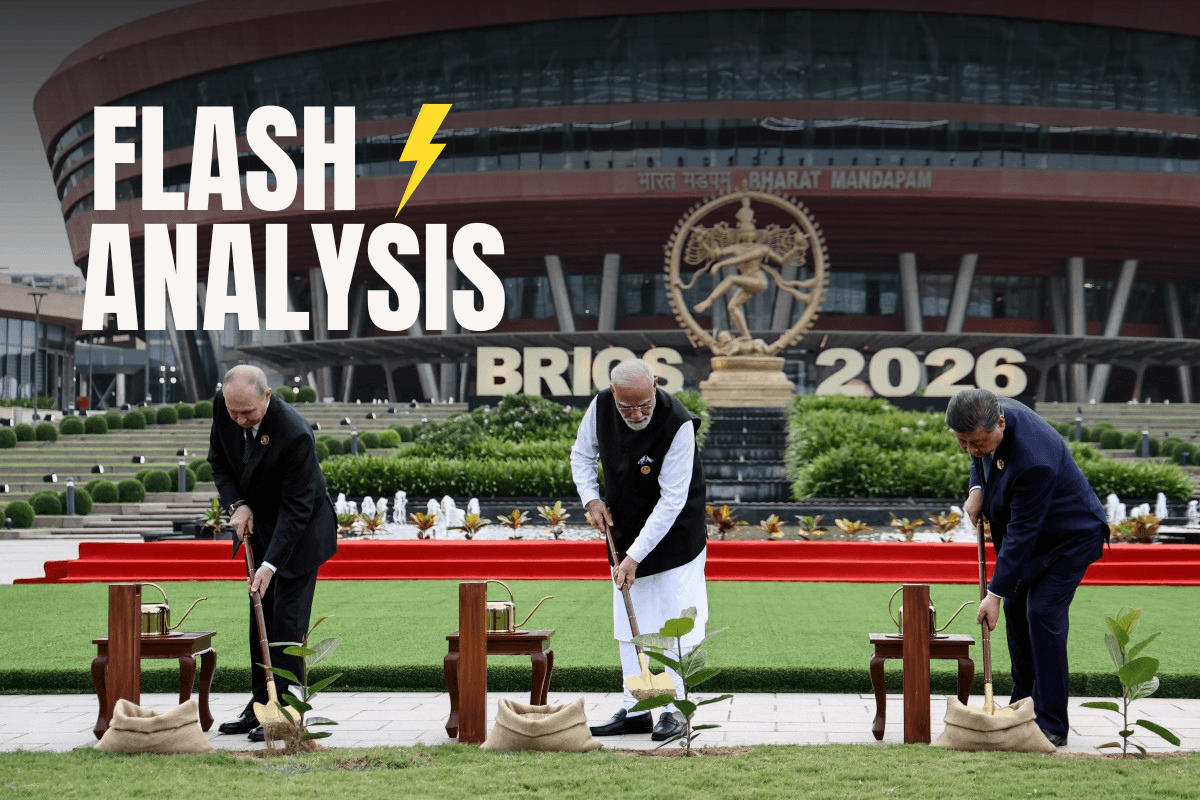
This approach also fits India’s broader multi-alignment. New Delhi does not regard participation in BRICS as incompatible with deeper relations with Europe or the United States. Indeed, India hosted Xi Jinping and Vladimir Putin at the BRICS summit after significantly upgrading relations with the EU earlier this year. At the same time, India has used its BRICS chairship to advance priorities that also underpin its wider international partnerships, including technology, resilient value chains and digital cooperation, particularly digital public infrastructure.
Xi Jinping’s first visit to India in seven years, alongside renewed efforts to stabilise China–India relations, gave the summit additional significance. However, while relations remain constrained, particularly by border and economic issues, both sides have incentives to prevent bilateral tensions from limiting wider cooperation. Ahead of China’s chairmanship in 2027, Xi called for a “third golden decade” of BRICS cooperation, signalling a more substantive economic and technological agenda, including deeper cooperation on AI, trade, supply chains and special economic zones. However, it remains to be seen whether this bilateral rapprochement can translate into deeper institutional cooperation.
Financial cooperation illustrates both the scope and limits of this convergence. The New Development Bank is the clearest example, with both China and India supporting expanded local-currency financing and infrastructure lending, giving BRICS a more established channel for development finance. Efforts to deepen financial autonomy through interoperable payment systems and local-currency trade settlements have proved more difficult. While the New Delhi Declaration supports work on making national payment and messaging systems interoperable and on increasing the use of local currencies for trade and investment, it stops short of establishing a common BRICS payment system. China and India share an interest in reducing dependence on the dollar, but have different interests in how this should be achieved. India, however, has little interest in greater dependence on the renminbi, while China has an interest in expanding its international role.
BRICS should therefore neither be treated simply as an extension of China’s geopolitical strategy nor dismissed as rhetoric. The New Delhi Summit showed that the grouping’s broad and flexible format gives its members, including India, agency to shape its agenda and outcomes around their own priorities. For the EU, the implication is not to “counter” BRICS, but to understand why it is attractive: development finance, technology, economic resilience and greater autonomy in global governance. The EU will need to remain relevant to countries pursuing greater autonomy by offering credible partnerships on these issues.
Elixabete Arrieta is a Junior Policy Analyst in the Europe in the World Programme.
The support the European Policy Centre receives for its ongoing operations, or specifically for its publications, does not constitute an endorsement of their contents, which reflect the views of the authors only. Supporters and partners cannot be held responsible for any use that may be made of the information contained therein.