

Financing Europe’s future by mobilising more strategic investment
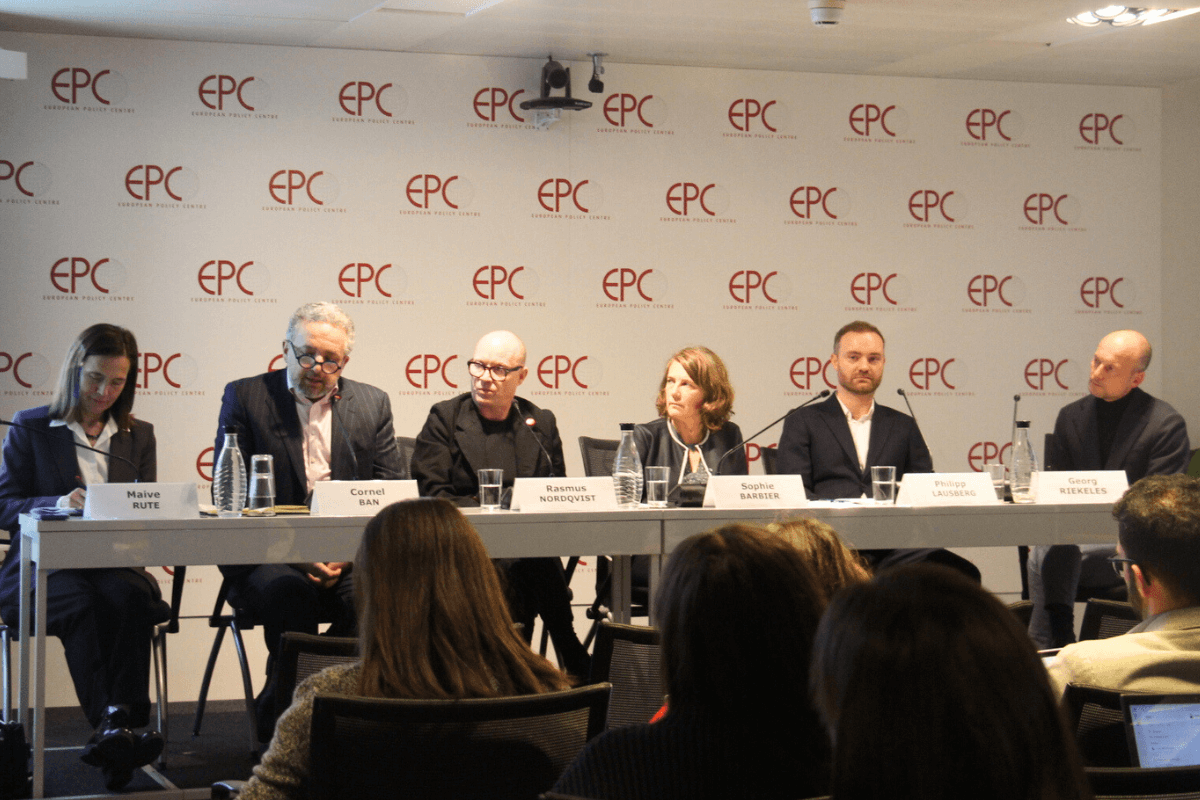
This week’s conference “Financing Europe’s Future: How to mobilise more strategic investment?” marked the conclusion of the EPC’s EU Strategic Investments project, which has already produced a widely cited report by Philipp Lausberg and Georg Riekeles, “From mission polity to mission economy: Making the EU a strategic investment power.”
Opened by a keynote address from Maive Rute, Deputy Director-General at DG GROW, the conference brought together policymakers, public investors and private capital for two focused panels on how the next EU budget and Europe’s financial markets can better mobilise investment towards strategic priorities — from the green and digital transitions to security and competitiveness.
A clear message emerged: Europe has the ingredients it needs to overcome today’s economic challenges — but only if it gets the reforms right.
As highlighted in the EPC report, volatility in US economic policy, the weakening of rules-based institutions, and the erosion of the Washington consensus are reshaping global capital allocation. If it adopts the right reforms, the EU is well placed to benefit from its strengths: rules and predictability, an open trading system, a stable global euro, and a strong pipeline of high-quality investment opportunities.
Maive Rute stressed how the proposed new European Competitiveness Fund could help address one of Europe’s long-standing weaknesses: “not getting research results to the market.” Turning innovation into scale remains a decisive challenge.
Sophie Barbier from Caisse des Dépôts highlighted the critical role of InvestEU in crowding in private capital by leveraging limited EU funds through a strong network of implementing partners.
From the private sector perspective, Victor Englesson of EQT struck an optimistic note. With talent increasingly moving from the US to Europe, he argued that “Europe has the opportunity of a lifetime” to build the next generation of global tech champions — provided it creates the right conditions, including a long-discussed 28th regime for startups.
The takeaway? The EU should bet more — and bigger — on leveraging its budget for strategic investment. But it’s not just about more EU money. It’s about smart design, effective instruments, and the political will to act. Europe’s window of opportunity is open. The question is whether it will seize it.
Rajnish Singh is a Media Outreach Executive at the EPC Communications team.
The support the European Policy Center receives for its ongoing operations, or specifically for its publications, does not constitute an endorsement of their contents, which reflect the views of the authors only. Supporters and partners cannot be held responsible for any use that may be made of the information contained therein.