

EU–China relations at a crossroads, Vol. V: The geometry of coexistence
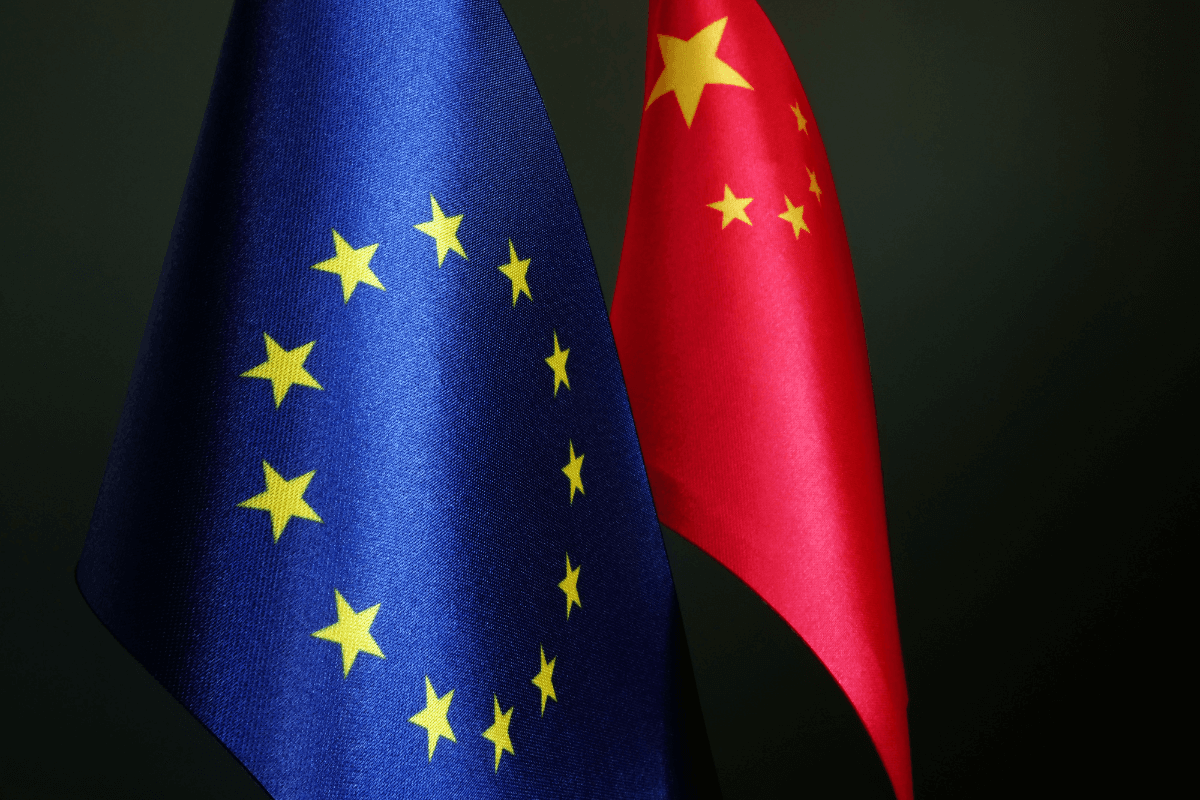

The fifth volume of this compendium series brings to a close the second phase of the EU-funded EU & China Think Tank Exchanges project, launched in 2020. Since then, the geopolitical landscape has shifted dramatically. The COVID-19 pandemic, tit-for-tat sanctions, Russia’s full-scale invasion of Ukraine, mounting trade tensions, conflict in the Middle East and rapid advances in artificial intelligence have all reshaped the context in which Europe and China engage. Through these changes, EU–China relations have remained among the world’s most consequential bilateral relationships, marked by periods of engagement and friction but arguably shaped more often by tension than rapprochement.
It is against this backdrop that the title of this volume, The Geometry of Coexistence, takes on its meaning. Coexistence, here, describes a relationship that is necessary but unsettled, connected but not convergent. EU–China ties no longer follow a predictable line. They bend, collide and reconfigure across policy areas. They move between escalation and de-escalation, proximity and distance, cooperation and competition. This is not a relationship that settles into stable patterns. It is one that must be continuously recalibrated under pressure.
Within this shifting geometry, the project created a rare and sustained space for exchange. Over its duration, the project convened 36 events and recorded around 1,000 expert participants. Five compendia were published containing 60 papers and more than 700 policy recommendations. Yet these figures tell only part of the story. Statistics alone cannot capture the depth of the exchanges that took place, the networks that were built or the importance of preserving spaces for informed dialogue at a time of geopolitical uncertainty and strained relations.
This project is also a story of impact. At a time when both formal and informal channels of communication between the EU and China were narrowing – and in some cases closing altogether – it helped keep critical lines of exchange open. It served as a discreet but effective conduit for transmitting messages, clarifying positions and explaining the reasoning behind policy choices on both sides. Perhaps most visibly, it brought people back into the room. Among the first cohorts of think tankers to travel between China and Europe following the easing of COVID-19 restrictions, participants were able to reconnect face to face, re-establish professional trust and encounter perspectives that had become difficult to access from a distance.
The project carved out an early space to debate what was then termed the “geoeconomic determinant”, a forerunner of today’s de-risking and economic security agenda. At times it became a “dialogue of anticipation”, allowing both sides to read and signal emerging shifts before they fully took shape. It also seeded new institutional partnerships, turning exchanges into sustained collaboration and opening avenues for joint work between European and Chinese experts.
All of this unfolded amid a steady deterioration in EU–China relations. Yet this is precisely what makes structured exchange more necessary. For think tanks, the work begins – and has the greatest impact – in creating spaces in which differences can be clarified, assumptions tested and relationships sustained.
It also highlights the enduring importance of translation in its broadest sense: not only between languages, but between ways of thinking, interpreting and engaging with the world. A short walk from the EPC offices, on one of the upper floors of the House of European History, visitors encounter a line by the Italian philosopher Umberto Eco: “The language of Europe is translation.” Although conceived in the context of European integration, the idea speaks clearly to EU–China relations as well. What matters is not the emergence of a single shared language, but the continuous effort to bridge differences and negotiate meaning across them. In this sense, translation is not a technical exercise; it is the very condition that makes the relationship possible.
Earthquakes are often preceded by tremors whose meaning becomes clear only in hindsight. The EU–China relationship may be experiencing such a moment. It remains unclear whether the strains of recent years are part of a difficult adjustment to a new equilibrium or the first signs of a deeper rupture to come.
That uncertainty is precisely why communication cannot be treated as a luxury reserved for periods of agreement. The ability to keep talking may be what allows an increasingly complex relationship to absorb future shocks without breaking.
This publication was produced under the EU & China Think-Tank Exchanges project. The input papers contained in this publication are the sole responsibility of the authors and do not necessarily reflect the views of the EU or the EPC. The EU’s financial support to the project does not constitute any EU endorsement of the contents of the project events or any papers and publications produced. Supporters and partners cannot be held responsible for any use that may be made of the information contained therein. This work was made possible by the contributions of Julian Hale, Almut Möller, Jessica Moss, Jon Wainwright, Elixabete Arrieta and Simona Lusuardi.